My deeply rooted Italian table began with Sunday suppers at my Sicilian grandparents’ home—Ellis Island Italians who carried their traditions with them into New York State kitchens. Like many families across the region and the country, I grew up with layered roots, moving between cultures not by intention, but by routine.
Sundays meant two stops. First, my Sicilian grandparents’ house in Cold Spring, New York, where the table was filled with homemade pastas, biscotti, and the quiet thrill of being allowed a small sip of coffee—and occasionally wine—a small moment that made the table feel grown-up and welcoming. Food was generous, expressive, and deeply tied to memory. It was nourishment, yes—but also identity.
Then we drove farther south along the Hudson River to Garrison, New York—Scottish and German by heritage—where dinner looked entirely different. Pot roast, potatoes, and a more restrained table defined that side of my family. Both meals were cooked with care, both rooted in tradition, and both reflected where those families came from. I didn’t realize it at the time, but I was learning that culture shapes the plate as much as appetite does.
Italy Through a Professional Lens
Years later, after becoming a dietitian and graduating from culinary school, I married a Northern Italian and moved to the Veneto region of Italy to open a restaurant with him. It was there that I encountered an entirely different expression of Italian food, one that was lighter, more subtle, and shaped by climate and geography rather than abundance. Butter appeared where olive oil once reigned. Rice and polenta often replaced pasta. Meals were precise, purposeful, and deeply local.
That experience solidified my passion for the Mediterranean table, not as a trend or prescription, but as a way of eating that feels organic, intuitive, and naturally supportive of health.
Returning to Sicily
Years later still, after my divorce, I treated myself to a month-long sojourn in Sicily—part healing, part language immersion, part quiet reckoning. I arrived without an agenda beyond learning the language and giving myself the gift of time. What I didn’t expect was how quickly Sicily felt less like a destination and more like a return.
In Catania, I found the exact right place to be. On the first day of class, the instructor studied my face for a moment, then smiled and said, “Sei di qui, proprio di qui … gli occhi lo dicono.” You’re from here, really from here, your eyes tell.
It wasn’t said as flattery, but as recognition. In that instant, something settled.
Sicilian Foodways and Cultural Layers
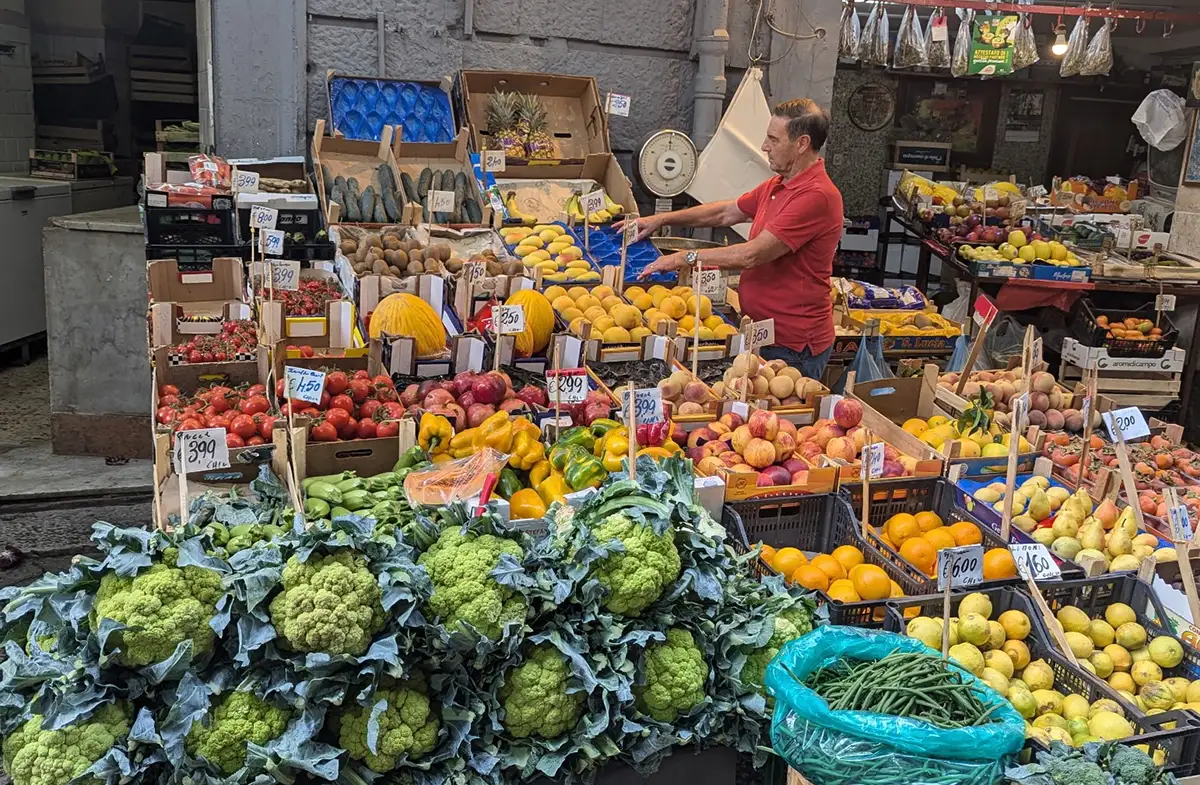
Sicily has a way of doing that. Its food, like its people, carries layers—Mediterranean, North African, Middle Eastern—shaped by sun, sea, resilience, and centuries of exchange through trade, migration, and successive civilizations. Meals were always simple and deeply satisfying, displaying vegetables cooked in olive oil until fully expressive; humble, grounding legumes; seafood pulled from nearby waters; and sweets perfumed with citrus and almonds. Nothing felt excessive. Nothing felt deprived.
I’ve returned to Sicily many times since that first stay, traveling throughout its provinces and coming to understand how much they share and how proudly distinct they remain. Across the island, common threads emerge: olive oil as the foundation; vegetables and legumes as daily staples; seafood shaped by proximity to the coast; pasta enjoyed in just the right amounts, without calculation; sparing but deliciously local meats; and sweets built around citrus, nuts, and ricotta. Yet each province expresses those elements differently, with deep pride in its own dishes, techniques, and flavors.
From the east to the west, from coastal towns to inland hills, Sicilian food reflects both unity and individuality—a reminder that the Mediterranean table is not a rigid model, but a living framework shaped by place, history, and identity.
It was there, sitting at small neighborhood tables and absorbing daily life, that the Mediterranean table fully revealed itself to me, not as an abstract model of healthy eating, but as a lived tradition that nourishes both body and spirit.
Sicily didn’t teach me a new way to eat. It reminded me of one that felt like home.

What’s Actually on the Italian Mediterranean Table
The Italian Mediterranean table isn’t composed of aspirational meals or perfectly balanced plates. It’s made up of familiar foods, prepared simply and eaten often. Vegetables appear at nearly every meal, in the form of sautéed greens dressed with olive oil and lemon; tomatoes simmered slowly into sauces, starring in salads, or quickly flashed in a pan for the simplest pastas; and eggplant roasted or stewed until silky. Vegetables are not treated as garnish or obligation, but are cooked with patience and some healthy fat until they become the soul of the dish.
Beans and lentils are not side dishes but comfort foods, cooked with garlic, herbs, and sometimes a spoonful of tomato, then eaten with bread meant to soak up every last bit. Olive oil is the foundation, used generously but with purpose—to cook, to finish, and to bring flavor and satiety.
Good bread is present daily—torn, dipped, and shared. Fish and seafood appear regularly, while meat plays a supporting role, used to flavor dishes rather than take center stage.
Meals are rarely elaborate. Breakfast is modest. Lunch may be the largest meal of the day, particularly in Southern Italy, followed by a lighter dinner. Desserts are simple and seasonal—citrus, nuts, ricotta, or a small pastry enjoyed without excess or guilt. Wine, when present, is consumed with food, slowly, and almost never alone. Low-alcohol spritzes, often made with local botanicals, may precede lunch.
Why This Way of Eating Endures
What makes the Mediterranean way of eating endure is not discipline or novelty, but satisfaction. The foods are flavorful and filling. Meals feel complete without excess. There is pleasure without guilt, and nourishment without deprivation.
Today, I express my passion for the Mediterranean table not only through writing, teaching, and consulting but through daily practice. At my restaurant, now 25 years young, I have the privilege of feeding roughly 1,000 to 1,500 diners each week. Guests arrive for celebration, comfort, and connection—and they leave nourished in ways that extend beyond the plate.
In that setting, the Mediterranean table reveals its greatest strength. Guests don’t come asking about dietary patterns or pyramids. They respond to food that tastes good, feels satisfying, and invites them back. Over time, they begin to recognize how this way of eating works—not because it’s explained, but because it’s experienced. The table, I’ve learned, is the best teacher.
From a health perspective, the benefits now associated with Mediterranean-style eating—cardiometabolic balance, cognitive health, and longevity—don’t come from a single ingredient. They emerge from a pattern: plant-forward meals, healthy fats, moderate portions of protein, minimal ultraprocessed foods, and regular shared meals that slow the pace of eating.
It’s also worth noting that many traditional food cultures around the world share similar strengths. Diets rooted in whole foods, vegetables, legumes, and diverse cultural eating patterns can offer comparable benefits. What distinguishes the Mediterranean diet is not exclusivity, but study. It has been examined extensively across decades of epidemiologic and clinical research, allowing science to describe what culture had already refined.
For dietitians, this matters. Evidence gives us language and credibility; culture gives people something they can live with. The Mediterranean table sits at that intersection—flexible, familiar, and deeply human. When food is good, shared, and rooted in tradition, health tends to follow.
— Laura Pensiero, RDN, is the chef-owner of Gigi Trattoria in Rhinebeck, New York, where she has been cooking Mediterranean-inspired food for 25 years. A registered dietitian, chef, and cookbook author, she coauthored The Strang Cancer Prevention Center Cookbook and authored Hudson Valley Mediterranean: The Gigi Good Food Cookbook; was the founding chef, nutritionist, and partner at Just Salad; writes the Laura’s Corner Table column for Sanctuary Magazine; and is a thought leader at the nexus of applied nutrition and culinary arts.