
To build your biceps you need to follow three rules:
- Do a small number of effective exercises with proper technique.
- Take most of your sets close to failure and incrementally add weight over time.
- Do about 5-to-6 sets per workout, about 6-to-10 reps per set, and about 30-to-60 total reps per workout.
Note what’s not on this list:
- Doing a dozen different biceps exercises to “hit them from all angles.”
- “Chasing the pump” with sets of 15–30+ reps.
- Training your biceps every day or with excessively high volumes (20+ sets per week).
The Best Biceps Workout
Chin-Up (weighted if possible): 3 sets | 4–6 reps | 2–3 min rest
Incline Dumbbell Curl: 2 sets | 6–8 reps | 1–2 min rest
Barbell Curl: 2 sets | 6–8 reps | 1–2 min rest
Total Sets: 7
Total Reps: 36–50
Effective Reps: ~21–28
Estimated Duration: ~14–23 min
Biceps Sets: 5.5
Biceps Effective Reps: ~17–22
This is as close to an “optimal” biceps workout as you can get.
It starts with the exercise that allows you to use the heaviest weight when you’re freshest (the chin-up). This comes with the added benefit of training your lats and traps, too.
Then you do two variations of the biceps curl:
- The incline dumbbell curl, which positions your elbows behind your torso (a position that may emphasize the long head of your biceps—more on this in a moment).
- The regular standing barbell curl, which positions your elbows at your sides.
In total, you’re doing just 3 exercises, 7 sets, and 28 effective reps (if you end each set one rep shy of failure, aka one rep in reserve).
Now, I typically wouldn’t recommend dedicating an entire workout just to biceps, even if that’s the primary muscle group you want to grow.
The reason for this is that there’s only so much productive training you can do in a single workout for a single muscle group. In general, doing more than about 2–3 exercises, 6–10 sets, and 15–30 effective (hard) reps in a single workout is unnecessary and potentially counterproductive (it causes more fatigue and muscle damage without meaningfully increasing muscle growth).
For most people, that’ll take around 20–30 minutes, which leaves plenty of time to train other muscle groups. What’s more, many of the best biceps exercises like the chin-up, one-arm dumbbell row, and lat pulldown also train your lats, traps, and rear delts, so it often makes sense to train these muscles in the same workout.
This is why it’s generally best to train your biceps as part of a back and biceps workout, pull workout, or upper body workout, rather than doing a workout just for biceps. In other words, an optimal biceps workout doesn’t really isolate your biceps, it emphasizes them.
This is how I program the workouts in my fitness books for men and women, Bigger Leaner Stronger and Thinner Leaner Stronger.
Here are several more workouts built around this principle.
Pull Day Workout with Biceps Emphasis
Barbell Deadlift: 3 sets | 4–6 reps | 2–3 min rest
One-Arm Dumbbell Row: 3 sets | 6–8 reps | 2–3 min rest
V-Grip Lat Pulldown: 3 sets | 4–6 reps | 2–3 min rest
Incline Dumbbell Curl: 3 sets | 6–8 reps | 1–2 min rest
Total Sets: 12
Total Reps: ~60–84
Effective Reps: ~36–48
Estimated Duration: ~27–42 min
Biceps Sets: 6
Biceps Effective Reps: ~18–24
This workout starts with the heaviest and most technically demanding exercise—the barbell deadlift, which primarily trains your spinal erectors, glutes, and hamstrings (your posterior chain muscles).
Then, you do the dumbbell row and V-grip lat pulldown, both of which train your biceps, lats, traps, and rear delts.
Finally, the incline dumbbell curl trains both the short- and long-head of your biceps.
Upper-Body Workout with Biceps Emphasis
Dumbbell Bench Press: 3 sets | 6–8 reps | 2–3 min rest
One-Arm Dumbbell Row: 3 sets | 6–8 reps | 2–3 min rest
Shrug-Back (immediately after dumbbell row): 1 set to failure | about 3 reps per arm
Lat Pulldown: 3 sets | 6–8 reps | 2–3 min rest
Bayesian Curl (Incline Cable Curl): 3 sets | 8–10 reps | 1–2 min rest
Total Sets: 13
Total Reps: ~81–105
Effective Reps: ~39–51
Estimated Duration: ~29–44 min
Biceps Sets: 6
Biceps Effective Reps: ~18–24
The dumbbell bench press trains your chest, shoulders, and triceps. The one-arm dumbbell row and lat pulldown train your biceps, traps, lats, and rear delts. The single set of shrug-backs trains your traps and midback. And the Bayesian curl trains the short- and long-head of your biceps.
Full-Body Workout with Biceps Emphasis
Barbell Back Squat: 3 sets | 4–6 reps | 2–3 min rest
Barbell Bench Press: 3 sets | 4–6 reps | 2–3 min rest
Chin-Up: 3 sets | 4–6 reps | 2–3 min rest
Incline Dumbbell Curl: 3 sets | 8–10 reps | 1–2 min rest
Total Sets: 12
Total Reps: ~60–84
Effective Reps: ~36–48
Estimated Duration: ~27–42 min
Biceps Sets: 4.5
Biceps Effective Reps: ~14–18
The barbell squat trains your quads, glutes, and spinal erectors. The barbell bench press trains your chest, shoulders, and triceps. The chin-up trains your biceps, lats, traps, and rear delts. And the incline dumbbell curl trains the short- and long-head of your biceps.
Keep in mind that this workout doesn’t train your hamstrings or calves at all and doesn’t train your lateral or rear delts much, so you’ll want to make sure you train these muscle groups on another day.
To progress these workouts, use double progression: use a weight that allows you to work within the given rep range, take each set 1–2 reps shy of failure, and once you hit the top of the range for your first set, add weight.
Finally, a note for the ladies reading this:
You don’t need to train your biceps differently than men. In my experience working with tens of thousands of women through my books and coaching, most women prefer strong, defined, “toned” upper arms, but don’t want them to get bulky.
The reality is that it’s exceptionally difficult (basically impossible) for your biceps to get “too big” if you follow the biceps workouts in this article.
The reason men’s arms get bigger when they follow this workout plan is that they have 15-20 times more testosterone flowing through their veins than you do.
So unless you start taking steroids to alter your physiology to mirror that of a man, your arms will never “blow up” in the same way.
The 12 Best Biceps Exercises
The 12 best exercises for growing your biceps are:
- Bayesian Curl (Incline Cable Curl)
- Incline Dumbbell Curl
- EZ-bar Preacher Curl
- Machine Curl
- Barbell Curl
- Alternating Dumbbell Curl
- Dumbbell Hammer Curl
- Chin-Up
- Pull-Up
- Lat Pulldown
- One-Arm Dumbbell Row
- Machine Row
To understand why I chose these exercises, it’s worth taking a moment to understand a bit about biceps anatomy.
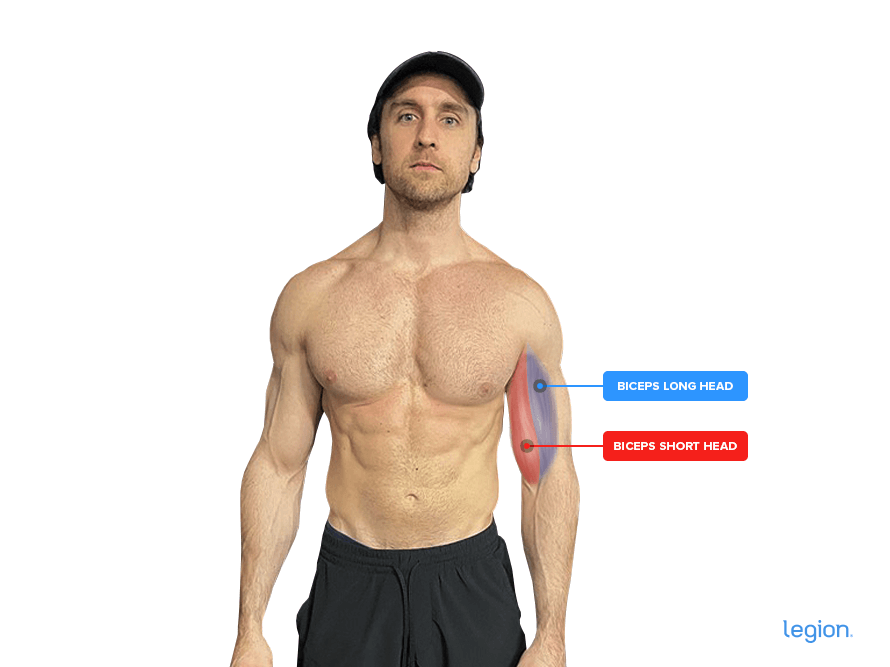
Your biceps have two portions, or “heads:”
- The long head is located toward the outside of the upper arm and gives the appearance of a “peak” when flexed.
- The short head is on the inside of the upper arm and contributes more to biceps width and “thickness” than the long head.
Then there’s also a separate, smaller muscle called the brachialis that sits beneath the biceps brachii. It separates the biceps and triceps and adds to the biceps’ size and circumference.
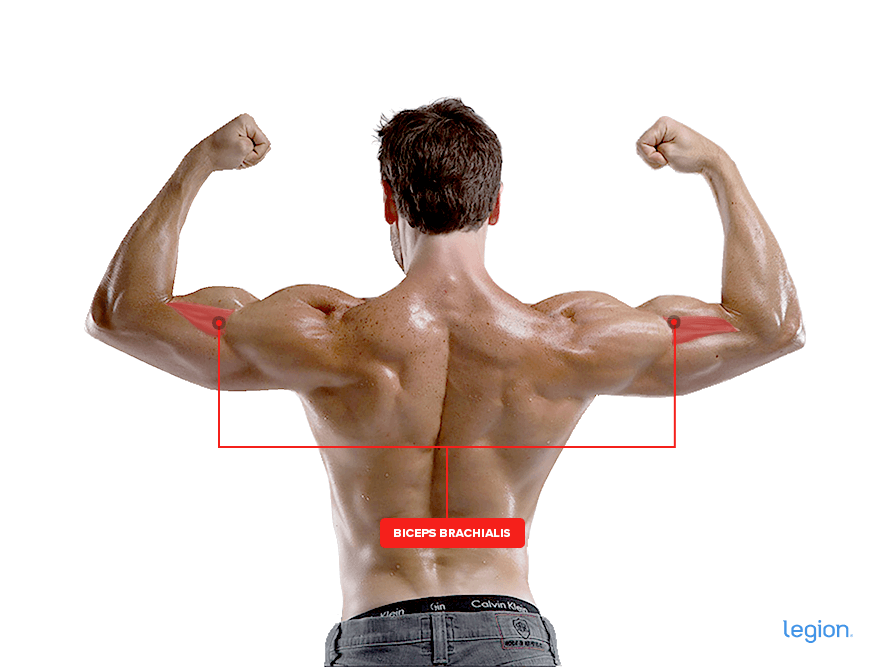
Any exercise that involves bending your elbows is going to train the short and long heads of your biceps and the brachialis.
At bottom, training your biceps is as simple as bending your elbows, and many people have built very impressive biceps with nothing more than pull-ups, rows, and some barbell curls.
That said, there is some theoretical and anecdotal evidence that certain portions of your biceps are better trained with particular exercises.
Specifically, due to the way the long head of the biceps attaches to your shoulder, it’s likely that you’ll better activate this portion of your biceps by performing exercises with your elbows behind your torso (like incline dumbbell curls or Bayesian curls).
Likewise, anecdotally, many people find that their brachialis grows better when they include biceps exercises performed with a neutral grip (like hammer curls).
Thus, if you want to do everything you can to optimize your biceps growth, it’s sensible to ensure that some of the biceps exercises you do position your elbows behind your torso and involve a neutral grip. You don’t need to do these exercises if you don’t want to, but there’s no downside and it might improve your biceps growth.
1. Bayesian Curl (Incline Cable Curl)
How to:
- Set a cable pulley to its lowest position, attach a single handle, and stand in front of the pulley.
- Grab the handle with your right hand, then turn so you’re facing away from the pulley.
- Take 1-2 steps forward and relax your right arm, allowing the weight to pull it straight and slightly behind your torso.
- Turn your right palm forward (supinated grip), place your left hand on your left thigh for support, and lean back slightly until you feel a stretch in your biceps.
- Curl the handle as close to your shoulder as you can without letting your elbow move forward.
- Pause for a brief moment and then lower the handle and return to the starting position. Finish the desired number of reps, and repeat with your left arm.
Sets, Reps, and Rest: 3 sets | 8–10 reps | 1–2 min rest
Why: The Bayesian cable curl trains your biceps with your elbow behind your torso, a position that may emphasize the long head of your biceps. The cable also keeps consistent tension on your biceps throughout the entire rep.
Mike’s tip: Some people find that they get an even stronger contraction if they lean forward slightly at the top of each rep, though personally I like to keep my torso more or less stationary. Also, it’s best to perform this exercise with a staggered stance, but it doesn’t matter which leg you put forward.
Alternatives:
2. Incline Dumbbell Curl
How to:
- Sit back on an incline bench set to 45 degrees. Hold a dumbbell in each hand and let your arms hang straight down with your palms facing forward.
- Curl the dumbbells up as close to your shoulders as you can without letting your elbow move forward.
- Pause for a brief moment and then lower the dumbbells and return to the starting position.
Sets, Reps, and Rest: 3 sets | 6–8 reps | 1–2 minutes rest
Why: Like the Bayesian curl, the incline dumbbell curl trains your biceps while your upper arms are behind your torso. It’s a good alternative and has the advantage of letting you train both arms at the same time, but I prefer the Bayesian curl because the cable keeps consistent tension on your biceps throughout every rep.
Mike’s tip: Keep your elbows behind your torso—avoid the temptation to push your elbows forward at the top of each rep.
Alternatives:
3. EZ-bar Preacher Curl
How to:
- Adjust a preacher curl station so the top of the pad sits snugly against your armpits and the backs of your upper arms when you’re sitting.
- Grab the EZ-bar with your palms facing up and about shoulder-width apart, rest your upper arms against the pad, and extend your elbows until your arms are nearly straight.
- Curl the bar as close to your shoulders as you can without lifting your upper arms off the pad.
- Pause for a brief moment and then lower the bar and return to the starting position.
Sets, Reps, and Rest: 3 sets | 8–10 reps | 1–2 minutes rest
Why: The preacher curl makes it hard to use momentum to cheat so your biceps do most of the work.
Mike’s tip: Make sure you keep the backs of your arms and elbows glued to the pad throughout the entire rep. You’ll still see some folks cheating on this exercise by jerking their torsos backward and lifting up their elbows, which defeats the point of using a preacher pad. Don’t do that.
Alternatives:
- Dumbbell Preacher Curl
- Machine Preacher Curl
4. Machine Curl
How to:
- Adjust the arm pad or seat (depending on your machine) so the top of the pad sits snuggly against your armpits and the backs of your upper arms when you’re sitting.
- Grab the handles with your palms facing up and extend your elbows until your arms are nearly straight.
- Curl the handles as close to your shoulders as you can without lifting your upper arms off the pad.
- Pause for a brief moment, and then lower the handles and return to the starting position.
Sets, Reps, and Rest: 3 sets | 8–10 reps | 1–2 minutes rest
Why: The machine curl makes it almost impossible to cheat and requires almost no coordination, so you can focus on contracting your biceps as hard as possible and taking each set close or all of the way to failure.
Mike’s tip: Curl machines are hit or miss. Some machines force you into an awkward position or have a very extreme resistance curve (the weight feels significantly harder during portions of the rep than others), whereas others are very comfortable and keep consistent tension on your biceps throughout each rep. If your gym has one, give it a shot, but don’t be afraid to stick with dumbbells, barbells, or cables instead.
Alternatives:
5. Barbell Curl
How to:
- Load a barbell and grab it with your palms facing away from you, a little wider than shoulder-width apart.
- Stand up straight, take a deep breath, and brace your core.
- Curl the bar as close to your shoulders as you can without letting your elbows drift in front of your torso.
- Pause for a brief moment, and then lower the bar and return to the starting position.
Sets, Reps, and Rest: 3 sets | 8–10 reps | 1–2 minutes rest
Why: The barbell curl allows you to add weight in small increments, is safe and comfortable for most people, and you can do it in nearly any gym in the world.
Mike’s tip: If a straight bar bothers your wrists or elbows, use an EZ-bar. The angled grip often feels more comfortable, and it works just as well as a straight bar.
Alternatives:
6. Alternating Dumbbell Curl
How to:
- Hold one dumbbell in each hand and stand up straight with your feet about shoulder-width apart.
- Curl your right hand as close to your shoulder as you can with your palm facing upward, allowing your elbow to move slightly forward as the dumbbell rises.
- Lower the dumbbell to the starting position, repeat the exercise with your other hand, and repeat until you’ve completed the desired number of reps for both arms.
Sets, Reps, and Rest: 3 sets | 8–10 reps | 1–2 minutes rest
Why: The alternating dumbbell curl is easy to learn and comfortable for most people, and you can do it in any gym that has dumbbells.
Mike’s tip: Try to keep your torso as stable as possible during the entire set. It’ll be tempting to use “body language” to help swing the dumbbells upward, but this reduces the effectiveness of the exercise.
Alternatives:
7. Dumbbell Hammer Curl
How to:
- Hold one dumbbell in each hand with your palms facing each other and your feet about shoulder-width apart.
- Curl your right hand as close to your shoulder as you can with your thumb pointed at the ceiling, allowing your elbow to move slightly forward as the dumbbell rises.
- Lower the dumbbell to the starting position, repeat the exercise with your other hand, and repeat until you’ve completed the desired number of reps for both arms.
Sets, Reps, and Rest: 3 sets | 8–10 reps | 1–2 minutes rest
Why: The dumbbell hammer curl uses a neutral grip, which many people find more comfortable than the traditional palms up (supinated) grip. This also may help activate the brachialis more than regular dumbbell curls.
Mike’s tip: Keep your torso as still as possible throughout the entire set. If you have the heave the dumbbells up, use less weight.
Alternatives:
- None (though neutral-grip pull-ups offer some of the benefits)
8. Chin-Up
How to:
- Grab a pull-up bar with your palms facing toward you and your hands about shoulder-width apart.
- Lift your feet off the floor and relax your arms and shoulders, letting your body weight pull your arms straight and your shoulders as high as possible (they should be almost touching your ears).
- Stare straight ahead and flex your glutes and hamstrings to keep your lower body from swinging (a good cue to remember is “tighter is lighter”).
- Lift your body upward by pulling your shoulder blades down as far as you can, without bending your elbows.
- Once your shoulder blades are pulled down as far as they’ll go, bend your elbows and pull your body upward until your chin rises above your hands, and then lower yourself to the starting position.
Sets, Reps, and Rest: 3 sets | 4–6 reps | 2–3 minutes rest
Why: The chin-up trains your biceps, lats, traps, and rear delts, and you can add weight in small increments with a dip belt. Research shows that the chin-up also activates the biceps slightly more than the pull-up, though both exercises train your biceps well.
Mike’s tip: Pause for a brief moment at the top and bottom of each rep. This helps eliminate any swinging and ensures you’re effectively training the target muscles.
Alternatives:
9. Pull-Up
How to:
- Grab a pull-up bar with your palms facing away from you and your hands about shoulder-width apart.
- Lift your feet off the floor and relax your arms and shoulders, letting your body weight pull your arms straight and your shoulders as high as possible (they should be almost touching your ears).
- Stare straight ahead and flex your glutes and hamstrings to keep your lower body from swinging (a good cue to remember is “tighter is lighter”).
- Lift your body upward by pulling your shoulder blades down as far as you can, without bending your elbows.
- Once your shoulder blades are pulled down as far as they’ll go, bend your elbows and pull your body upward until your chin rises above your hands, and then lower yourself to the starting position.
Sets, Reps, and Rest: 3 sets | 4–6 reps | 2–3 minutes rest
Why: The pull-up trains all of the same muscles as the chin-up, but some people find it more comfortable for their shoulders and elbows. It can also allow you to get a slightly deeper stretch and may activate the lower traps slightly more than the chin-up.
Mike’s tip: Instead of choosing between pull-ups or chin-ups, do one for 8–12 weeks and then switch. If either starts to irritate your shoulders or elbows, switch to the other sooner.
Alternatives:
10. Lat Pulldown
How to:
- Adjust the thigh pad so it locks your legs in place and prevents your butt from rising off the seat.
- Grab the bar with your palms facing away and a few inches wider than shoulder-width apart. Sit down and wedge your legs under the thigh pad.
- Sit slightly behind the cable with your chest up and a slight arch in your lower back.
- Relax your arms and shoulders, letting the weight pull your arms straight and your shoulders as high as possible.
- Staring straight ahead, begin the rep by pulling your shoulder blades down and slightly back.
- Bend your elbows and pull the bar until it’s a few inches from your collarbone. Your shoulders and elbows should finish moving at about the same time.
- Pause briefly, then straighten your arms and let the weight pull your shoulder blades as high as they’ll go.
Sets, Reps, and Rest: 3 sets | 6–8 reps | 2–3 min rest
Why: The lat pulldown trains your biceps, lats, traps, and rear delts. It requires less coordination to perform than the pull-up and is easier and safer to take close to failure. The main downside is that some lat pulldown machines force you to add weight in large increments, which can make it harder to progress.
Mike’s tip: Think about lifting your chest to meet the bar as you pull it down and slamming your elbows into the floor. Use a shoulder-width grip or V-grip. Using a wide-grip makes the exercise more awkward and doesn’t train your biceps or lats any better.
Alternatives:
11. One-Arm Dumbbell Row
How to:
- Hold a dumbbell in your right hand. Plant your left knee and hand firmly on a bench, set your right foot on the floor, and let your right arm hang straight down.
- Let the weight pull your right shoulder blade as far forward as it can go. Rotating your torso slightly can deepen the stretch.
- Keeping your back straight, retract your right shoulder blade as far as you can without bending your elbow.
- Once your shoulder blade is back, pull the dumbbell to your torso while keeping your elbow close to your side.
- Straighten your arm and let the weight pull your shoulder blade forward to return to the starting position.
- Finish the set, then repeat with your left arm.
Sets, Reps, and Rest: 3 sets | 6–8 reps | 2–3 min rest
Why: The one-arm dumbbell row trains your biceps, lats, traps, and rear delts, it’s safe and comfortable for most people, and you can do it in any gym with dumbbells.
Mike’s tip: If your grip fails before your biceps or back, use weightlifting straps. This makes the exercise easier on your grip, but more effective for every other muscle group (including your biceps).
Alternatives:
12. Machine Row
How to:
- Adjust the seat so the top of the chest pad is level with the top of your breastbone. If the handles move, set them just out of reach when your arms are straight.
- Grab the handles and let the weight pull your arms straight and your shoulder blades as far forward as they’ll go.
- Staring straight ahead, pull your shoulder blades back and together without bending your elbows.
- Once your shoulder blades are back, bend your elbows and pull the handles as far toward your body as you can.
- Pause briefly, then straighten your arms and let the weight pull your shoulder blades forward to return to the starting position.
Sets, Reps, and Rest: 3 sets | 6–8 reps | 2–3 min rest
Why: Since your torso is supported, you aren’t limited by your low-back strength, which makes it easier to isolate your biceps and back and take your sets closer to failure. It’s also easy to set up and perform, and allows you to add weight in small increments.
Mike’s tip: Try to avoid letting the weight rest on the machine at the bottom of each rep. Instead, try to make sure that your muscles are supporting the weight throughout every set.
Alternatives:
Want More Workouts Like This?