
Instructions (Cable Lat Pulldown)
- Adjust the thigh pad so that it locks your legs in place and prevents your butt from rising off the seat when pulling the bar down.
- Grab the bar with your palms facing away from you and a few inches wider than shoulder-width apart, and sit down, letting your body weight pull the bar down with you, and then wedge your legs underneath the thigh pad.
- Sit slightly behind the cable rather than directly under it, with your chest proud and a slight arch in your lower back.
- Relax your arms and shoulders, letting the weight pull your arms straight and your shoulders as high as possible (they should be almost touching your ears).
- Staring straight ahead, initiate the rep by pulling your shoulder blades down and slightly back.
- As soon as your shoulder blades begin moving, bend your elbows and pull the bar down until it’s a few inches from your collarbone (usually an inch or two below your chin). Your shoulders and elbows should finish moving at about the same time.
- Pause briefly, then reverse the movement to return to the starting position: straighten your arms and let the weight pull your shoulder blades as high as they’ll go.
Instructions (Plate-Loaded Machine Lat Pulldown)
- Adjust the thigh pad so that it locks your legs in place and prevents your butt from rising off the seat when pulling the handles down.
- Grab the handles with your palms facing away from you and a few inches wider than shoulder-width apart, and sit down, letting your body weight pull the handles down with you, and then wedge your legs underneath the thigh pad.
- Sit slightly behind the handles rather than directly under them, with your chest proud and a slight arch in your lower back.
- Relax your arms and shoulders, letting the weight pull your arms straight and your shoulders as high as possible (they should be almost touching your ears).
- Staring straight ahead, initiate the rep by pulling your shoulder blades down and slightly back.
- As soon as your shoulder blades begin moving, bend your elbows and pull the handles down as low as you can, usually until your hands are about level with your chin. Your shoulders and elbows should finish moving at about the same time.
- Pause briefly, then reverse the movement to return to the starting position: straighten your arms and let the weight pull your shoulder blades as high as they’ll go.
Expert Tips
- If you struggle with pulling your shoulder blades down, practice that movement a few times during your warm-up (this is called a “shrug-down”). This may feel strange at first, but it’s the best way to ensure the lat pulldown effectively trains your traps.
- If your grip gives out before your lats do, use lifting straps. This prevents you from having to end your sets prematurely due to your grip giving out, allowing you to train your back, traps, and biceps more thoroughly.
- Avoid swinging your torso back and forth to finish your reps. It’s fine to lean back a little to help engage your lats and bring your chest closer to the bar, but avoid using momentum to make the exercise easier.
- Once you reach the point where you can’t pull the bar (or handles) under your chin, don’t be afraid to do a few partial reps. These generally aren’t as effective for building muscle as full reps, but they’re better than cutting the set short, provided the reps stay controlled.
- If you can’t feel your lats working, don’t worry. Many people report the same thing. If you follow the steps above, your lats, traps, and biceps are all going to be thoroughly trained by this exercise. That said, it is possible that some muscles may work harder than others depending on your anatomy, which is one of the reasons it can often be helpful to do other lat isolation exercises, too.
- Don’t bother with wide-grip lat pulldowns. Many people think these are better at isolating the lats, but this isn’t true. Instead, they just make it harder to grip the bar and force you to use less weight, making the exercise less effective overall. Stick with a grip around shoulder-width or slightly wider, or try a V-grip/close-grip lat pulldown if that feels more comfortable.
Mike’s Take
The lat pulldown is one of my favorite exercises for training your lats, biceps, and (if you follow the steps I outlined above) traps.
It’s been a staple in my workouts for over 20 years, and I include it in my Bigger Leaner Stronger program for men and Thinner Leaner Stronger program for women.
The main benefits of the lat pulldown are:
- It allows you to train your lats, biceps, and traps through a full range of motion.
- It allows you to add weight in small increments.
- It’s safe, comfortable, and easy to learn for almost everyone.
- Almost every gym in the world has a lat pulldown machine.
- It requires very little balance or coordination, which makes it more effective at isolating the target muscles.
In terms of whether you do the regular cable or machine version, this is mostly a matter of personal preference. That said, one drawback of the cable version is that many cable lat pulldown machines force you to add weight in larger increments (often 10–20 pounds), whereas with a plate-loaded lat pulldown machine, you can add weight in much smaller increments (typically 2.5–5 pounds).
You’ll also see many people online claiming that a wide grip is best for training your lats, but I disagree. On the whole, most research (and practical experience) shows that it’s best to use a grip about shoulder-width or narrower, and that going wider just makes the exercise more awkward and less effective.
For example, researchers from Sogn og Fjordane University College in Norway found similar muscle activity in the lats and traps with narrow, medium, and wide overhand grips. The weightlifters were also able to pull more weight using narrow and medium grips than with a wide grip.
Another study from Penn State Berks found that lat pulldown grip width made little difference in muscle activation.
Muscle activity doesn’t perfectly correlate with muscle growth over time, but on the whole, this does suggest there’s little benefit to doing wide-grip pulldowns.
I’d also recommend you avoid the behind-the-neck lat pulldown for several reasons:
- It reduces the range of motion of the exercise and generally reduces how much weight you can lift, which makes it less effective for gaining muscle and strength.
- Most people find it very uncomfortable for their neck, shoulders, and wrists. It’s all kinds of awkward.
- It doesn’t meaningfully improve muscle activation, so it has no clear training advantage over pulling the bar in front of your head.
Personally, I prefer the medium-grip pronated cable lat pulldown, the machine lat pulldown (also with a medium-width grip), and the V-grip lat pulldown, and I like to rotate between these exercises every 8 weeks or so.
In terms of programming, I typically do the lat pulldown as part of my pull workouts, after some kind of hip-hinge movement like a barbell deadlift or Romanian deadlift and some kind of horizontal pull like a seated cable row or T-bar row.
A good starting place is 2–3 sets of 6–8 reps with 2–3 minutes of rest, taking each set 1–2 reps shy of failure. You can also use 8–10 or 10–12 reps if that feels better on your elbows and shoulders.
Lat Pulldown Alternatives
- Pull-Up. An outstanding alternative that trains all of the same muscles, but it’s harder to learn and perform and less convenient to load.
- Chin-Up. Almost identical to the pull-up, but it emphasizes your biceps slightly more.
- V-Grip (Close-Grip) Lat Pulldown. This is the same as a regular lat pulldown but performed with a V-grip handle. Many people find it more comfortable and feel like it allows them to use a slightly longer range of motion.
- Single-Arm Lat Pulldown. This is a great variation of the regular lat pulldown that many people find more comfortable. It allows you to lift slightly more weight in total, but it also forces you to make larger relative jumps in weight, can feel awkward with heavier weights, and takes twice as long to finish each set.
- Cable Pullover (Straight-Arm Lat Pulldown). This is basically a lat pulldown performed without bending your elbows. This makes it better for isolating your lats, but it doesn’t meaningfully train your biceps, traps, or grip strength.
- Reverse-Grip (Supinated Grip) Lat Pulldown. Like the chin-up, this trains all of the same muscles but emphasizes your biceps slightly more than the regular, palms-facing-away lat pulldown.
- Banded Lat Pulldown. This is a fine option if you don’t have access to a regular lat pulldown machine, but it’s impractical to load and perform and generally just not as effective for gaining muscle and strength.
- Dumbbell Pullover. This trains the same basic movement pattern as the cable pullover, but it’s more awkward to perform and has a worse resistance curve than the cable version (meaning the weight is significantly more or less challenging at different points throughout each rep).
3 Lat Pulldown Workouts
Here are three sample workouts that show you how to program the lat pulldown.
Back Workout with the Lat Pulldown
Lat Pulldown: 3 sets | 6–8 reps | 2–3 min rest
One-Arm Dumbbell Row: 3 sets | 6–8 reps | 2–3 min rest
Shrug-Backs (Immediately after your last set of rows): 1 set to failure of as many reps as possible
Machine Rear Delt Fly: 3 sets | 8–10 reps | 1–2 min rest
Barbell Shrug: 3 sets | 8–10 reps | 1–2 min rest
Pull Day Workout with the Lat Pulldown
Barbell Deadlift: 3 sets | 4–6 reps | 2–3 min rest
Lat Pulldown: 3 sets | 6–8 reps | 2–3 min rest
Chest-Supported Row: 3 sets | 6–8 reps | 2–3 min rest
EZ-Bar Curl: 3 sets | 8–10 reps | 1–2 min rest
Upper-Body Workout with the Lat Pulldown
Barbell Bench Press: 3 sets | 4–6 reps | 2–3 min rest
Lat Pulldown: 3 sets | 6–8 reps | 2–3 min rest
Incline Dumbbell Bench Press: 3 sets | 8–10 reps | 2–3 min rest
Chest-Supported Row: 3 sets | 6–8 reps | 2–3 min rest
To progress these workouts, use double progression: use a weight that allows you to work within the given rep range, take each set 1–2 reps shy of failure, and once you hit the top of the range for your first set, add weight.
Lat Pulldown vs. Pull-Up: Which Is Better?
It depends.
The lat pulldown and pull-up involve the same basic vertical-pulling motion and train the same main muscle groups. A small study from James Cook University compared chin-ups with lat pulldowns and found that both strongly involved the lats. Chin-ups involved the biceps and lower back more while lifting, while pulldowns involved the abs more while lowering the weight.
In another study from the Mayo Clinic, pull-ups and chin-ups produced similar lat activity, though chin-ups involved the biceps and pecs more and pull-ups involved the lower traps more.
On the whole, it’s not worth reading too much into the nuances of muscle-activation research, and in terms of muscle activation the lat pulldown and pull-up are largely interchangeable.
That said, they each have a few pros and cons:
- Many people aren’t strong enough to do a pull-up or chin-up, which makes the lat pulldown a better stopgap exercise until they develop more upper-body strength. The pull-up and chin-up are also very taxing, which can make the lat pulldown a better exercise to include at the end of your workout when you’re already gassed.
- The lat pulldown requires less coordination, which generally makes it better for isolating the target muscles (though it’s still simple enough that I don’t think this is a dealbreaker).
- Once you can do at least 6–8 bodyweight pull-ups, you can add weight in very small increments using a dip belt, which can make it a bit better for progressive overload.
In the main, though, you can use the pull-up and lat pulldown interchangeably in your workouts, and which one you prioritize largely comes down to personal preference.
Muscles Worked by the Lat Pulldown
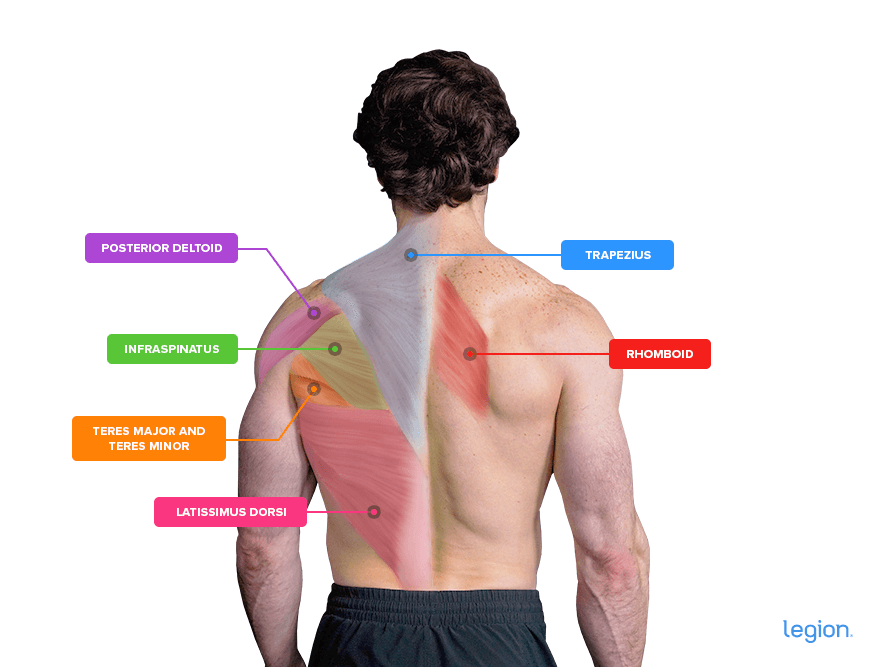
The lat pulldown primarily trains your latissimus dorsi (lats), biceps, and teres major, which help pull your upper arms toward your torso. If you perform the exercise as I’ve outlined in this article—initiating each rep by pulling your shoulder blades down—then it’s also a fantastic exercise for your lower traps (otherwise it doesn’t do much for your traps).
Finally, your brachialis and brachioradialis help bend your elbows, while your forearm muscles help you grip the bar. Your posterior deltoids (rear delts), rhomboids, and several smaller muscles also contribute.
You’ll sometimes hear people say that the lat pulldown is an effective rear delt exercise, but this isn’t entirely true. While it does train the rear delts, most people need to do rear delt isolation exercises to build proportional shoulders.
More Back Exercises