
When I was raising my kids, I was already deep into plant-based eating. So when other parents in my community started asking me which vegan or plant-based baby formulas were actually worth using, I knew this was a question I had to dig into properly, not just as a mom, but as a board certified health coach and nutritionist.
But the truth is, finding a truly vegan baby formula is hard. Most options marketed as “plant-based” still contain animal-derived ingredients, particularly vitamin D3 sourced from lanolin (sheep’s wool). That doesn’t make them bad options, it just means parents need to know what they’re actually buying. And that’s exactly what this guide is for.
I’ve evaluated every formula on this list based on ingredient quality, nutritional completeness, what the research says, and whether I’d feel comfortable recommending it to the parents I work with. Whether you’re raising a vegan baby, dealing with a cow’s milk allergy, looking to supplement along with breastfeeding, or just looking for a cleaner formula option, I’m breaking it all down so you can make the most informed choice for your family.
Quick note: Every baby is different. Before switching or starting any formula, always check with your pediatrician first. The information in this guide is not a substitute for professional medical advice.
What Is Vegan Baby Formula?
Vegan baby formula is made entirely from plant-derived ingredients. That means no animal proteins and no animal byproducts. Most traditional formulas are made from cow’s milk or goat’s milk. Vegan and plant-based formulas use alternative protein sources instead. The most common are soy protein, hydrolyzed rice protein, and pea protein.
Soy is the most widely available option in US stores and is approved for babies 0-12 months. Rice protein formulas (like Bebe M) are suitable from birth but are classified as foods for special medical purposes in the EU and require medical supervision. Almond-based formulas (like Else Nutrition) are currently only available as toddler formulas for 12+ months.
It’s also worth knowing the difference between three terms you’ll see a lot:
Dairy-free formula means no cow’s milk or goat’s milk, but it may still contain other animal-derived ingredients like fish-oil-derived DHA or animal-based vitamin D3. Dairy-free does not automatically mean vegan.
Plant-based formula uses a plant protein base but may still include small amounts of animal-derived vitamins or additives.
Truly vegan formula contains no animal-derived ingredients at all, including vegan-sourced vitamin D3 (from lichen or mushrooms rather than lanolin) and algae-based DHA rather than fish oil.
Why Is It So Hard To Find A Truly Vegan Formula?
The main issue is vitamin D3. Most formulas use lanolin-derived D3 (from sheep’s wool), because it’s more bioavailable than D2 and easier to source than vegan D3. Vegan D3, which is extracted from lichen or mushrooms, exists, but it’s significantly more expensive and harder to obtain at scale.
Because of this, most formulas that use a plant-based protein base will still label themselves as “plant-based” rather than “vegan” because of that one ingredient. Globally, only a small handful of truly 100% vegan infant formulas exist.
If your goal is to avoid all animal-derived ingredients entirely, the options are limited and most are made in Europe or Australia. I’ll break those down below.
Ingredients To Look For
Here’s what I look for when evaluating formulas as a nutritionist:
Organic or non-GMO: This ensures the ingredients are grown without synthetic pesticides and the soy (if used) isn’t genetically modified, which is a big concern of mine when it comes to conventional soy.
Iron-fortified: Some breastfed and formula-fed babies don’t have adequate iron stores. Iron-fortified formula is important for supporting healthy development.
DHA from algae, not fish: DHA is critical for brain and eye development, but obviously fish oil isn’t vegan. I recommend looking for algae-derived DHA rather than fish-oil-derived DHA.
No corn syrup or glucose syrup solids: Because plant-based formulas can’t use lactose (a naturally occurring dairy sugar) as their carbohydrate source, they need a substitute. Many formulas will use syrup solids or maltodextrin so I look for formulas that use a plant-based starch instead.
Third-party heavy metal testing: This is one I feel strongly about. Rice-based formulas in particular can be a source of arsenic if not properly tested. Always look for formulas that do batch-level third-party testing for heavy metals.
Ingredients To Avoid
Watch out for these in plant-based formulas:
- Corn syrup or glucose syrup solids: Simple added sugars with no nutritional benefit
- Animal-derived DHA: Not vegan-friendly
- GMO ingredients: Choose organic or non-GMO certified
- Palm oil: Linked to reduced calcium and fat absorption in some studies, and a sustainability concern
- Note: If your baby has a cow’s milk allergy, also avoid: casein, whey, lactoglobulin, lactalbumin, lactoferrin, lactose, and rennet
The Best Vegan And Plant-Based Baby Formulas
I’ve organized these into three categories to make it easier to find what you’re looking for:
#1: 100% Truly Vegan Formulas (Readily Available)
These are the formulas I’ve found that contain zero animal-derived ingredients – they contain both vegan D3 and algae-based DHA. Additionally, these are formulas that US parents can actually get their hands on without too much difficulty.
Sprout Organic Vegan Baby Formula: Best Certified Vegan Formula
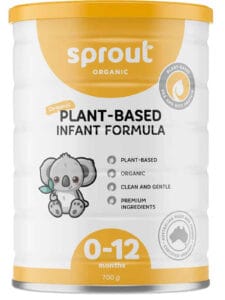
Sprout Organic is the world’s first certified vegan baby formula, and I have been genuinely impressed with both its ingredients and safety standards.
It’s made in Australia with a rice and pea protein base, and it’s soy-free, lactose-free, and contains no palm oil or added sugar. For parents who want official vegan certification (not just a plant-based claim), Sprout carries the Vegan Australia Certified logo, which means it’s been independently verified as completely free from animal-derived ingredients at every stage of production.
The one tradeoff here is that Sprout uses vitamin D2 rather than D3. Vitamin D2 is vegan-friendly, but it’s not absorbed as efficiently by the body as D3. This is worth discussing with your pediatrician – they may want to add a D3 supplement alongside this formula. Sprout is available in both cans and convenient pouches (great for on-the-go bottle prep), and it’s suitable from birth to 12 months.
World’s first certified vegan formula
Made with rice protein and pea protein
Contains plant-based DHA & ARA
Made for babies 0-12 months
Uses vitamin D2 (less bioavailable than D3)
Manufactured in a plant that also processes dairy and soy
Else Nutrition Plant-Based Toddler Formula: Best US-Available Vegan Formula (12+ months)
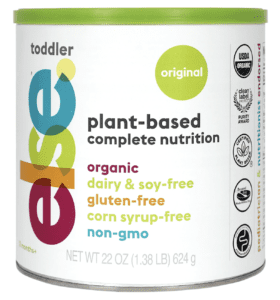
Else Nutrition is the only 100% vegan formula you can actually buy in the US, but it’s important to know it’s technically a toddler formula, designed for babies 12 months and up. If your baby is under the age of 1 and you’re considering it, make sure to talk to your pediatrician first.
That said, as a toddler formula it’s outstanding. It’s USDA Organic, Clean Label Project certified, made with an almond base, and free from soy, gluten, corn syrup, and lactose. The newer version also includes added omega fatty acids (DHA), which is a great upgrade. The fact that even the vitamin D3 is vegan makes it truly unique in the US market. It’s also one of the more affordable options on this list.
One thing to be aware of: some parents report it can be harder to mix than other formulas. Shaking vigorously in two batches (four scoops to 8oz of water) seems to help.
- Cost: $34.99 for a 22 oz can ($33 for a 22 oz can for monthly subscriptions)
- Where to buy it: Online on Else’s website or Amazon.
100% vegan formula with vegan Vitamin D3
Clean Label Project Purity certified
No added sugar or syrup solids
Toddler formula only (consult pediatrician for infants)
Contains tapioca-derived maltodextrin
#2: Plant-Based Soy Formulas (US-Available, 0-12 Months)
These soy-based formulas are made with plant protein but contain lanolin-derived D3 or fish-oil DHA — so they’re not 100% vegan. They’re the most accessible options for US parents who need something on store shelves. I’d consider these fallback choices: safe and FDA-approved, but with more ingredient tradeoffs than the options above.
Enfamil ProSobee Soy Sensitive
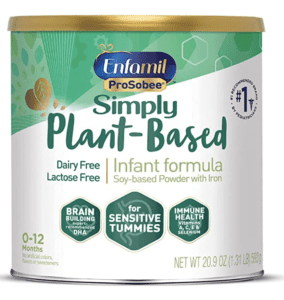
Enfamil ProSobee is the most widely available soy formula in the US. You can find it at virtually any pharmacy, Target, or Walmart. It’s lactose-free, kosher, and Enfamil is the number one pediatrician-recommended formula brand in the country. It’s also suitable for babies experiencing fussiness or gas related to milk protein sensitivity.
That said, I recommend it as a fallback rather than a first choice. It’s not organic, contains GMO ingredients, and relies on corn syrup solids as its carbohydrate source. The DHA and vitamin D3 are not vegan-friendly. If this is what your budget allows or what your pediatrician recommends, it is a safe, FDA-approved option, just know the ingredient tradeoffs.
- Cost: $38.99 for 20.9 oz can; $11.99 for a 32 fl oz bottle; $7.99 for a 13 oz concentrate bottle
- Where to buy it: Target or Walmart, or on Amazon.
Dairy-Free and lactose-free
Contains corn syrup solids
DHA and Vitamin D3 are likely not vegan (making this formula not vegan)
High vegetable oil content
Gerber / Dr. Brown’s Good Start Soy Infant Formula
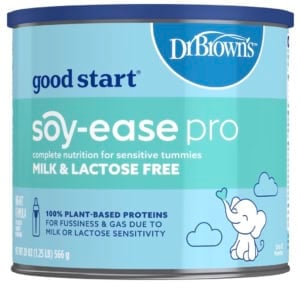
Gerber Good Start Soy has recently been rebranded to Dr. Brown’s Soy Formula. It’s another widely available and affordable soy formula for babies 0-12 months.
It’s dairy-free, lactose-free, kosher, and halal, and contains DHA and ARA. Like Enfamil ProSobee, it’s a reasonable fallback if accessibility and cost are your primary concerns.
The ingredient list isn’t as clean as the top two options above: it contains maltodextrin, sucrose, and a high percentage of vegetable oils, and it’s not organic. Some parents also report it contributed to constipation in their babies, so watch for that if you try it.
Contains added sugar (sucrose)
DHA and Vitamin D3 are not vegan
Some customers mentioned this formula constipated their babies
Similac Soy Isomil Baby Formula
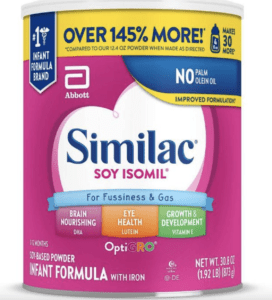
Similac Soy Isomil is a budget-friendly soy formula designed specifically for babies with lactose intolerance or galactosemia. It’s dairy-free, lactose-free, and contains added prebiotics, DHA, ARA, and lutein.
My biggest concern with this one is that corn syrup solids make up 39% of its composition. That’s a significant amount of added simple sugar for a baby’s formula. It’s also not organic and contains GMO ingredients. Like the other soy formulas in this section, the DHA and vitamin D3 are not vegan. I’d only recommend this if the other options aren’t accessible or your pediatrician specifically suggests it.
- Cost: It costs $23.99 per 12.4oz can
- Where to buy it: Target, Walmart, and other leading grocery stores.
Contains DHA, ARA, and lutein
Contains 39% corn syrup solids
DHA and Vitamin D3 are not vegan
Limited availability, can be hard to find
#3: European Vegan Formulas Worth Knowing About
There are two other truly vegan infant formulas are worth mentioning, even though I can’t reliably recommend a current US distributor for either of them: Bebe M and Premibio. Both are made in France, both are 100% organic and EU-regulated, and both use vegan D3 and algae-derived DHA, which puts them in an extremely small category globally.
The honest reason they’re not in my main list is availability. Finding a reputable US distributor who stocks them consistently and ships reliably has become increasingly difficult. If you do find them through a trusted source, they’re worth considering, but I’d encourage you to verify the distributor carefully before ordering imported formula for your baby.
Here’s a quick overview of each:
Bebe M (Bebe Mandorle) Organic Rice-Based Infant Formula: A French formula made with hydrolyzed rice protein, organic coconut oil, almond oil, and rapeseed oil. It comes in three stages (0-6 months, 6-9 months, 10 months-3 years) and is one of the only formulas that is both 100% vegan and contains vegan D3. It is classified as a “Food for Special Medical Purposes” (FSMP) under EU regulations, meaning it should be used under medical supervision, always check with your pediatrician before starting it.
- Cost: ~$64.99 for a 600g can (when available)
- Pros: 100% vegan | Certified organic | Vegan D3 and algae DHA | Soy-free, dairy-free, gluten-free | No palm oil | 3 stages
- Cons: Very hard to find a reliable US distributor | More expensive | FSMP classification requires medical supervision | Contains corn-derived maltodextrin
Premibio Organic Vegan Baby Formula: Another French formula made with hydrolyzed rice protein and regulated under strict EU standards. Like Bebe M, it uses vegan D3 and plant-based DHA, comes in three stages, and is completely free from animal-derived ingredients. It uses organic corn-derived maltodextrin as its carbohydrate source.
- Cost: ~$48.99 for a 600g can (when available)
- Pros: 100% vegan | Certified organic | Vegan D3 and algae DHA | Soy-free, dairy-free, gluten-free | No palm oil | 3 stages | No added sugar
- Cons: Very hard to find in the US | More expensive | Contains organic corn-derived maltodextrin
A note on discontinued US formulas: Two plant-based formulas that were previously available in the US have been discontinued: Earth’s Best Non-GMO Soy Formula and Baby’s Only Organic Pea Protein Formula. Earth’s Best was the only non-GMO soy infant formula available in US stores for babies 0-12 months, and Baby’s Only was the only organic pea protein-based formula on the US market. Both were solid options while they lasted. If you come across either at a retailer, check the expiration date carefully before purchasing.
Vegan Baby Formula FAQs
Below you will find the answers to some of the most frequently asked questions about vegan baby formula:
Yes, with the right nutrition in place. All baby formula sold in the US is required by the FDA to be a complete source of nutrition for babies 0-12 months, covering at least 30 essential nutrients. That said, vegan diets can be lower in B12, vitamin D, iron, calcium, and omega-3s, so working closely with your pediatrician is important throughout the first year.
If your baby is on formula consistently, the formula itself will cover vitamin D3 and B12. If you’re breastfeeding, you’ll need to supplement with Vitamin D3 separately (and eventually you might have to supplement with B12 as your baby starts solids). For vitamin D3, liquid drops are the easiest to administer: I like Raise Them Well Baby Vitamin D & K Drops for this age group. For B12, options specifically formulated for infants are limited, but this B12 drops option works well for older babies transitioning to solids. Always confirm dosing with your pediatrician.
No, regular plant-based milk (oat, almond, soy, coconut) is not safe for babies under 12 months. These milks don’t have the right nutrient profile for an infant’s rapid growth. Baby formula is specifically engineered to match the nutrition of breast milk, and plain plant-based milk should never replace it before your baby’s first birthday.
For full-term, healthy babies, yes: soy formula has been used safely for over 80 years and is approved by the American Academy of Pediatrics for babies with cow’s milk allergy or lactose intolerance. It’s not recommended for preterm infants. Current research has not found a discernible hormonal impact from phytoestrogens in full-term babies. Always choose organic or non-GMO soy formula to avoid GMO ingredients.
Absolutely not. Homemade formula cannot replicate the precise nutrient balance your baby needs and carries serious risks including bacterial contamination, nutrient deficiencies, and unsafe ingredients. If you can’t find a formula that works for your situation, your pediatrician can help you identify a safe alternative. Never DIY formula.
More Baby Formula Guides!
Final Thoughts
I hope this guide has helped you find the best vegan formula for your baby!
I know that finding the right formula takes more research than most parents expect, but it is absolutely possible to feed your baby well on a plant-based diet. My top picks come down to this: if you want 100% vegan, go with Sprout Organic (best for infants) or Else Nutrition (best for toddlers in the US). If you need something available in US stores for an infant, Enfamil ProSobee is the most widely available option, with Dr. Brown’s Good Start Soy as a close second.
And if you end up using a plant-based formula with a few animal-derived vitamins because it’s what your baby needs, your budget allows, or it’s what your pediatrician recommends, that’s okay too. Fed is best, always. You can transition your baby to a fully vegan diet once they move past formula age and into solid foods.
Have a vegan formula I didn’t cover, or one that’s hit the US market recently? Leave a comment below and let me know, I update this guide regularly and respond to every question I get!