
If you’ve ever taken pre-workout while fasting, you’ve probably had this thought: “Did I just ruin my fast?”
Here’s the simplest practical answer:
- Most pre-workouts don’t break a fast because the core performance-enhancing ingredients (like caffeine, beta-alanine, and citrulline) provide essentially no calories.
- Some formulas include calorie-containing add-ins—most commonly sugars or amino acids like BCAAs—and therefore will break a fast.
- Even when a pre-workout breaks a fast, it usually doesn’t change your results unless it meaningfully increases your calorie intake or makes the fasting routine harder to stick to.
This article will help you understand whether your pre-workout technically breaks a fast, and decide whether that matters based on why you’re fasting.
Key Takeaways
- A pre-workout “breaks a fast” if it contains meaningful calories (often from sugars or amino acids like BCAAs).
- Most pre-workouts contain very few or zero calories because the main performance ingredients are essentially calorie-free.
- For fat loss, the benefit of fasting comes from having fewer opportunities to eat—not from keeping insulin at a baseline level for extended periods.
- For health and longevity, autophagy mostly tracks energy availability: when calories are matched, fasting doesn’t cause more autophagy than eating on a regular schedule.
- The practical reason to keep pre-workout near-zero calories is consistency: it helps preserve the structure that makes fasting work if it’s a style of eating you like.
Does Pre-Workout Break a Fast? Use This Flowchart to Find Out
Use the flowchart below to quickly see whether your pre-workout breaks a fast:
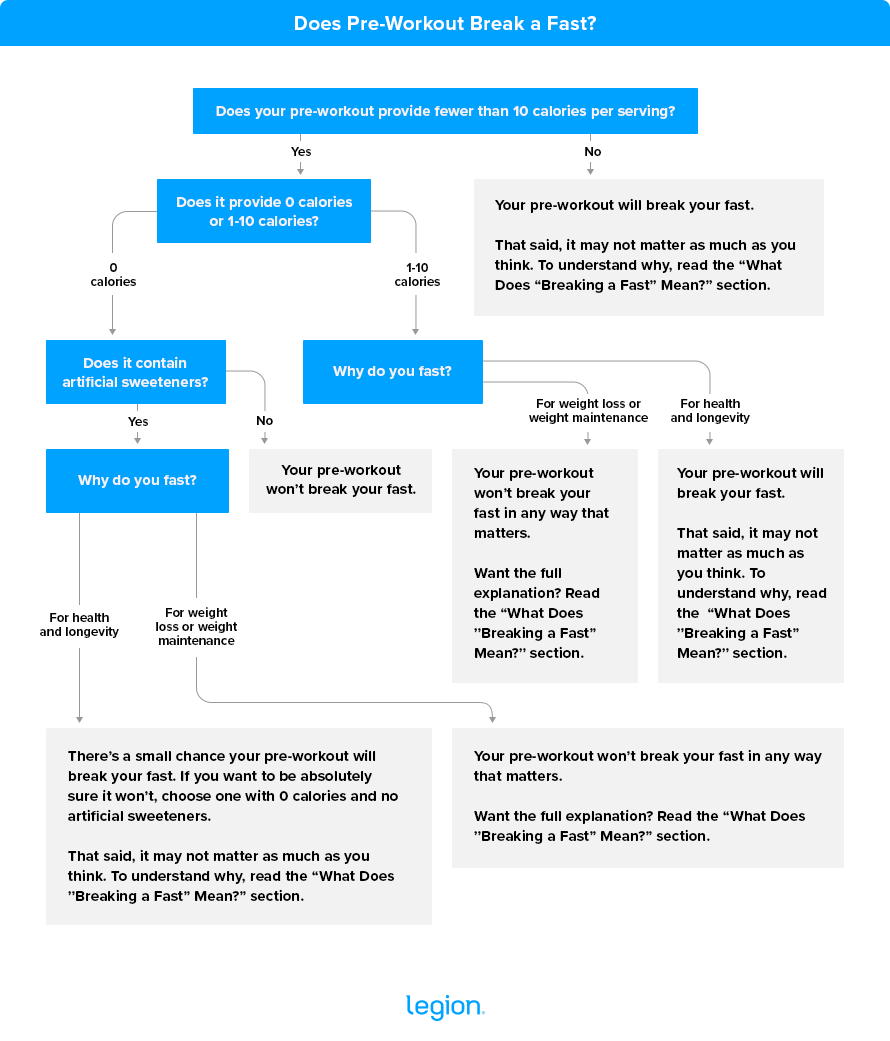
Does Pre Workout Break A Fast? Full Explanation
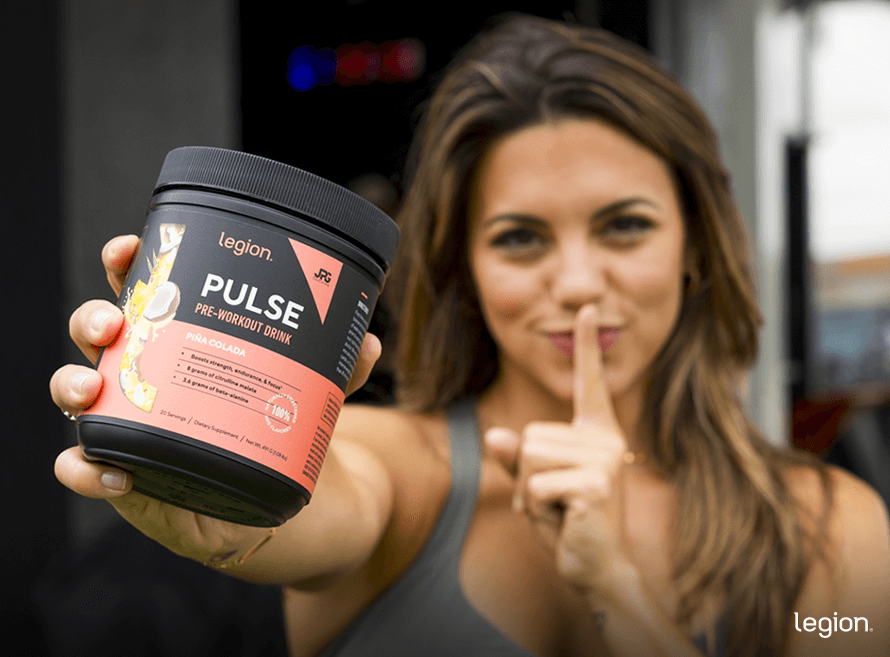
Whether pre-workout breaks your fast depends mostly on whether it contains a meaningful number of calories—because calories tend to raise insulin.
Most of the performance-enhancing ingredients in pre-workout don’t contain meaningful calories, so they won’t break a fast.
The issue is that some pre-workouts also include add-ins that do contain calories—usually carbs (like sugars) or amino acids (like BCAAs)—and those can raise insulin enough to break a fast.
What Does “Breaking a Fast” Mean?
“Breaking a fast” is usually defined as eating or drinking something that contains calories and raises insulin above its baseline level.
People care about this for different reasons.
Some are concerned that raising insulin interferes with fat loss. Others worry it shuts down cellular processes that boost health and longevity.
Let’s discuss what breaking a fast actually means in both of these contexts, starting with fasting for weight loss or weight maintenance.
If You’re Fasting for Weight Loss or Maintenance
If you’re fasting to lose weight—or to keep your weight steady—whether you “break” a fast by raising insulin doesn’t matter much.
Fasting only “works” in this context because it reduces how many times per day you eat, which can make it easier to control your calorie intake. So the main reason to avoid breaking a fast isn’t insulin—it’s preserving the structure of your diet.
In other words, fasting is just a tool.
Even if something like a very-low-calorie pre-workout causes a small, temporary insulin bump during your fast, you aren’t “ruining” your results as long as you still control your total calorie intake.
That said, avoiding calories during your fasting window is still useful because it keeps your intake predictable and helps prevent unplanned eating that can quietly undermine weight loss or lead to gradual weight gain.
If You’re Fasting to Improve Health and Longevity
Some people fast because they believe it boosts autophagy—your body’s process of recycling worn-out cellular parts. (This is sometimes referred to as “clean fasting.”)
The idea is that fasting turns autophagy up, eating turns it down, and insulin is the switch.
That’s directionally true—but it also makes fasting sound special, as if it flips autophagy “on” in a way normal dieting never can.
In reality, autophagy is always occurring and mostly depends on how much energy (calories) your body has available: it increases when energy is scarce and decreases when energy is plentiful.
So yes—autophagy increases while you’re fasting. But if you eat enough afterward to maintain your weight overall, that increase doesn’t result in more total autophagy than if you’d eaten the same number of calories spread more evenly.
The same principle applies when you’re in a calorie deficit.
If fasting helps you maintain a calorie deficit over time, it will increase overall autophagy—but the same amount of autophagy occurs whether you fast or simply eat fewer calories on a regular schedule, as long as total calorie intake is the same in both cases.
Does this mean fasting is useless from a health and longevity standpoint?
No.
For many people, fasting makes it easier to lose weight or maintain a healthy body weight, which is one of the strongest predictors of long-term health.
That’s also why minimizing calories during your fasting window is still smart. Even if small insulin bumps don’t meaningfully affect health, eating during a fast undermines the structure that makes fasting useful in the first place. Once that happens, it’s easier to eat extra calories you didn’t plan for.
So if you’re fasting for health, don’t treat it like a fragile metabolic state that gets “ruined” by small bumps in insulin—but do treat it as a tool that works best when you actually use it as intended: by spending long stretches not eating.
Pre-Workout Ingredients That Determine Whether You Break A Fast
Most pre-workouts are “fasting-neutral” because their core ingredients are essentially calorie-free. What changes the equation are add-ins that contribute calories.
Carbohydrates
The ingredients that most often provide calories and raise insulin are carbohydrates added for flavor, such as sugar, dextrose, and maltodextrin.
Amino Acids And BCAAs
Some pre-workouts contain amino acids that your body uses as building blocks for protein—most commonly branched-chain amino acids (BCAAs).
These amino acids contain calories and raise insulin, so they do break a fast.
It’s worth noting that some pre-workout ingredients—such as citrulline, betaine, and L-theanine—are technically amino-acid–derived compounds, but they don’t meaningfully affect calorie intake or insulin levels so they’re not a concern from a fasting standpoint.
Artificial Sweeteners And Insulin Response
Artificial sweeteners are sometimes blamed for “breaking” a fast, but in most cases, they’re not a real concern.
While some studies suggest some artificial sweeteners may raise insulin in a small subset of people, this is the exception rather than the rule.
In other words, artificial sweeteners are usually fine from a fasting standpoint. That said, if you happen to have a personal preference for strict “clean fasting,” you may want to avoid formulas containing artificial sweeteners on the off chance they cause an insulin response for you.
Can You Take Pre Workout While Fasting?
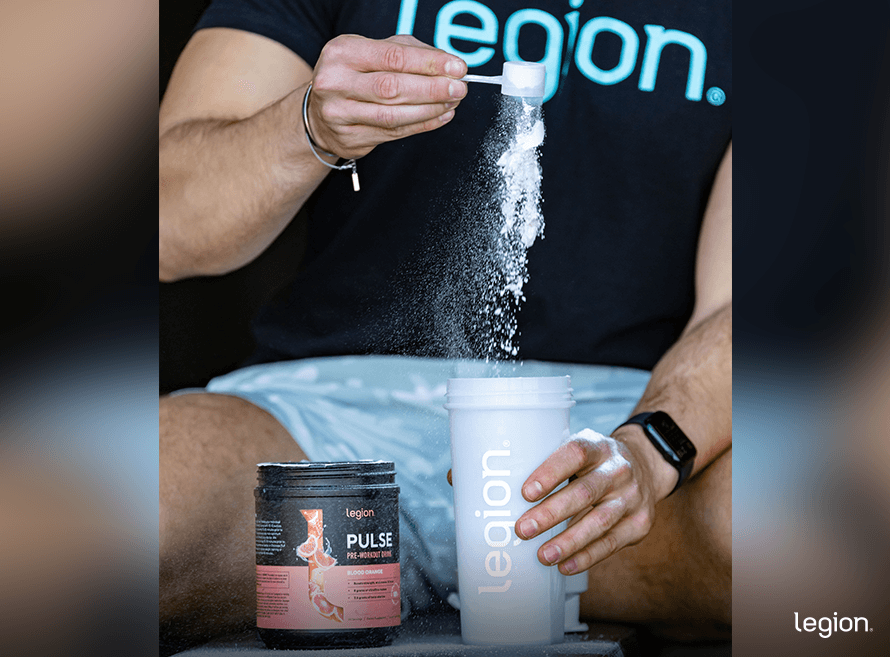
Usually, yes.
Here’s a simple heuristic:
- If your pre-workout contains few or no calories, don’t worry about it breaking your fast. As a practical rule, 10 calories is a good cutoff for most people.
- If it contains a meaningful number of calories (roughly 10+), treat it as something that breaks your fast.
That said, it’s still worth keeping this in perspective.
Whether your goal is fat loss or long-term health, the main practical benefit of fasting is the same: it helps some people control their calorie intake by creating clear periods where they don’t eat.
A small number of calories from a pre-workout during your fasting window isn’t what’s going to derail your results or erase any health benefits, as long as your total calorie intake stays where it needs to be for your goals.
Having said that, minimizing calories during your fasting window still makes sense: not because fasting is a fragile metabolic state, but because sticking to the structure is what makes the approach work in the first place.
Fasting-Friendly Alternatives To Pre-Workout
Many of the benefits people get from pre-workout come from caffeine.
Caffeine doesn’t contain calories and doesn’t raise insulin levels in any meaningful way, so taking it on its own is an easy way to get most of the benefits of pre-workout without breaking a fast.
You can do this in a couple of simple ways:
- Drinking black coffee, which contains negligible calories.
- Taking caffeine pills, which are calorie-free.
As long as you get enough caffeine to be effective, either option works well.
Research shows that an effective dose for improving physical performance is about 3–6 mg per kilogram of body weight, with 5–6 mg per kilogram generally considered the sweet spot for maximizing benefits while minimizing unwanted side effects like jitters, dizziness, or urgently needing to use the bathroom.
The Bottom Line On Whether Pre Workout Break A Fast
Most pre-workouts won’t break a fast because the main performance ingredients contain negligible calories.
What can break a fast are formulas that include calorie-containing add-ins—mainly carbohydrates (like sugar, dextrose, or maltodextrin) or amino acids like BCAAs—which can raise insulin.
Even then, keep it in perspective: if you’re fasting for fat loss, what matters most is whether your pre-workout fits your daily calorie target and helps you stick to your eating schedule—not whether it causes a small, temporary insulin bump.
FAQ #1: Can you have pre-workout when intermittent fasting?
Yes, usually—though it depends on the formulation. If your pre-workout contains few or no calories (like Pulse), it’s unlikely to meaningfully affect your fast. If it contains meaningful calories—most often from added carbs or BCAAs—treat it as something that breaks your fast.
FAQ #2: Does pre-workout kick you out of ketosis?
It depends on what’s in it. Most standard pre-workout ingredients (like caffeine, beta-alanine, and citrulline) won’t affect ketosis much because they contain little to no carbohydrate. What can kick you out is a pre-workout that includes meaningful carbs or sugar, which can raise blood glucose and insulin.
FAQ #3: Will a pre-workout with artificial sweeteners break a fast?
For most people, artificial sweeteners don’t meaningfully raise insulin or blood sugar, so they’re unlikely to “break” a fast in any practical sense. If you personally prefer strict “clean fasting,” you may choose to avoid artificial sweeteners to eliminate any edge cases.
Want More Content Like This?
Check out these articles:
Scientific References +
- Seimon, Radhika V., et al. “Do Intermittent Diets Provide Physiological Benefits over Continuous Diets for Weight Loss? A Systematic Review of Clinical Trials.” Molecular and Cellular Endocrinology, vol. 418, no. 2, Dec. 2015, pp. 153–172, https://doi.org/10.1016/j.mce.2015.09.014.
- Glick, Danielle, et al. “Autophagy: Cellular and Molecular Mechanisms.” The Journal of Pathology, vol. 221, no. 1, 3 Feb. 2010, pp. 3–12, www.ncbi.nlm.nih.gov/pmc/articles/PMC2990190/, https://doi.org/10.1002/path.2697.
- Templeman, Iain, et al. “A Randomized Controlled Trial to Isolate the Effects of Fasting and Energy Restriction on Weight Loss and Metabolic Health in Lean Adults.” Science Translational Medicine, vol. 13, no. 598, 16 June 2021, stm.sciencemag.org/content/13/598/eabd8034, https://doi.org/10.1126/scitranslmed.abd8034.
- Farhana, Aisha, and Anis Rehman. “Metabolic Consequences of Weight Reduction.” PubMed, StatPearls Publishing, 10 July 2023, www.ncbi.nlm.nih.gov/books/NBK572145/.
- Nowak, Marcin M., et al. “Impact of Body Mass Index on All-Cause Mortality in Adults: A Systematic Review and Meta-Analysis.” Journal of Clinical Medicine, vol. 13, no. 8, 1 Jan. 2024, p. 2305, www.mdpi.com/2077-0383/13/8/2305, https://doi.org/10.3390/jcm13082305. Accessed 3 May 2024.
- Shan, Jun, et al. “Body Mass Index and Multimorbidity Risk: A Systematic Review and Dose-Response Meta-Analysis.” Archives of Gerontology and Geriatrics, vol. 123, 1 Aug. 2024, pp. 105418–105418, pubmed.ncbi.nlm.nih.gov/38604087/#:~:text=In%20the%20longitudinal%20studies%2C%20the, https://doi.org/10.1016/j.archger.2024.105418. Accessed 22 Aug. 2024.
- Y, Z., H, K., K, M., J, S., G, B., Y, K., & Y, S. (2011). Effects of branched-chain amino acid supplementation on plasma concentrations of free amino acids, insulin, and energy substrates in young men. Journal of Nutritional Science and Vitaminology, 57(1), 114–117. https://doi.org/10.3177/JNSV.57.114
- Dhillon, Jaapna, et al. “The Cephalic Phase Insulin Response to Nutritive and Low-Calorie Sweeteners in Solid and Beverage Form.” Physiology & Behavior, vol. 181, Nov. 2017, pp. 100–109, https://doi.org/10.1016/j.physbeh.2017.09.009.
- Zhang, Roselyn, et al. “The Effect of Non-Nutritive Sweetened Beverages on Postprandial Glycemic and Endocrine Responses: A Systematic Review and Network Meta-Analysis.” Nutrients, vol. 15, no. 4, 20 Feb. 2023, p. 1050, pubmed.ncbi.nlm.nih.gov/36839408/, https://doi.org/10.3390/nu15041050. Accessed 30 Mar. 2023.
- MS, G., JF, K., DJ, C., LE, A., & CM, M. (2009). Effect of caffeine on sport-specific endurance performance: a systematic review. Journal of Strength and Conditioning Research, 23(1), 315–324. https://doi.org/10.1519/JSC.0B013E31818B979A
- Del Coso, Juan, et al. “Dose Response Effects of a Caffeine-Containing Energy Drink on Muscle Performance: A Repeated Measures Design.” Journal of the International Society of Sports Nutrition, vol. 9, no. 1, 8 May 2012, https://doi.org/10.1186/1550-2783-9-21.
- ASTORINO, TODD A., et al. “Effect of Two Doses of Caffeine on Muscular Function during Isokinetic Exercise.” Medicine & Science in Sports & Exercise, vol. 42, no. 12, Dec. 2010, pp. 2205–2210, https://doi.org/10.1249/mss.0b013e3181e3a11d.