I thought I was relaxed. I took vacations. Lit candles. Got massages, meditated, the whole thing. And yet my mind was still running a marathon. I felt like there was always something else I should be doing. An email to write, a call to make, or a picture to post. Even rest had become a line item on my to do list. When anyone asked how I was doing, I’d answer busy, as if that were proof I deserved to take up space.
But since when did business become a badge of honor? Hustle culture, productivity culture — whatever you want to call it, I was always experiencing the constant low hum of pressure that makes you feel like if you’re not doing two things at once, you’re falling behind. Which inevitably leads to one thing: burnout.
What Is Burnout?
The World Health Organization recognizes burnout as a syndrome caused by chronic, unmanaged workplace stress that causes low energy, negativity, and yes, even reduced efficiency1. In other words, burnout is truly counterproductive — you can be so stressed about work that you become less effective at your job.
What WHO forgot to put on the list of burnout symptoms is the constant mental noise. The reflex to check my phone at dinner. The feeling of guilt whenever I’m not blasting through my to do list. Rest and relaxation stopped feeling like a human right and something I had to earn.
Dolce Far Niente as the Remedy to Burnout
But then I took a trip to Hotel Mediterraneo Sorrento. I arrived with a carry-on full of sundresses and a nervous system that had forgotten how to power down. But something was about to shift. That’s what I love most about travel. Every new destination, it’s like I pin a sign to my back that says: Change me. And it’s always for the better.
Sorrento taught me the art of dolce far niente, the sweetness of doing nothing. It isn’t laziness. It’s the practice of being in the moment and taking genuine pleasure in it. When you’re eating, you enjoy the taste. When you’re swimming, you feel the water on your skin. You don’t squeeze the moment for more. You simply savor it and exist, unapologetically, in the pleasure of being alive.
Arriving at Hotel Mediterraneo Sorrento
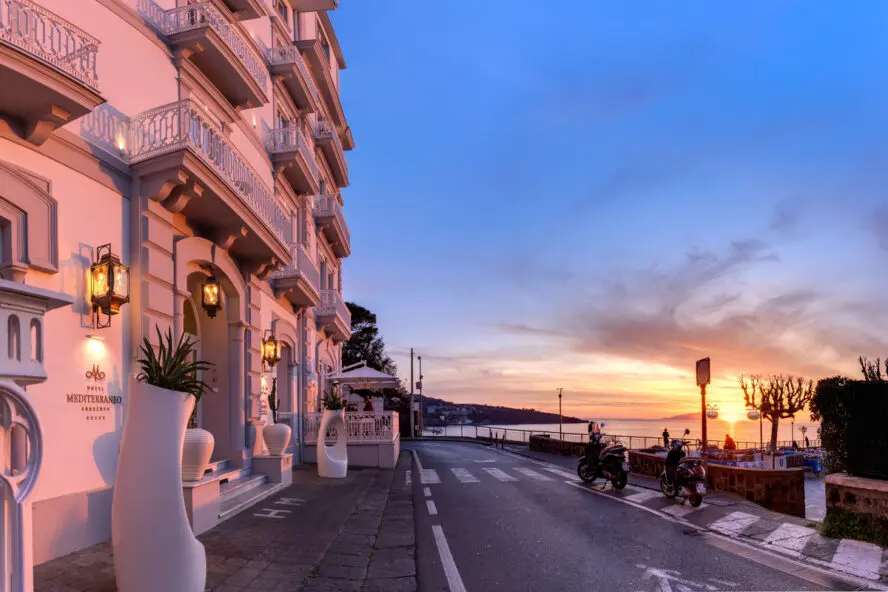
In Sant’Agnello, just fifteen minutes from central Sorrento, Hotel Mediterraneo Sorrento rises from the cliffs above the Bay of Naples. The hotel began as a private villa in 1912, and has been in the Monti family for five generations. If you’re looking for hotels in Sorrento, Italy, look no further. There are many Sorrento hotels with rich histories, but Hotel Mediterraneo truly delivers an unmatched experience by making you feel at home.
From the moment I arrived, I felt less like a hotel guest and more like family. Recently awarded a Michelin Key and elevated to five-star status, Hotel Mediterraneo feels intimate and elegant in true Italian style. My room had sleek brass details, terrazzo floors, and soft lighting. Nearly every room has a balcony, which I took full advantage of — stepping out onto mine each morning in my cosy bathrobe felt less like a hotel stay and more like I belonged there, enjoying a morning espresso al fresco to prepare for the day.
My Daily Routine at Hotel Mediterraneo Sorrento
My daily rituals only added to the feeling of belonging. My mornings continued with yoga in the garden surrounded by lemon trees, followed by leisurely breakfasts overlooking the sea. After lunch, I relaxed my nervous system even more with a facial at Lepietre Cozy Spa, carved into the original tuff stone caves beneath the property. I fell asleep during the Luce di Sorrento facial infused with lemon essential oil from Sorrento.
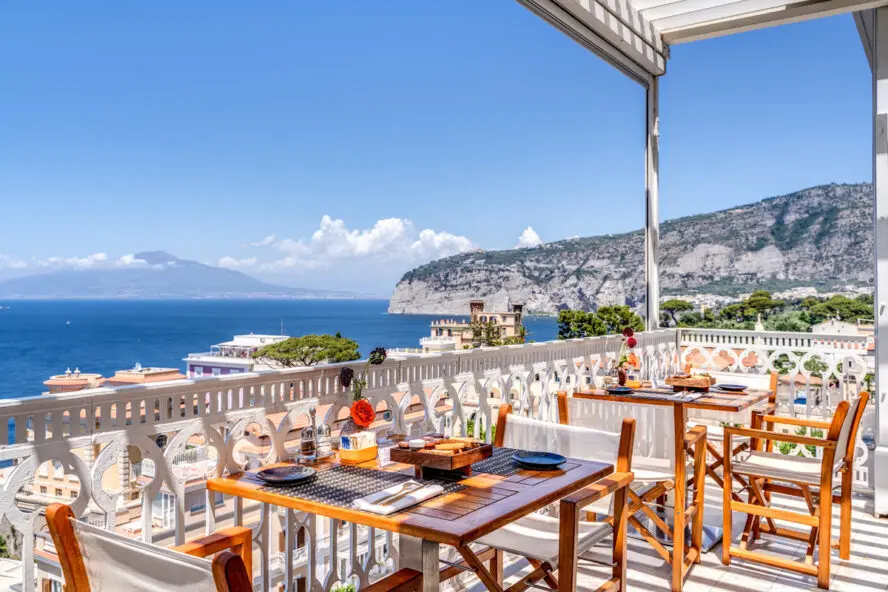
Afterward, you can hop into an elevator carved into the cliff, which delivers you directly onto La Marinella Beach Club. I pinched myself. How often do you take an elevator down to the beach? There’s an Italian saying spalmata, which means you’re so relaxed at the beach you are butter melting on toast. That’s how I began to feel, melting into each moment.
Evenings began with a sunset aperitivo at the Vista Sky Bar on the rooftop, where the Bay of Naples stretches out below and Mt. Vesuvius rises the distance. The aperitivo is all about transition as the sun sets and the colors pop in the sky, before fading into a deep blue backdrop for twinkling stars.
The pre-dinner cocktails were tasty, but there was something even more delicious on offer — the pleasure of feeling, perhaps for the first time in my life, that I had nowhere else to be.
The Art of Dining in Sorrento
In Sorrento, dining isn’t something you squeeze in between plans. It’s perhaps the main reason you’re there at all. Campania takes its ingredients seriously: smooth and grassy extra virgin olive oil, perfectly ripened Sorrento tomatoes, freshly pulled treccia di mozzarella, Provolone del Monaco with a sharp nutty edge, Spaghetti alla Nerano with friend zucchini and delicate local cheese. And the lemons are truly extraordinary. Also, no one puts the check on the table while you are still eating. Ever. And when I finally did ask for the bill, I was met with a confused look and was asked why I was leaving so soon?
There are also opportunities to go behind the scenes and don a chef’s apron of your own. The pizza-making class with master pizzaiolo Benito at Hotel Mediterraneo Sorrento’s Aqua Pool Lounge was pure delight. By the end I was covered in flour and I could manage the long handled spatula like a pro. Benito has worked at the hotel for more than 50 years. His eyes were the brightest blue I’ve ever seen and his beaming smile was contagious. It felt like time stopped, measured only in slices of bubbling pizza and laughter. I want to be more like Benito, living a life of simple pleasures like pearls on a string: the sea, sun, family, friends, pizza, and joy.
An Evening at Vesuvio
For dinner I dressed up for Vesuvio, Hotel Mediterraneo Sorrento’s Michelin-starred restaurant. Vesuvio stuns with a five-course tasting menu, rooted in Campania tradition but expertly reimagined.
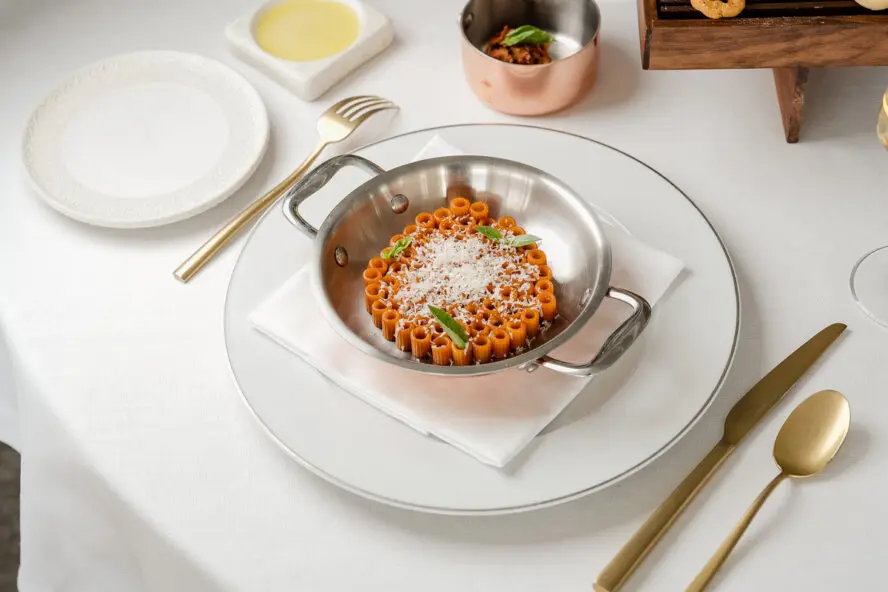
The whole menu was a delicious homage to Nonna Etta, the founder of the hotel who loved to cook for guests and family with ingredients from her orto (personal garden). Think linguine with yellow cherry tomatoes, anchovy sauce “colatura” from the Amalfi coast and fish butter. Red prawns and squids with “pizzaiola” sauce and a foam of Neapolitan potato “gâteau.” Sausage stuffed with potato purée and porcini mushrooms. Mouthwatering local wine pairings were hand-selected, including Taurasi, Greco di Tufo, and Lacryma Christi grown on the volcanic slopes of Vesuvius itself.
More Must-Eat Experiences in Sorrento
Beyond the hotel, I walked across the street to Terrazza Mediterraneo Italian Bistro perched on the edge of the cliff. The bistro delivers panoramic views, a relaxed vibe, and freshly picked zero-kilometer ingredients in equal measure. Must-try items on the menu include the Italian oysters, the raw fish menu, and for dessert, Delizia al Limone, a delicate Sorrento sponge cake with lemon cream.
Another stand-out in Sorrento was Ristorante Il Buco. In the center of town, I followed an ancient cobblestone vicolo and entered through a high arch made of stones that opened into a 16th‑century monastic cellar. Il Buco boasts an impressive selection of over 1,600 labels of wine. Inside, you can choose a table in the historic setting or a few steps away in an updated modern contemporary space.
A Michelin Star since 2004, Chef Peppe Aversa’s mission at Il Buco is to share the flavors of Southern Italy with the world. It’s a valiant mission, considering Southern Italy truly is packed with flavor. The Sorrentine Peninsula alone holds more than ten Michelin-starred restaurants within a small stretch of coastline. But what impressed me wasn’t the prestige. It was the pace. There’s zero rush, and no one reaches for their phone during dinner. Your table is yours for the night. You’re free to relax, linger, and truly savor a fine dining experience.
The Sorrentine Peninsula
People tend to lump Positano and the Amalfi Coast together, but the Sorrentine Peninsula has its own distinct identity. This narrow finger of land juts into the Tyrrhenian Sea in Campania, with the Gulf of Naples to the north and the Amalfi Coast stretching to the south. Perched high on the northern cliffs, Sorrento provides an exquisite view of the Bay of Naples and sits under the silhouette of Mount Vesuvius.
It’s often referred to as “the gateway” to the Amalfi Coast, but the term undersells Sorrento entirely. This isn’t a stopover. It’s a destination characterized by cliffs, citrus groves, and views of the sea so intoxicating the ancient Greeks called this stretch of coastline ‘the Land of the Sirens.’
The Culture of Sorrento
Nearby towns like Sant’Agnello have a true local rhythm, where fishing boats return each morning and lemon groves have been in the same families for generations. The old town of Sorrento follows an ancient Roman tangle of narrow lanes funneling you inevitably back to Piazza Tasso.
Daily life is loud, the way southern Italy should be. Men debate politics and football in coffee bars. Vespas speed through impossibly narrow streets. Women laugh walking arm in arm down cobblestone lanes and children play in the piazza. Sorrento feels real, not touristy and overdone.
In Sorrento, everyone takes a walk in the early evening — not for exercise, but simply to enjoy being outside together. By the time I reached Piazza Tasso, la passeggiata was in full swing. Corso Italia was filled with families and couples ambling along at an unhurried pace. A lemon gelato felt obligatory. People strolled toward Villa Comunale to look over the Bay of Naples, or down to Marina Grande where fishing boats rocked quietly against the quay.
Back home, I would have called this doing nothing. But in Sorrento, it felt like the most natural way to enjoy dolce far niente.
Truly Unlocking Dolce Far Niente
I used to think relaxing meant escaping my daily grind and something I had to plan. A weekend away, a spa day, a quick reset before getting back to “normal life”. But Sorrento taught me something else entirely. Normal life doesn’t have to be a grind. It’s not that Italians are better at “doing nothing”. They’ve perfected the art of loving what they’re doing and letting that be more than enough.

On my last evening in Sorrento, I watched the sunset at the Vista Sky Bar as the last light of day faded over the Bay of Naples. I didn’t feel the urgency to take a photo. I simply sipped my negroni, rolled the liquid in my mouth and savored the taste.
As I relished in the changing colors of the dramatic sunset, I realized how much hustle culture and burnout cost me. Each moment in Sorrento felt more full and satisfying as I embraced the pleasure of what was without seeking more. For the first time in a long while, I stopped anticipating what came next. And look, one trip doesn’t magically undo years of habit, and I’m certainly still practicing the art of dolce far niente. But I find that as I savor the moment and enjoy what is here right now, life is truly sweeter without needing to do more.
Getting to Sorrento
Skip the rental car if you can, as driving in southern Italy isn’t for the faint of heart. Plus, the train from Rome or Naples Central Station offers a super easy, stress-free trip to the local Sorrento train station. There’s also a ferry that runs from Naples to Sorrento four times a day, a scenic 45-minute crossing across the bay. For those who are brave enough to drive, the journey from Naples International Airport takes roughly an hour and is serviced by most major airlines and rental car agencies.
Sources:
- https://www.who.int/news/item/28-05-2019-burn-out-an-occupational-phenomenon-international-classification-of-diseases

Add Organic Authority as a preferred source on Google?