
Most advice about getting rid of “bat wings” is overwhelming and useless at the same time.
It’s overwhelming because it dumps 20 random exercises on you. It’s useless because it avoids the only question that matters: What’s actually causing your bat wings—and what fixes that specific cause?
Sometimes it’s extra fat. Sometimes it’s underdeveloped triceps. Sometimes it’s loose skin. Often it’s a mix.
In this guide, you’ll learn how to identify what you’re dealing with, then apply the right fix: the training principles that build upper-arm muscle, the diet approach that lowers body fat without misery, and how cardio fits in if you want results faster.
Key Takeaways
- “Bat wings” are usually caused by having extra upper-arm fat, underdeveloped triceps, or loose skin—and the fix depends on which one is driving the problem.
- You can’t spot-reduce arm fat. If your arms are flabbier than you want, you have to lose body fat overall.
- The fastest way to get rid of bat wings is to build upper-arm muscle with progressive strength training while losing fat.
- If you’re already lean and strong and your arms still look “wobbly,” loose skin may be the limiter—and exercise can only help so much.
- You don’t need supplements to get rid of bat wings, but caffeine, yohimbine, and a fat burner can accelerate your progress.
What “Bat Wings” Really Are (Fat vs. Loose Skin vs. Low Muscle)
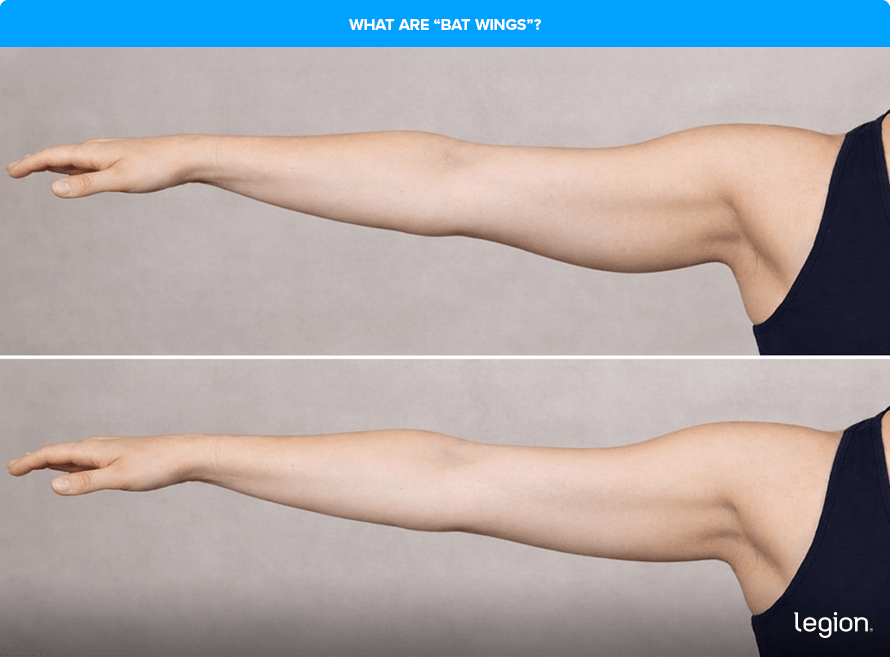
“Bat wings” is just a nickname for upper arms that look soft, saggy, or a little “wobbly,” especially when your arms are lifted out to the side.
Here’s how they look (top) compared to slimmer arms (bottom):
The important thing to understand is that bat wings usually come from one (or more) of three things:
- Excess fat in the upper arms: If you’re carrying a bit more fat overall, some of it tends to show up in the upper arms. That can make the back of the arm look fuller and less defined, even if you do arm workouts.
- Undermuscled upper arms: The triceps are the main muscle on the back of your upper arm. If they’re undertrained, the area often looks flatter and softer, because there’s not much muscle “pushing up” against the skin.
- Loose skin: There are several ways skin can lose its “snap”. It can happen with aging, after weight loss, or just because genetics dealt you that card. When this is the main issue, the arm can look saggy even if you’re fairly lean.
In most cases, the first two are the issue—and fortunately, fixing them is also the easiest. I’ll explain how soon.
If your bat wings are mostly the result of loose skin, the fix is a bit more challenging—but we’ll cover that later, too.
Can You Actually Spot-Reduce Bat Wings?
No—you can’t pick a body part, hammer it with exercises, and force your body to burn fat there first (“spot reduction”).
That’s not how fat loss works.
When you lose fat, your body pulls energy from fat cells all over, in whatever pattern your genetics decide. For some people, the waist leans out first. For others, it’s the face. For a lot of people, the last places to change are the spots they’re most annoyed by (like the upper arms).
That’s why “arm fat exercises” are so frustrating: you can train your triceps several times a week and still see little change in how your arms look—because the real limiter isn’t your effort. It’s your overall body fat.
That said, this is where people get confused:
Even though you can’t spot-reduce fat from your arms, you can build muscle there. And that matters, because bat wings are usually a two-part problem: too much fat and too little muscle (especially in the triceps).
So if you can’t “burn arm fat” directly, what should you do to get your arms leaner and firmer?
What to Focus on Instead (Full-Body Fat Loss & Upper-Arm Muscle)
To get rid of bat wings, most people need to do two things: lose overall body fat and build upper-arm muscle (especially the triceps).
Cardio and diet matter here—and we’ll get to both—but strength training is the backbone of the plan.
Why?
Because strength training helps on both fronts: First, it builds muscle in your upper arms, which gives the back of your arm more shape and firmness. And second, it makes fat loss easier in a few practical ways:
- A muscular body burns more calories resting and moving than a similarly-sized fat one.
- Muscle also supports good metabolic health, which is vital for maintaining a healthy body fat percentage
- Strength training even alters the expression of certain genes that accelerate fat burning
Put simply: lifting weights doesn’t just change how your arms look—it changes the conditions that make it easier to stay lean.
READ MORE: How to Use Strength Training for Weight Loss
How to Get Rid of Bat Wings With Exercise
Most guides on how to get rid of bat wings push the same handful of moves—kickbacks, pushdowns, bench dips, and other triceps “burners.”
Those can help if the only issue is that your triceps are undermuscled.
But even then, they’re rarely the best use of your time. And if you also have too much body fat (which is common), doing more isolation exercises like these won’t fix the problem by itself.
To get the biggest payoff from your workouts, focus on these three principles:
- Compound exercises: A compound exercise is any exercise that targets multiple muscle groups at once. Studies show that compound exercises produce the greatest increases in metabolic rate, muscle mass, and strength, which means they’re the best type of exercise for increasing fat loss.
- Heavy weightlifting: Research shows that training with 75–85% of your one-rep max (weights that you can do 6–12 reps with before failing) builds more muscle and burns more fat than training with lighter weights.
- Progressive overload: To maximize the muscle-building and fat-burning effects of weightlifting, strive to add weight or reps to every exercise in every workout. This is known as progressive overload, and it’s the single most important driver of muscle growth.
You can’t force your body to burn fat on the back of your arms, but this combination of lifting heavy, getting stronger, and losing fat overall is what eventually shrinks that area.
The Best Flabby Arm Exercises
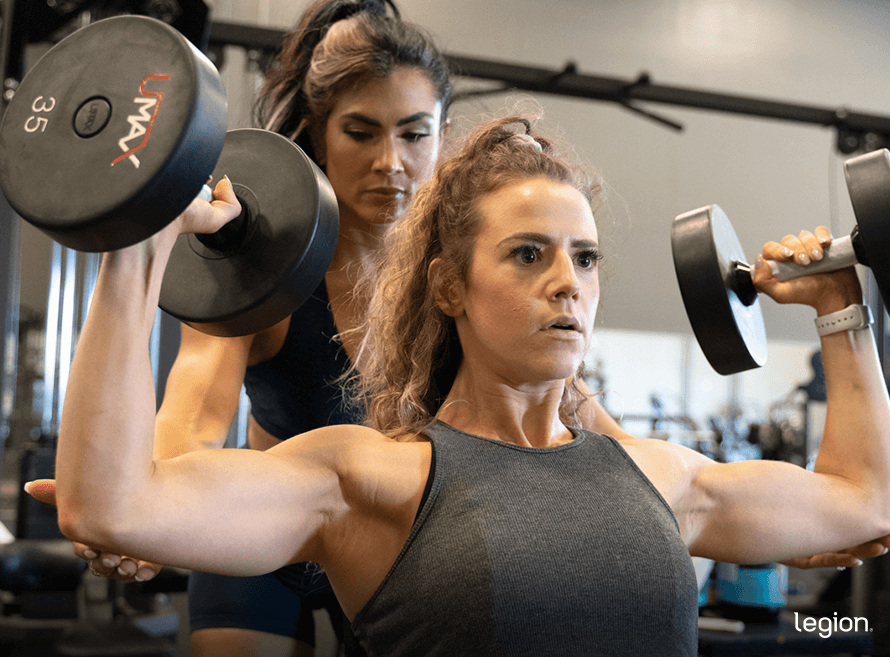
If you want your arms to look firmer and more defined, you don’t need a laundry list of “toning” moves.
You need exercises that do two things: build your triceps and biceps (so your arms look tighter) and train a lot of muscle at once (so getting leaner is easier).
The flabby arm exercises below do exactly that. They’re simple, effective, and easy to progress—so you can keep getting stronger and keep seeing changes.
Push-up
How to:
- Start in a high plank with your hands slightly wider than shoulder-width.
- Lower your chest toward the floor by bending your elbows.
- Reverse the movement and return to the starting position.
READ MORE: How to Do the Push-up: Form, Variations, and Workouts
Diamond Push-up
How to:
- Start in a high plank and form a diamond with your index fingers and thumbs under your chest.
- Lower your chest toward the floor by bending your elbows.
- Reverse the movement and return to the starting position.
Close-Grip Dumbbell Bench Press
How to:
- While sitting on a flat bench, hold a dumbbell in each hand and rest them on your thighs.
- Lie back and “kick” the dumbbells up into position so you’re holding them by your chest with your palms facing each other.
- Press the dumbbells straight over your chest until your arms are straight and your elbows are locked.
- Bring the dumbbells together over your chest.
- While keeping them pressed together, lower the dumbbells until they touch your torso.
- Press them up and return to the starting position.
Shoulder Press
How to:
- Sit on an upright bench and hold a dumbbell in each hand.
- Bring the dumbbells up in front of your shoulders with your palms facing away.
- Press the dumbbells overhead.
- Reverse the movement and return to the starting position.
READ MORE: How to Perfect the Seated Dumbbell Shoulder Press
Lat Pulldown
How to:
- Adjust the thigh pad so it holds your legs firmly in place.
- Stand up and grab the bar with an overhand grip slightly wider than shoulder width.
- Keeping your grip on the bar, sit down and secure your thighs under the pad.
- Pull the bar down until it reaches your upper chest.
- Reverse the movement and return to the starting position.
READ MORE: How to Do the Lat Pulldown: Form, Benefits, & Variations
One-Arm Dumbbell Row
How to:
- Hold a dumbbell in your right hand.
- Plant your left knee and arm firmly on a bench, your right foot on the floor a foot or two from the bench, and let your right arm hang straight down.
- Keeping your back straight, pull the dumbbell up until it touches your torso, and then return it to the starting position.
- Once you’ve completed the desired number of reps, repeat the process with your left arm.
READ MORE: How to Do the Bent-Over Dumbbell Row
Cardio: Where It Fits for Overall Fat Loss
If you want to get rid of your arm wings as quickly as possible, research shows that combining strength training and cardio is better for fat loss than doing either alone.
Here’s what I recommend:
- Do 2–3 sessions of low- or moderate-intensity cardio workouts per week (e.g., walking, swimming, or rucking) for 20–60 minutes each.
- Do one HIIT workout weekly if you enjoy it.
- Limit total cardio to 2–3 hours weekly.
- Do cardio and weightlifting on separate days if possible. If you have to do both in one day, lift first and separate the sessions by at least 6 hours.
And if you want to learn more about how to combine strength training and cardio, check out this article:
Concurrent Training: The Right Way to Combine Cardio and Strength Training
Why “Flabby Arm Exercises” Work Best When You Pair Them With Diet
Strength training builds muscle and boosts calorie burn, but your diet is what ultimately determines whether you get rid of bat wings.
The good news?
Losing fat doesn’t require extreme dieting or cutting out all your favorite foods. Here’s a simple three-step approach that makes fat loss—including arm fat—far more manageable:
Calories
Research shows that eating 20–25% fewer calories than you burn every day is the sweet spot for losing fat quickly without feeling miserable, losing muscle, or dealing with ravenous hunger.
This moderate deficit is big enough to produce weekly progress but small enough to maintain for several months—which is usually what’s needed for stubborn areas like the upper arms to lean out.
Macros
No matter your calorie goal, aim for:
- About 1 gram of protein per pound of body weight per day
- Around 20–30% of your daily calories from fats
- The rest of your daily calories from carbs
This balance supports muscle growth, performance, and overall health.
To learn more about how to calculate your macros, check out this article:
How to Calculate Your Macros for Weight Loss & Muscle Gain
Supplements
You don’t need supplements to shrink flabby arms, but the right ones can make the process faster and more comfortable.
- Caffeine: 3–6 mg of caffeine per kilogram of body weight per day increases metabolic rate and helps you train harder while dieting.
- Yohimbine: 0.1–0.2 milligrams of yohimbine per kilogram of body weight before fasted training enhances fat loss.
- Fat Burner: Effective fat burners contain ingredients that boost the number of calories you burn and reduce hunger and cravings, making weight loss more straightforward.
And if you’d like to know exactly what other supplements you should take to reach any and all of your fitness goals, take the Legion Supplement Finder Quiz.
When Exercise Won’t Be Enough (And What People Do Instead)
For most people, bat wings improve a lot when they build upper-arm muscle and lower their body fat percentage.
But there’s one situation where exercise hits a wall: when the main issue is loose skin.
If the “wobble” you’re seeing is mostly skin (not fat), you can build stronger triceps and get leaner and still have some sagging—because training can’t tighten skin the way it can build muscle or reduce fat.
At that point, your options aren’t “better triceps exercises.” An arm lift (brachioplasty) is the surgical option. It removes excess skin (and sometimes fat) from the upper arm to create a tighter look.
There are also non-surgical treatments marketed for upper arms (often focused on fat reduction or skin tightening). These may help with mild issues, but they’re generally much less dramatic than surgery.
Before considering any procedure, make sure you’ve:
- Reached a stable body weight
- Given training and nutrition a long-term effort
- Talked to a board-certified professional about risks, costs, and realistic expectations
Surgery isn’t a shortcut—but in cases where the issue is skin, not fat, it may be the only way to fully tighten the area.
The Bottom Line on How to Get Rid of Bat Wings
You can’t spot-reduce bat wings, but you can get rid of them in most cases. The winning formula is simple: build upper-arm muscle (especially the triceps) and reduce overall body fat.
Do that with progressive strength training, a sensible amount of cardio, and a diet that keeps you in a sustainable calorie deficit, and the back of your arms will tighten up over time. If loose skin is the main issue, exercise can still help—but cosmetic options may be the only true “fix.”
FAQ #1: Can you reverse batwing arms?
Usually, yes. In most cases, bat wings are caused by a combo of too much body fat and too little upper-arm muscle. If you lose fat overall and build your triceps (and other upper-body muscles), the back of your arms will look tighter over time.
If the main issue is loose skin, you can still improve the look, but you may not be able to “erase” it with exercise alone.
FAQ #2: How to tone batwing arms fast?
The fastest way to tone bat wings is to focus on progressive strength training (so your triceps and biceps grow), maintain a modest calorie deficit (so overall fat drops), and add a sensible amount of cardio if it helps you stick to that deficit. Do that consistently and many people notice visible changes in 8–12 weeks.
FAQ #3: How to make bat wings go away?
You can’t spot-reduce the back of your arms, so the solution is indirect: get leaner overall and build more muscle in the upper arms.
That means lifting weights in a way that lets you get stronger over time, doing some cardio if it helps your fat loss, and dieting in a way you can stick to long enough to lower your body fat.
FAQ #4: How long does it take to reduce bat wings?
If your bat wings are mainly due to extra fat and low muscle, you’ll usually see them start to shrink within 8–12 weeks if you follow the approach in this article. Stick with it for 3–6 months, and most people look significantly different.
Want More Content Like This?
Check out these articles:
Scientific References +
- McClave, Stephen A., and Harvy L. Snider. “Dissecting the Energy Needs of the Body.” Current Opinion in Clinical Nutrition and Metabolic Care, vol. 4, no. 2, Mar. 2001, pp. 143–147, https://doi.org/10.1097/00075197-200103000-00011.
- Willoughby, Darryn, et al. “Body Composition Changes in Weight Loss: Strategies and Supplementation for Maintaining Lean Body Mass, a Brief Review.” Nutrients, vol. 10, no. 12, 3 Dec. 2018, p. 1876, www.ncbi.nlm.nih.gov/pmc/articles/PMC6315740/, https://doi.org/10.3390/nu10121876.
- MacKenzie-Shalders, Kristen, et al. “The Effect of Exercise Interventions on Resting Metabolic Rate: A Systematic Review and Meta-Analysis.” Journal of Sports Sciences, vol. 38, no. 14, 12 May 2020, pp. 1635–1649, https://doi.org/10.1080/02640414.2020.1754716.
- Kim, Gyuri, and Jae Hyeon Kim. “Impact of Skeletal Muscle Mass on Metabolic Health.” Endocrinology and Metabolism, vol. 35, no. 1, 2020, p. 1, https://doi.org/10.3803/enm.2020.35.1.1.
- Vechetti, Ivan J., et al. “Mechanical Overload‐Induced Muscle‐Derived Extracellular Vesicles Promote Adipose Tissue Lipolysis.” The FASEB Journal, vol. 35, no. 6, 25 May 2021, https://doi.org/10.1096/fj.202100242r.
- Farinatti, Paulo TV, and Antonio G Castinheiras Neto. “The Effect of Between-Set Rest Intervals on the Oxygen Uptake during and after Resistance Exercise Sessions Performed with Large- and Small-Muscle Mass.” Journal of Strength and Conditioning Research, vol. 25, no. 11, Nov. 2011, pp. 3181–3190, https://doi.org/10.1519/jsc.0b013e318212e415.
- MARX, JAMES O., et al. “Low-Volume Circuit versus High-Volume Periodized Resistance Training in Women.” Medicine and Science in Sports and Exercise, Apr. 2001, pp. 635–643, https://doi.org/10.1097/00005768-200104000-00019.
- Schoenfeld, Brad J. “The Mechanisms of Muscle Hypertrophy and Their Application to Resistance Training.” Journal of Strength and Conditioning Research, vol. 24, no. 10, Oct. 2010, pp. 2857–72, https://doi.org/10.1519/JSC.0b013e3181e840f3.
- Ho, Suleen S, et al. “The Effect of 12 Weeks of Aerobic, Resistance or Combination Exercise Training on Cardiovascular Risk Factors in the Overweight and Obese in a Randomized Trial.” BMC Public Health, vol. 12, no. 1, 28 Aug. 2012, bmcpublichealth.biomedcentral.com/articles/10.1186/1471-2458-12-704, https://doi.org/10.1186/1471-2458-12-704.
- Brellenthin, Angelique G., et al. “Resistance Exercise, Alone and in Combination with Aerobic Exercise, and Obesity in Dallas, Texas, US: A Prospective Cohort Study.” PLOS Medicine, vol. 18, no. 6, 23 June 2021, p. e1003687, https://doi.org/10.1371/journal.pmed.1003687.
- Huovinen, Heikki T., et al. “Body Composition and Power Performance Improved after Weight Reduction in Male Athletes without Hampering Hormonal Balance.” Journal of Strength and Conditioning Research, vol. 29, no. 1, Jan. 2015, pp. 29–36, https://doi.org/10.1519/jsc.0000000000000619.