
In Sweden, December 13 marks Lucia Day, one of the country’s most beloved winter traditions. The morning usually begins in candlelight, with processions of singers dressed in white and a young girl wearing a crown of candles. Alongside the music and warmth, there are always saffron buns “lussekatter” served with coffee or warm milk.
The Story of Lucia
The Lucia tradition in Sweden – like most of our traditions – is a mix of legends, faith, and folklore. Its roots stretch back to St. Lucia of Syracuse, a Christian martyr from the fourth century, but also to older Nordic myths about light and darkness. The name “Lucia” ties to lux, the Latin word for light, yet echoes of Lucifer linger too, reminders that winter once carried both fear and reverence.
Before Sweden adopted the modern calendar, the night of December 13 was considered the longest of the year; a turning point when spirits and animals were said to roam freely and the world tilted toward renewal. To stay safe and strong through the night, families would feast, often eating seven or nine breakfasts before sunrise. Work like threshing and slaughtering had to be finished by then, barns stocked for the coming cold.
In rural communities, young people once roamed from house to house dressed as “lussegubbar” – raucous Lucia figures who sang, played pranks, and asked for food and schnapps. It was part celebration, part mischief, and it filled the dark season with life.
From Folklore to Candlelight
The first known appearance of a white-clad Lucia was recorded in 1764, in a manor house in western Sweden. By the early 20th century, the tradition had shifted from village revelry to something more ceremonial. Schools and local associations began organizing Lucia processions, replacing the rowdy lussegubbar with choirs of children carrying candles and singing songs about light returning to the world. Stockholm crowned its first official Lucia in 1927, and the image has held ever since.
The Scent of Saffron
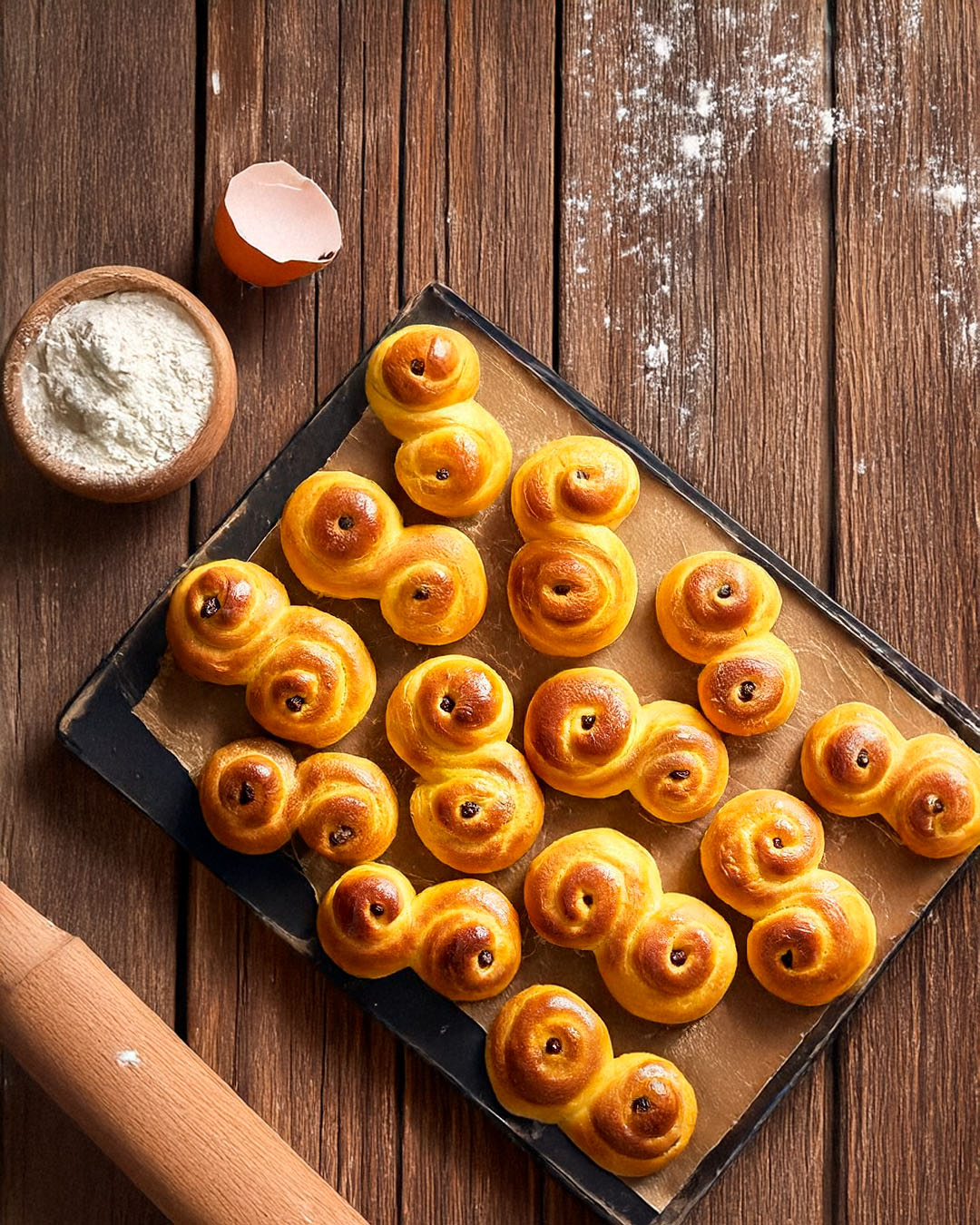
And then, of course, there are the buns. The golden lussekatter – soft, slightly sweet, and scented with saffron – have been part of the season long before Lucia wore her crown. They’re shaped into S-curves, often dotted with raisins, and served warm on the morning of December 13. The custom of Lucia serving coffee and buns to her family dates back to the 1880s, though the bread itself goes further back, linked to older midwinter baking traditions meant to honor light in the darkest month.
Today, Lucia Day blends the sacred and the everyday: song, candlelight, and the smell of saffron rising from the kitchen. It’s both a festival of light and a quiet reminder that, even in deep winter, warmth finds its way back.
Lucia Buns: How to Make Traditional Swedish “Lussekatter”
NOTE: While the overnight pre-dough gives better structure and deeper flavor, you can bake these the same day if needed. Prepare the pre-dough as written, but let it ferment at room temperature for 60–90 minutes, until visibly bubbly and slightly risen. Continue with the recipe as usual. Expect a slightly milder flavor and a softer crumb, but still very good results.
Day 1: Make the Pre-Dough
1. Bloom the yeast and saffron
Crumble the fresh yeast into a large bowl. Add the saffron mixture, vanilla sugar (or sugar), and a small splash of the cold milk. Stir gently until the yeast dissolves.
2. Build the pre-dough
Pour in the remaining milk, then add the flour for the pre-dough. Mix with a spoon just until combined. The mixture should be loose, sticky, and rough — this is not a kneaded dough.
3. Let it ferment slowly
Cover the bowl loosely with plastic wrap and place it in the refrigerator overnight (8–12 hours). The mixture will expand, so use a generously sized bowl. By morning, it should look bubbly, slightly domed, and smell lightly fermented.
Day 2: Prepare the Dough
4. Bring ingredients to room temperature
Remove the butter and egg from the refrigerator at least 1 hour before baking. Cold ingredients will slow gluten development and make the dough harder to work.
5. Soak the raisins
Bring the glögg to a brief boil, remove from heat, and add the raisins. Let them soak while you prepare the dough. Drain before using.
Mixing and Kneading
6. Incorporate the remaining ingredients
Add the softened butter, egg, sugar, and most of the remaining flour to the pre-dough. Mix slowly, adding flour gradually. The dough should feel sticky but cohesive and begin pulling away from the sides of the bowl.
7. Add the salt last
Once the dough has come together, add the salt and continue mixing. This timing matters — salt tightens gluten and slows fermentation.
8. Knead thoroughly
Knead by hand for 20–30 minutes, or 15–20 minutes in a stand mixer on low speed. The dough should become smooth, elastic, and glossy.
Gluten test:
Stretch a small piece of dough between your fingers. If it forms a thin, translucent membrane without tearing, it’s ready.
Resting and Shaping
9. Let the dough rest
Cover the dough and let it rest for 30 minutes at room temperature. This relaxes the gluten and makes shaping easier.
10. Divide and shape
Turn the dough onto a lightly floured surface. Divide into pieces of about 60 g (2 oz) each. Roll each piece into a rope and shape into classic Lucia “S” forms or coils.
11. Add the raisins
Press soaked raisins firmly into the dough so they don’t pop out during baking.
Final Proof and Baking
12. Final rise
Place buns on lined baking sheets, cover lightly, and let rise until doubled in size — about 60–90 minutes, depending on room temperature. The dough should feel airy and slightly springy when pressed.
13. Bake
Bake in the lower part of a 220°C / 425°F conventional oven (no fan) for 6–8 minutes, watching closely. They should be just golden, not browned.
14. Brush and cool
Immediately brush the hot buns with egg wash. Transfer to a rack to cool — leaving them on the tray will cause overbaking from residual heat.
Recipe Notes
Cold fermentation improves flavor and structure.
Kneading time is crucial—don’t cut it short.
The dough should remain slightly sticky; adding too much flour leads to dry buns.
Freeze buns the same day for best results.
Reheat directly from frozen in a low oven or microwave briefly.
FAQ
Can I skip the overnight fermentation?
Yes. While the overnight pre-dough gives better structure and deeper flavor, you can bake these the same day if needed. Prepare the pre-dough as written, but let it ferment at room temperature for 60–90 minutes, until visibly bubbly and slightly risen. Continue with the recipe as usual. Expect a slightly milder flavor and a softer crumb, but still very good results.
Why add alcohol to the saffron?
Alcohol helps extract saffron’s color and aroma more effectively than water alone.
Can I use dry yeast instead of fresh?
Yes. Substitute 1½ tbsp (14 g) active dry yeast. Dissolve thoroughly before mixing.
Why brush after baking, not before?
Brushing after baking keeps the buns soft and avoids sealing the surface too early.
Can I bake with convection (fan)?
Yes, lower the temperature to 390°F (200°C) and watch closely.
Traditional Swedish Lucia Buns: Lussekatter

Total Time: 3 hours plus overnight fermentation

Yield: buns

Print Recipe

Pin Recipe
Description
Soft, saffron-rich Lucia buns made the traditional Swedish way, with long fermentation and plenty of butter. A December essential.
Ingredients
Units
Pre-Dough
2 cups (5 dl) whole milk
0.05 oz saffron threads (1-1.5 g / 2-3 packets)
1½ tbsp dark rum or other spirit (optional but traditional)
2½ oz fresh yeast (40 g)
5 cups (600 g) high-quality wheat flour
1 tbsp sugar or vanilla sugar
Soaked Raisins
4 tbsp raisins
½ cup (1 dl) mulled wine (glögg) or hot water
Final Dough
About 3? cups (400 g) wheat flour (added gradually)
14 tbsp butter (200 g), room temperature
1 large egg, room temperature
1 cup (200 g) sugar
¾–1 tsp salt (5–10 g)
Egg Wash
1 egg
2 tbsp water
Pinch of salt
Instructions
Day 1 – Make the Pre-Dough
-
Crush saffron with a pinch of sugar and mix with rum (if using).
-
Crumble yeast into a large bowl. Add saffron mixture, sugar, and a little of the milk. Stir to dissolve.
-
Add remaining milk and flour for the pre-dough. Mix briefly.
-
Cover and refrigerate overnight. Use a large bowl—the dough will expand.
Day 2 – Prepare the Dough
-
Remove butter and egg from the refrigerator to come to room temperature.
-
Bring glögg or water to a boil, remove from heat, and soak raisins.
-
Add butter, egg, sugar, and flour to the pre-dough, adding flour gradually. The dough should be sticky but pull slightly from the bowl.
-
Add salt at the end of kneading.
-
Knead thoroughly: 20–30 minutes by hand or 15–20 minutes in a mixer, starting slowly. Perform a gluten test—the dough should stretch thin without tearing.
-
Cover and let rest for 30 minutes.
Shaping and Baking
-
Turn dough onto a work surface. Divide into 2 oz (60 g) pieces.
-
Shape into traditional Lucia buns (S-shapes).
-
Press raisins firmly into the dough so they don’t pop out during baking.
-
Cover and proof for at least 1 hour, until doubled in size.
-
Bake on the lower rack at 425°F (220°C, conventional oven) for 6–8 minutes.
-
Brush immediately with egg wash. Remove from trays to prevent overbaking.
-
Cool completely, then freeze as soon as possible.
Notes
Cold fermentation improves flavor and structure.
Kneading time is crucial—don’t cut it short.
The dough should remain slightly sticky; adding too much flour leads to dry buns.
Freeze buns the same day for best results.
Reheat directly from frozen in a low oven or microwave briefly.
- Prep Time: 30 min
- Fermentation Time: Overnight
- Cook Time: 135 min
 Category: Pastry
 Method: Baking
 Cuisine: Swedish
Nutrition
- Serving Size: 1 bun
- Calories: 210
- Sugar: 12g
- Sodium: 110mg
- Fat: 9g
- Saturated Fat: 5g
- Unsaturated Fat: 4g
- Trans Fat: 0g
- Carbohydrates: 28g
- Fiber: 1g
- Protein: 4g
- Cholesterol: 35mg
If you liked this, you are going to love these favorite Swedish recipes:
How to Make Swedish Meatballs
Swedish Christmas Classic – Jansson’s Temptation
Swedish-Style Cardamom Sourdough Rolls
The post How to Make “Lussekatter”: Traditional Swedish Lucia Buns appeared first on Honest Cooking and Travel.