
Jakarta moves fast. So do its appetites. Over the past five years, Indonesia’s food landscape has shifted further towards convenience and high-risk options, moving away from diets that are nourishing and environmentally grounded. Indonesia Health Survey 2023 tells the story in numbers: high-fat foods consumption rose from 58.5% in 2018 to 60.7% in 2023; salty foods jumped from 40.3% to 52.2%; and instant noodles climbed from 45% to 51.7%. Meanwhile, adequate vegetable intake (five portions per day) fell from 4.6% to 3.3%.
These are not minor shifts. They signal a cultural rewrite of food preferences. In Indonesia, preference is not just an individual decision; it is cultural, shaped by norms, daily routines, and the institutions that quietly teach us what is desirable to eat.
FCA Approach: Changing Meaning Before Changing Diets
At the Food Culture Alliance (FCA), we treat preference as a cultural and systemic outcome. Our NIBS framework (Narratives, Identity, Beliefs, Systems) assumes that diets do not change sustainably unless the meaning of food changes first. That is why FCA Indonesia, hosted by GAIN, places narrative shaping at the center of its demand-side work.
But narrative shaping cannot be delivered by one actor or one campaign. It depends on making the Alliance work together: activating institutions that already influence how Indonesians think about, feel about, and value food.
The Secretariat’s role: Connecting, Not Owning
FCA Indonesia’s Secretariat does not run members’ initiatives or replace their creativity. Its role is orchestration:
- Spot cultural entry points the public already trusts.
- Invite Alliance members into shared design spaces.
- Embed evidence in culturally fluent ways.
- Turn standalone activities into repeatable models for preference change
- In 2024, one such entry point was Tastemade Indonesia’s Walking Tour.
Tastemade’s Walking Tour as a Narrative Lab
Since 2022, Tastemade Indonesia has hosted walking tours as joyful celebrations of Jakarta’s food corridors. People join because they are local, human, and fun, thanks to the approach of making them immersible experiences. Simply letting the city tell its story through food. For FCA, this made the tour a natural Narrative Lab, a real-world setting where culinary heritage and everyday preference meet.
Roby Bagindo, Tastemade Indonesia’s Licensee and an FCA member under Masak.TV, observed that Jakarta’s culinary heritage is usually portrayed as nostalgia or tourism. Rarely is it recognised as ancestral intelligence – knowledge that historically integrated preservation, nutrition, food safety, and ecological adaptation into daily cooking. Through FCA’s framing, Roby found an opportunity to weave this dimension without making it feel like a classroom.
The Collaboration: Tastemade x Eathink x Faith Institutions. The Secretariat connected Tastemade with Eathink, another FCA member with strong nutrition and environmental expertise, and with faith institutions that shape food culture.
The goal was not to rebrand the tour, but to enrich its stories so that participants experience heritage food as full of meaning and resilience, not just flavour.
Each actor kept its role:
- Tastemade protected cultural authenticity and public trust.
- Eathink added scientific validation and ecological framing.
- FCA Secretariat ensured alignment with a shared theory of change.
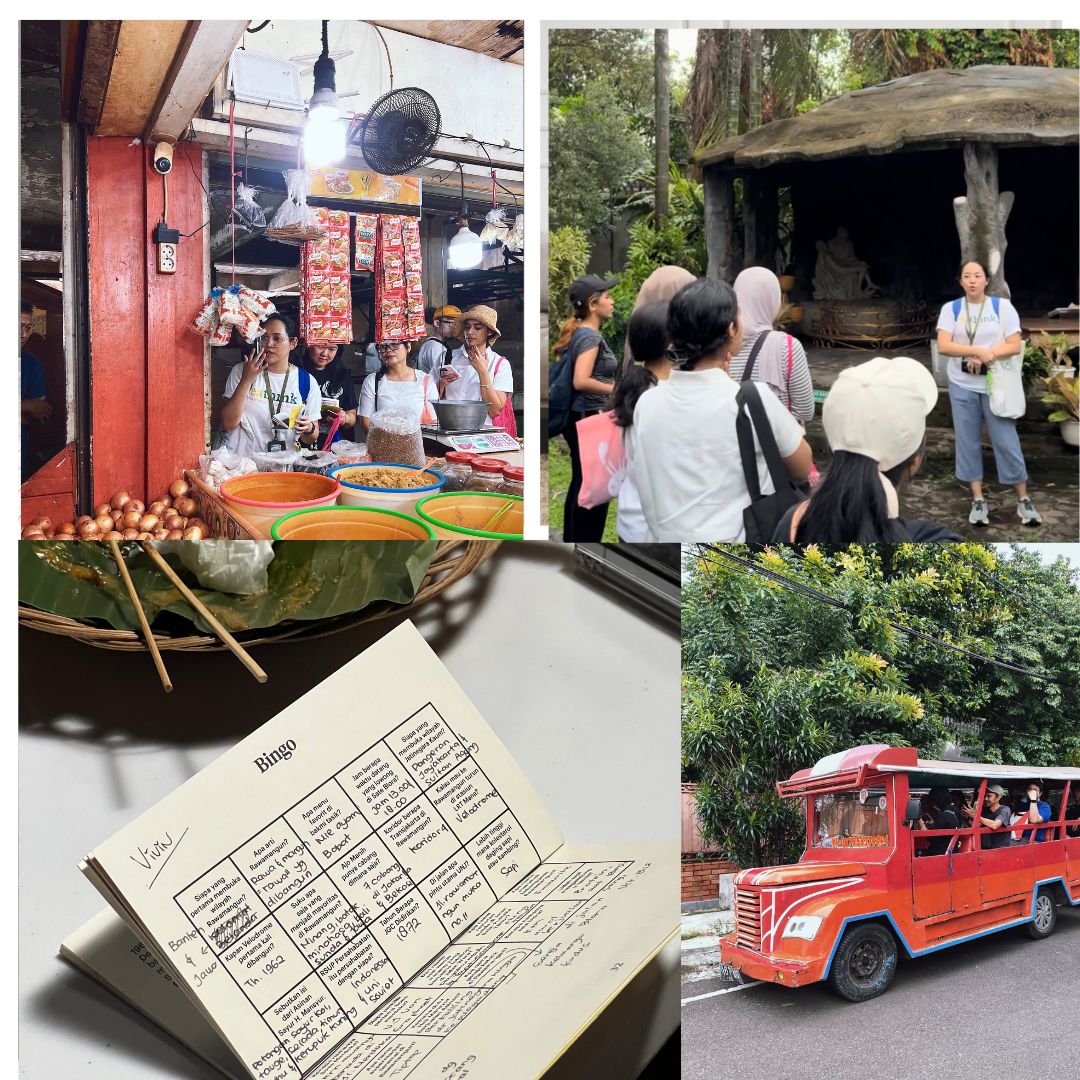
The November 2025 tour followed a 2.3-kilometre route from Rawamangun Market to the Holy Family Catholic Church, curated by Tastemade. Eathink embedded short, accessible insights at key stops.
Participants explored historic buildings, alleys, and food stalls, hearing how dishes and places evolved together. Stories of branding, neighbourhood identity, and regional variation (for example, Asinan Jakarta vs. Asinan Bogor), revealed heritage as a living system, not a static relic.
A recurring thread emerged: our ancestors’ preferences were shaped by resilience, preservation techniques, nutrient-sustaining ingredient pairings, and climate-adapted practices; all practical wisdom that still matters. Practical intelligence remains relevant.
The church stop became a narrative bridge, linking local foods to ecological stewardship in faith teachings. This connected heritage to moral and planetary responsibility without prescribing behaviour. The tour ended at Tastemade’s studio, with an interactive dialogue and a light bingo-style quiz to surface what participants retained from the history, culture, nutrition, and sustainability narratives.

What this demonstrates for GAIN
This activation is modest in scale but significant in insight:
- Demand-side transformation can be institution-led, not campaign-led. The Secretariat did not create a new channel; it aligned an existing, trusted cultural platform with Alliance intent.
- The Alliance’s value lies in orchestration, not ownership. Tastemade’s tour remains Tastemade’s. FCA Indonesia adds value by connecting Tastemade with Eathink and faith-based narratives.
- Narrative shaping becomes operational. Participants leave with re-expanded meaning: local food as identity, resilience, and part of a healthier, more sustainable future.
FCA Indonesia will keep tracking post-tour effects among Alliance members and participants, focusing on cultural retention – how people think about, feel about, and value local foods over time. At the same time, the Secretariat will expand the Alliance by bringing in strategically relevant members rooted in food-culture institutions, guided by FCA’s global and country frameworks. In Indonesia, food preference will shift when stories, institutions, and everyday experiences start pointing in the same direction.