
The North Sea meets Rogaland’s coast with ancient power, sending waves that crash against sandy beaches and rugged cliffs. Fjords lie dark and deep, their surfaces deceptively calm until storms wake what sleeps beneath. Mountains rise in the distance, made of granite and ice. The waters here have swallowed ships and men for centuries, an enormous number of wrecks rest just offshore, where Harald Fairhair once unified Norway in the Battle of Hafrsfjord.
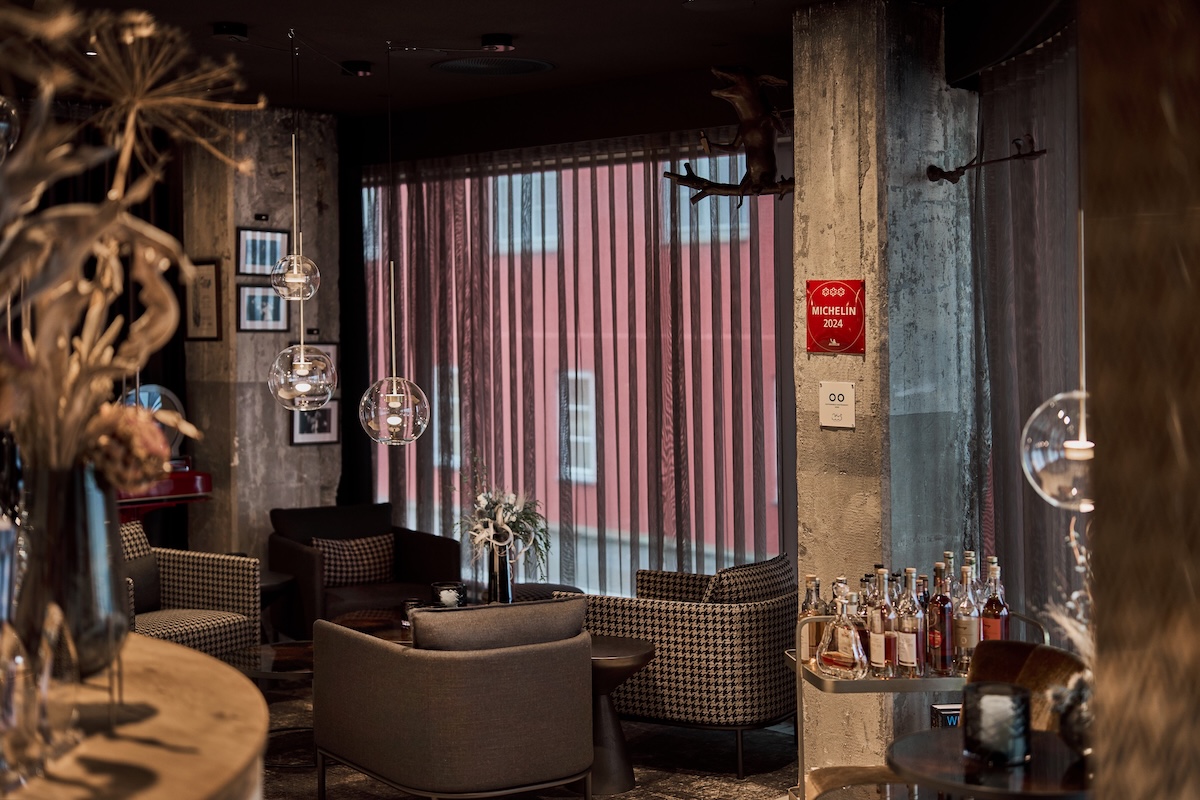
But inside RE-NAA, in Rogaland’s modern main city of Stavanger, something shifts. It’s not an escape from the darkness outside, but a crack through which a light definitely answers to it. The dining room holds warmth the way a hearth held warmth in the old longhouses. Wood and stone speak create shelter. You come expecting culinary excellence but you also find a playful resistance to the harshness outside.
Built on Proximity
At RE-NAA, the word “local” isn’t about marketing. It’s how people have lived here since the first Vikings dragged their boats ashore.
The restaurant sits so close to the sea you can see it through the windows, and the fjords, mountains, and farmlands that these elements guide the cooking. Ingredients arrive when Rogaland’s stubborn soil and Stavanger’s violent coastline decide they’re ready.
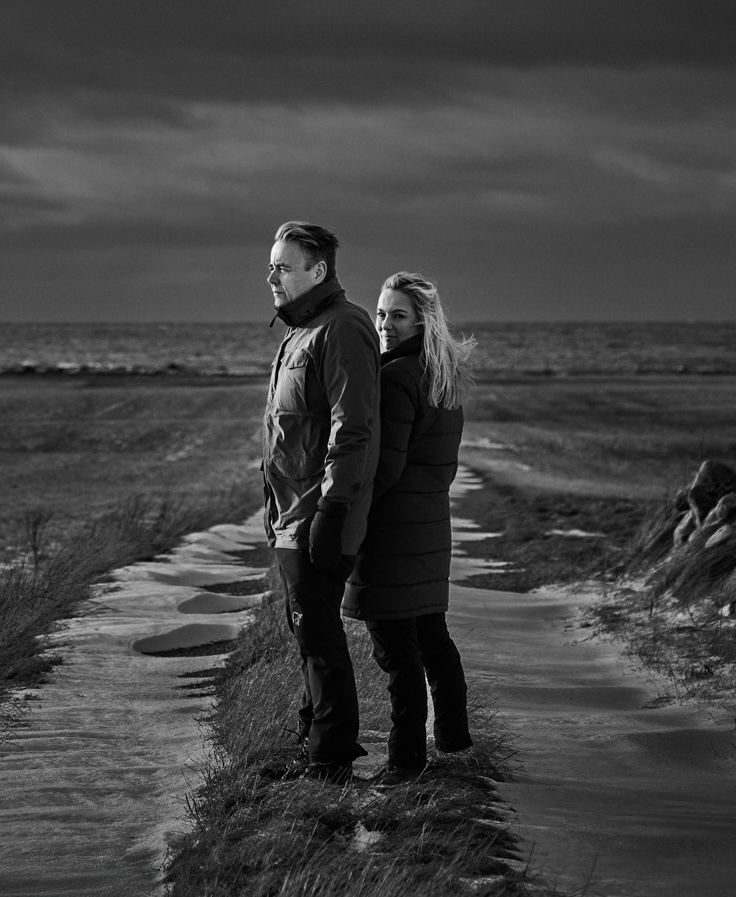
Sven Erik and Torill Renaa opened the restaurant in 2009, and from the beginning, it has been about closeness: between the kitchen and those it feeds, between two people who chose each other, between what can be coaxed from cold earth and what appears on the plate. From outside, you might see the story of a talented chef. From inside, it becomes clear this is a story of perseverance disguised as a restaurant, two people building something that must withstand not just seasons, but the relentless winds that blow off the North Sea and the darkness that falls at three in the afternoon for months on end.
A Partnership Forged in Fire
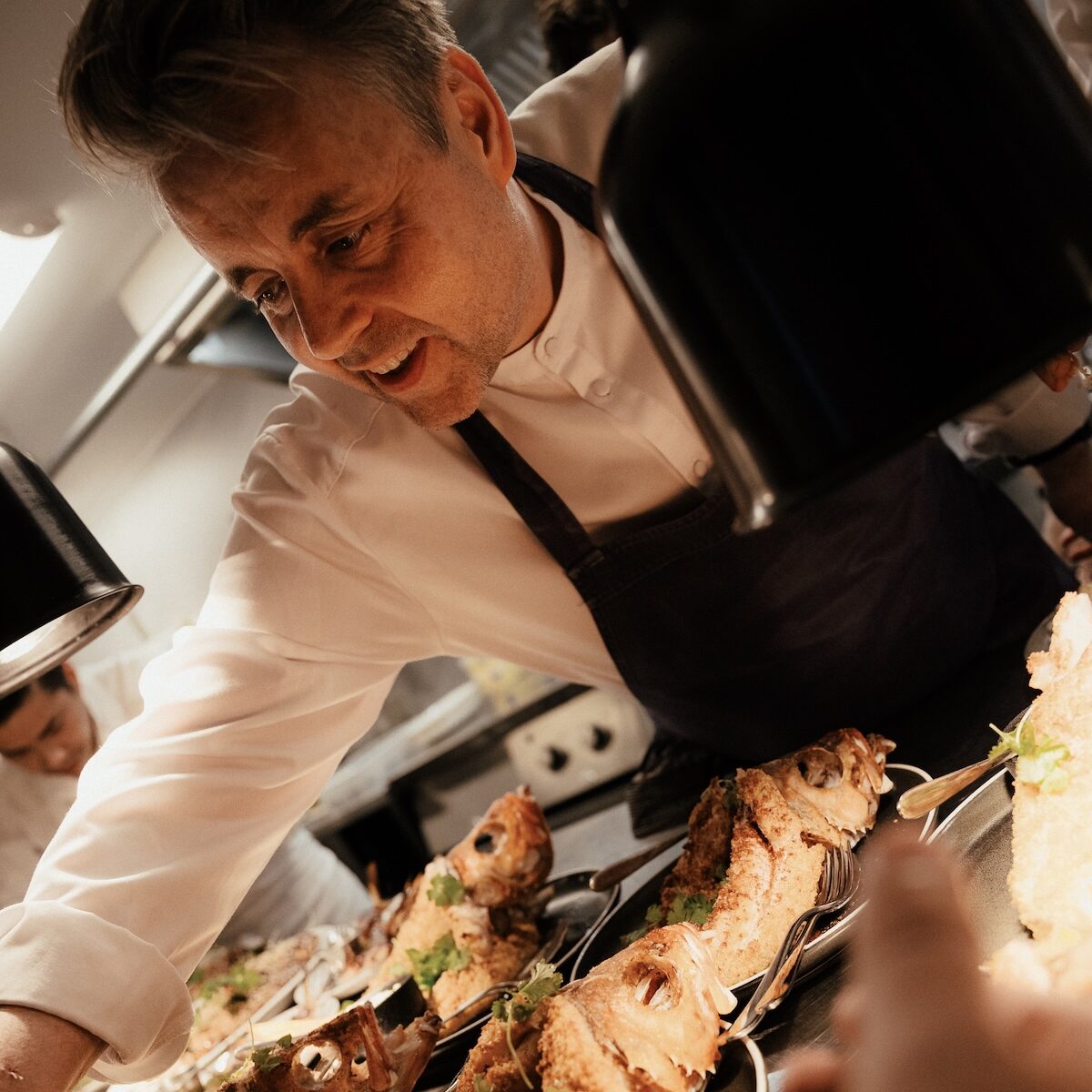
Sven Erik brings an obsession with flavor, a discipline learned through competition, and a restlessness that keeps a kitchen from growing comfortable. Torill brings structure, an understanding of when to hold guests close and when to give them space to breathe, and the steady calm that allows a restaurant to survive.
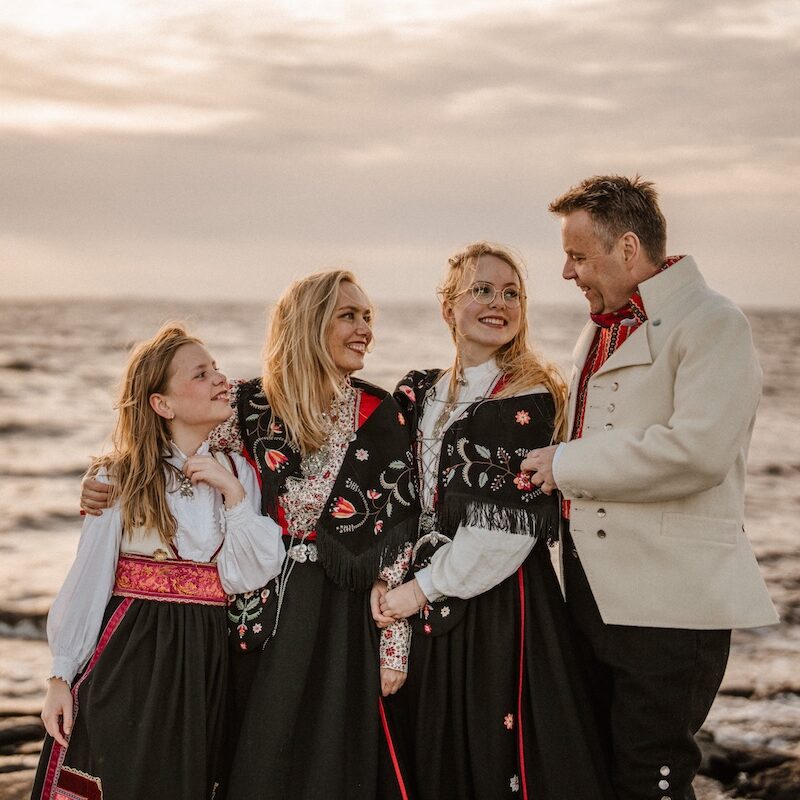
Their story begins with a decision that would break most people. “We signed the lease the same day we had a baby,” Torill says, and there’s no drama in her voice, only the quiet acknowledgement of what risk actually means. It’s the kind of choice that reveals character or forges it.
In the early years, RE-NAA tried to be two things at once: fine dining on the ground floor, a bistro above. Two concepts, two kitchens, 145 seats. They were fighting on two fronts. Then, in 2014, they made a choice that changed everything. They moved the fine dining space to a studio in the same building and reduced capacity to just twenty-four seats, while maintaining the bistro.
Fewer guests. More pressure per service. Less margin for error. No room to hide. But also: greater precision, sharper rhythm, and the ability to develop an intimate relationship with every ingredient that crosses the threshold, to know it the way a fisherman knows the sea. Standing in the dining room now, you can feel how that decision continues to shape the experience. Everything moves with the confidence of a crew that has sailed through storms and lived to tell about it.
The Path Through Fire and Ice
Sven Erik grew up in a restaurant family and trained in Trondheim before working in Oslo as Norway’s culinary landscape began to find its voice. But the real transformation came in 1997 when he left for New York City, crossing the Atlantic the way his ancestors once did, though with different intentions. The experience rewired his understanding of what was possible in a kitchen.
In Scandinavia, he says, everything was rooted in French classicism then, in Escoffier’s techniques and traditions, in rules that had been written by men who never knew what it meant to cook through a Norwegian pantry. New York was different. The pace was savage, the pressure relentless, and there was an appetite for experimentation that felt almost reckless, almost violent in its hunger for the new. When he returned, that energy came with him, but it had been tempered by something older, something that ran in his blood.
He channeled it into competition. He spent years in the world of culinary championships like the Bocuse d’Or circuit, competitions where every movement is measured and precision becomes a gold medal. These were battles fought with knives and fire instead of swords and shields, but battles nonetheless. But eventually, something was missing. The adrenaline of competition couldn’t replace the simple human need for connection. He found himself longing for something more immediate, more real. He missed guests. He missed the feedback that comes not from judges with clipboards but from people who close their eyes when they taste something beautiful.
Permission to Trust
RE-NAA’s first Michelin star arrived in 2016. Sven Erik describes it less as validation and more as permission to trust his own culinary instincts, even when it didn’t fit neatly into established categories, or when it spoke in the old languages of preservation and fermentation that his ancestors would have recognized.
The recognition also sparked a shift from instinct to system. Preservation stopped being something that happened when time allowed and became essential infrastructure. Throughout spring, summer, and early autumn, the restaurant now builds what might be called a library of flavor, but what their ancestors would have simply called preparing for the dark months: pickling, fermenting, curing, drying. Hundreds of preserved products fill the shelves. It’s work that happens largely out of sight, but its presence on the plate is unmistakable. Storing food for winter has always been survival in the North and it tastes like memory and defiance against whatever that wants to starve you.
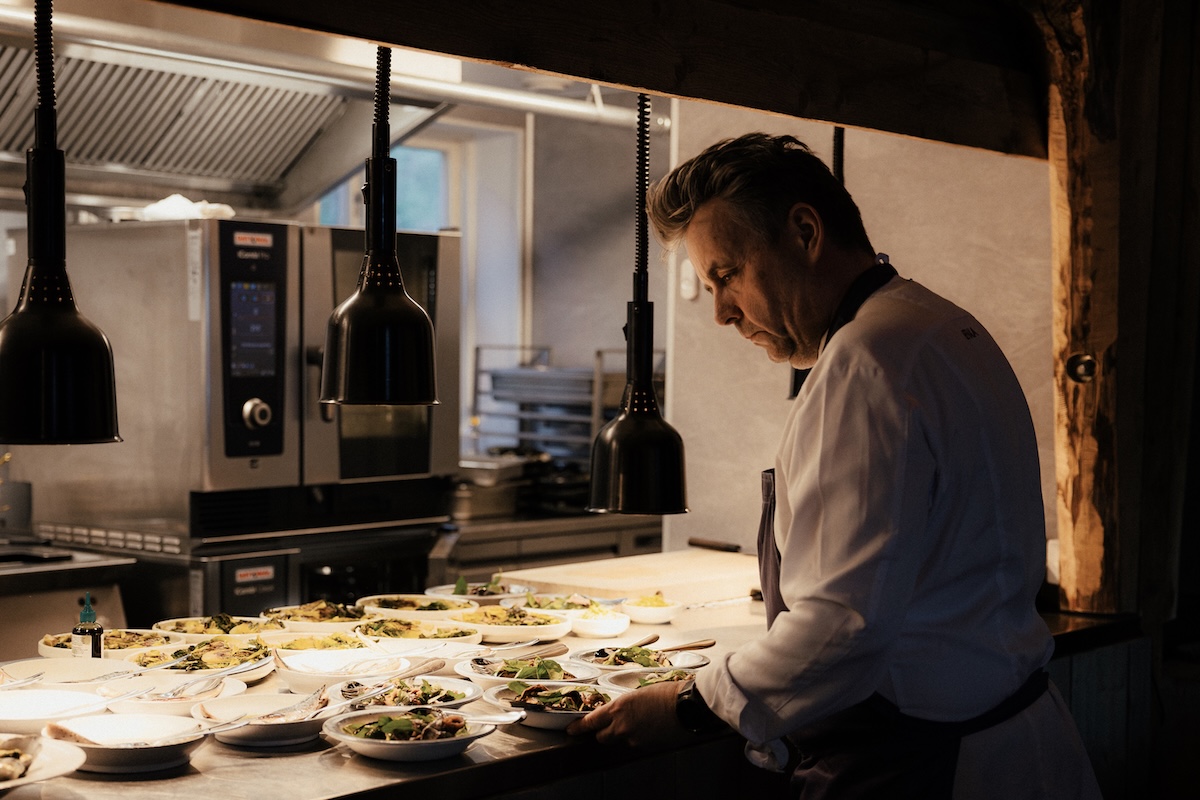
This is why RE-NAA resists simple labels. It wasn’t part of the early New Nordic movement in an official sense, but the commitment to place has always been there, as old as the stones that built this city. What evolved wasn’t ideology but a method to present dishes that look simple because the complexity lives in layers guests don’t see, the way an iceberg hides most of its mass beneath dark water.
Even the room reflects this philosophy. Much of the furniture and pottery comes from local makers, from hands that know this wood and this clay. The builders were from the area, men who understand how structures must stand against wind. These aren’t choices made for branding purposes; they’re choices made because community matters when winter comes, and the restaurant was built to belong to this place the way a tree belongs to the soil that feeds it.
A Preference for Depth Over Comfort
When Sven Erik talks about flavor, he speaks with directness. He loves acidity and bitterness, the sharp edges that wake the palate. He doesn’t want sweetness to resolve a dish too easily, even in desserts. What interests him is dimensions that reveal themselves gradually rather than all at once. He’s also suspicious of decoration without purpose. Visual complication doesn’t interest him.
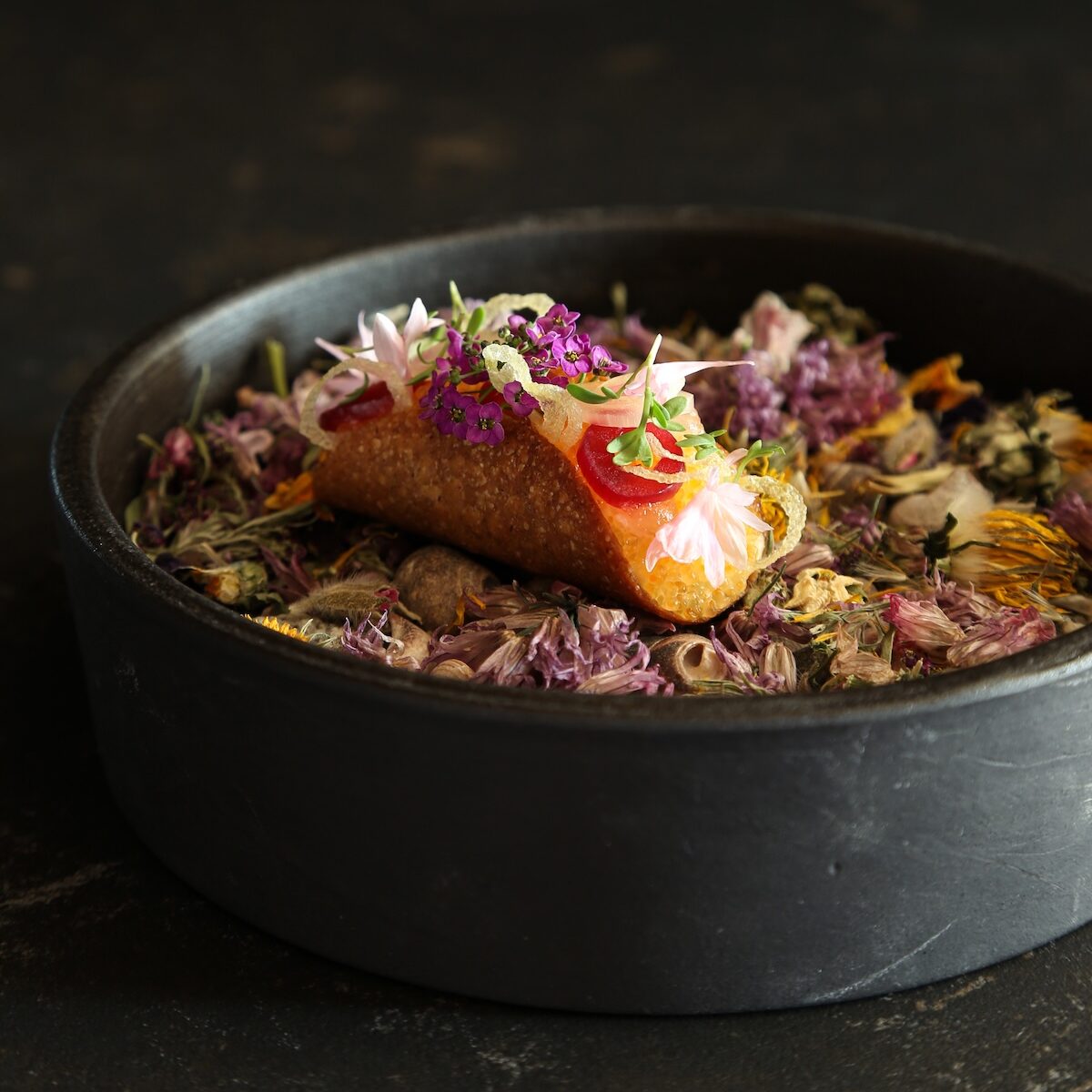
This directness defines the cooking at RE-NAA. Dishes that appear almost spare but taste as though they contain volumes of work, generations of knowledge. A scallop or langoustine might look straightforward on the plate, but the recipe can stretch across multiple pages. You don’t see the architecture but you can taste it the way you can taste the sea in the air even when you can’t see the water.
Over time, he found a description more accurate than any movement or trend: a coastal kitchen. Not just what’s visible from the window, but what Norway’s cold, merciless coast offers broadly: the sea with its moods and its violence, the shore where elements meet and fight, the fjords that hide their depths, and everything that demands preservation, patience, and careful attention simply to survive.
The Journey Through Light and Shadow
The tasting menu at RE-NAA moves with the inevitability of weather rolling in from the sea, always forward, shaped by what the season offers and what can be pulled from cold earth and colder water.
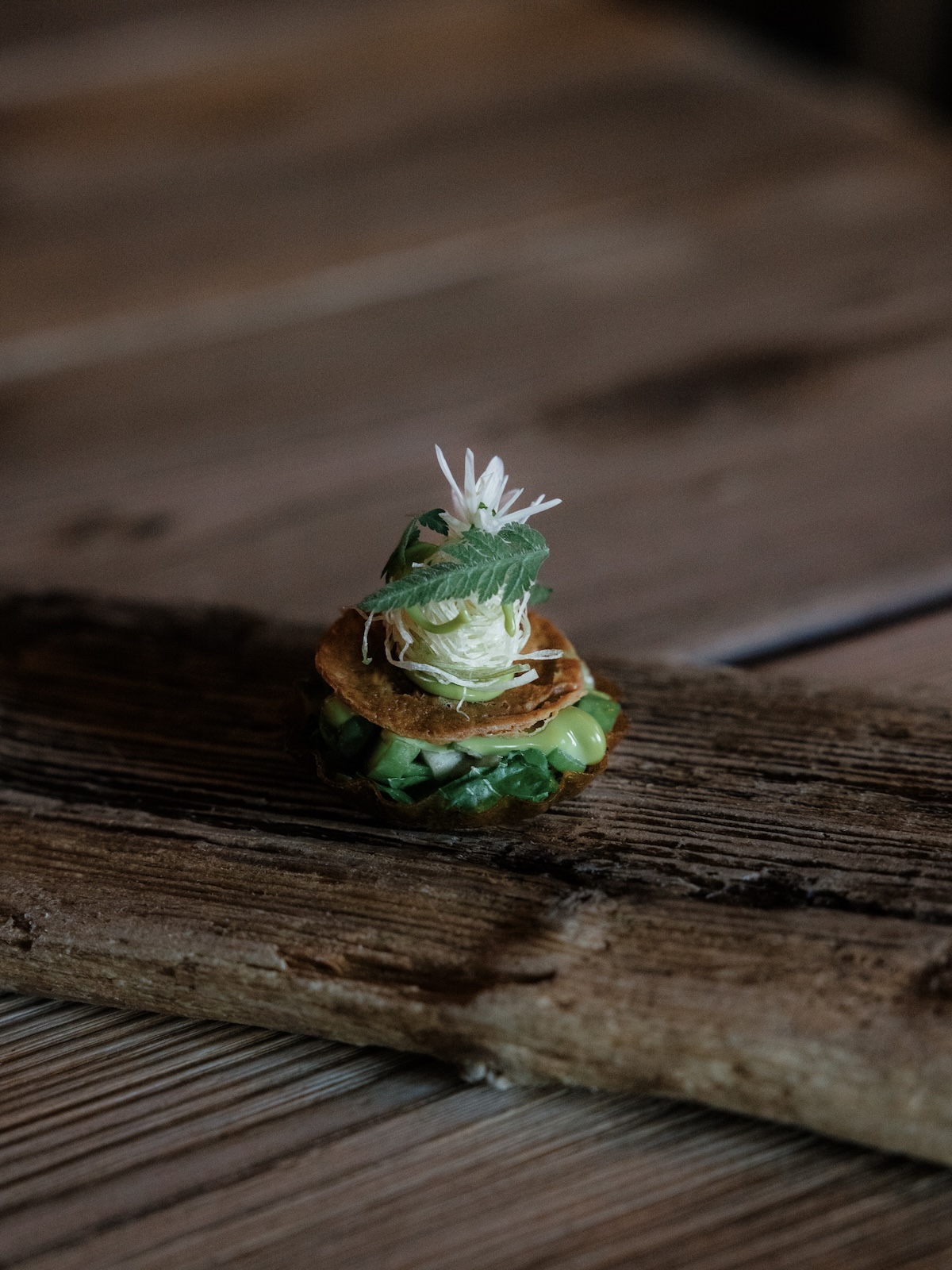
It begins with clean flavors that bring on light. Fermented wild trout appears with potato and Kalix eggs or løyrom, delicate and bright like first light after weeks of gray. Lobster arrives in a small tartelette, lifted by young ginger and yuzu, warmth against the chill. Smoked daikon is sharpened with tarragon and ponzu, each element precise as a blade. Reindeer tartare is cut with the forest’s offerings, elderberries and chanterelle, wild and lean, tasting of the deep woods where light barely reaches.
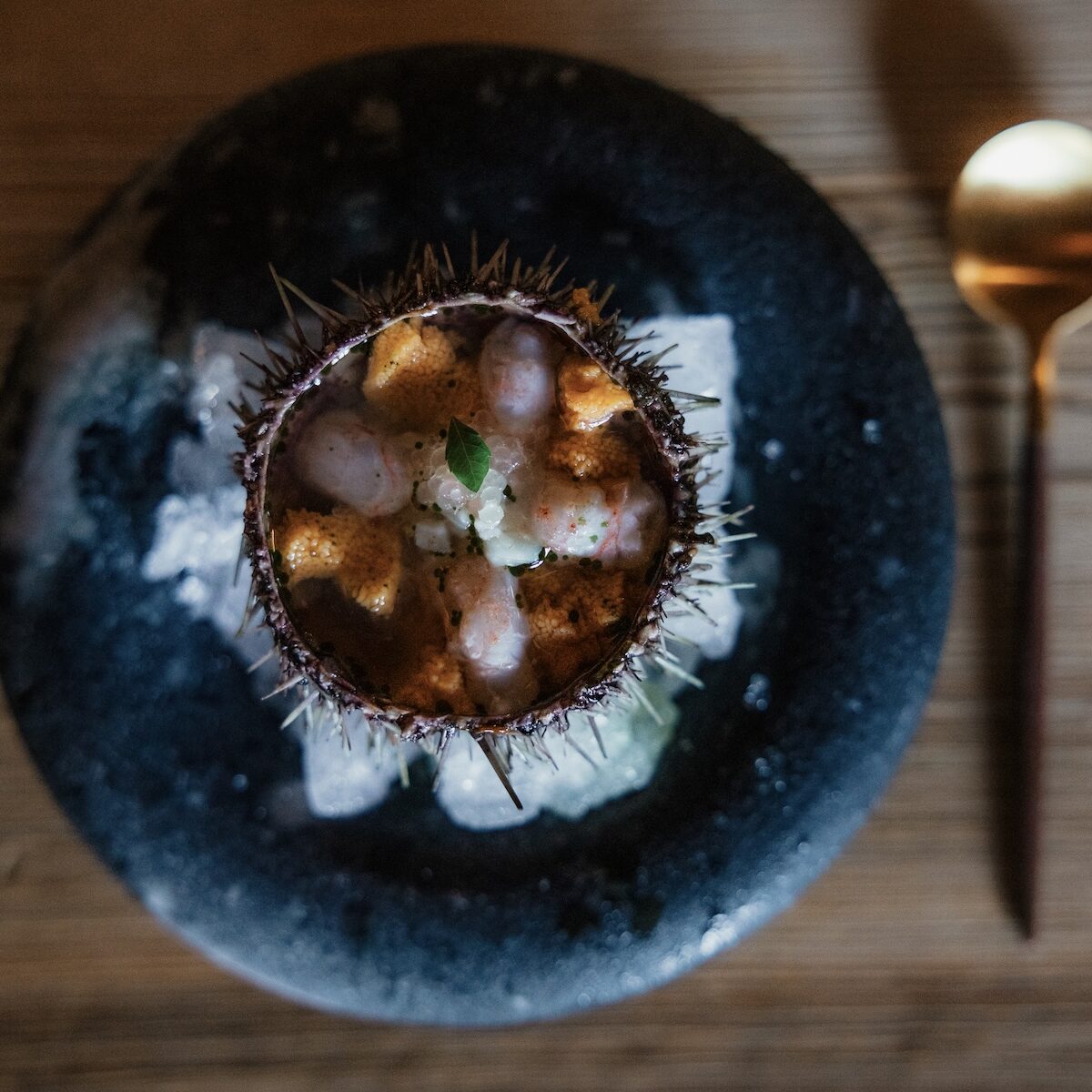
Then the coast asserts itself with the force it always has. Sea urchin from the Norwegian coastline meets verbena and green strawberries, its marine richness brought into sharp focus, tasting of depths and salt spray. Clams arrive in various forms, each one a small story of survival: mahogany clam woven through fermented tomato and wild garlic, carpet clam brightened by black currant’s sharp sweetness. Mussel escabeche provides a briny, sour pause, acidic as winter rain, before razor clam turns richer with almond, fig leaf oil, and RE-NAA’s own caviar, luxury pulled from these unforgiving waters.
As the meal progresses, warmth enters like spring, finally breaking winter’s grip. Bluefin tuna with kaffir lime and Japanese quince. Grilled scallop with barley and pine, smoke and earth. Lobster from Kvitsøy is given a spicy edge by jalapeño. Between the waves of seafood, there’s grounding: emmer sourdough bread with butter, simple and ancient, then heartier preparations like monkfish with mushroom and birch —the forest and the sea meeting on the plate— and grilled reindeer from Røros with sweet koji, strength and tenderness in balance.
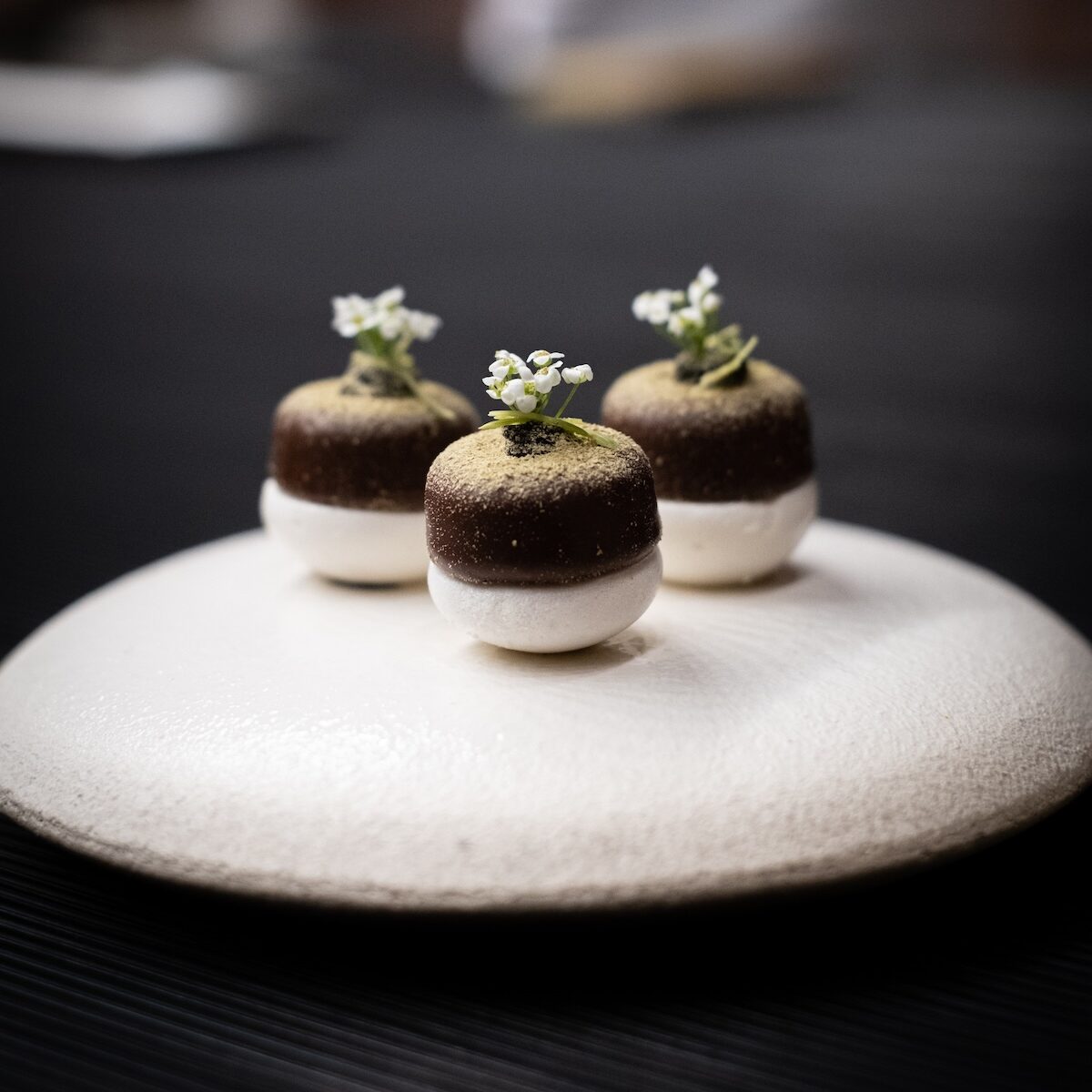
Two dishes stand out, not just for their flavors but for what they reveal about the people behind them.
The first is called simply the Macaron, though it upends every expectation that name carries. Duck liver mousse is dipped in dark chocolate, placed on a pine-water meringue, and finished with preserved spruce. It tastes like the forest distilled into a single bite, dark and surprising, sweet and savory dancing around each other like the endless dance between light and shadow in these latitudes.
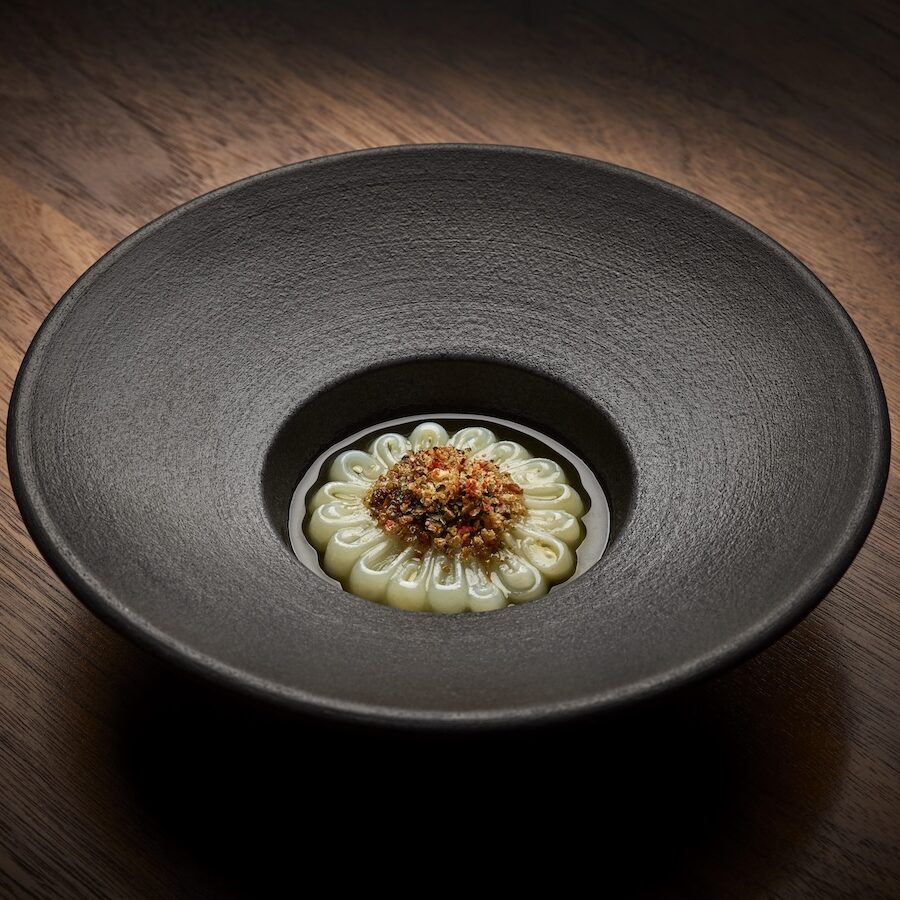
The second is the Squid, which Sven Erik calls “pasta without pasta,” and in that simple phrase lies a world of reinvention. The squid is shaped into a rosette and served with fermented-and-grilled lemon, black garlic, browned squid butter, and toasted sourdough crumbs. Meticulous and playful, this dish makes something intricate look effortless but, most importantly, it pays tribute to Sven Erik’s Italian father, a man from the south who felt for a woman from the north, their union another kind of light against darkness.
The ending stays clean rather than heavy. Citrus, sea buckthorn, ginger, and pinecone notes arrive in sequence, bright spots in the gathering dark, followed by petit fours and a cardamom bun that closes the meal with exotic warmth.
Drinks as Journey
The beverage program at RE-NAA follows the same principles as the kitchen: courage, curiosity, and an unwillingness to play it safe. Torill describes the focus as showcasing winemakers who are just beginning to be noticed, who are fighting their own battles against convention. This means small productions and unexpected names, therefore a constant adventure.
Two pairing options exist, like two paths through the same forest. Fine & Classic offers benchmark bottles from established regions: Chablis, German Riesling, Bordeaux, and older sweet wines.
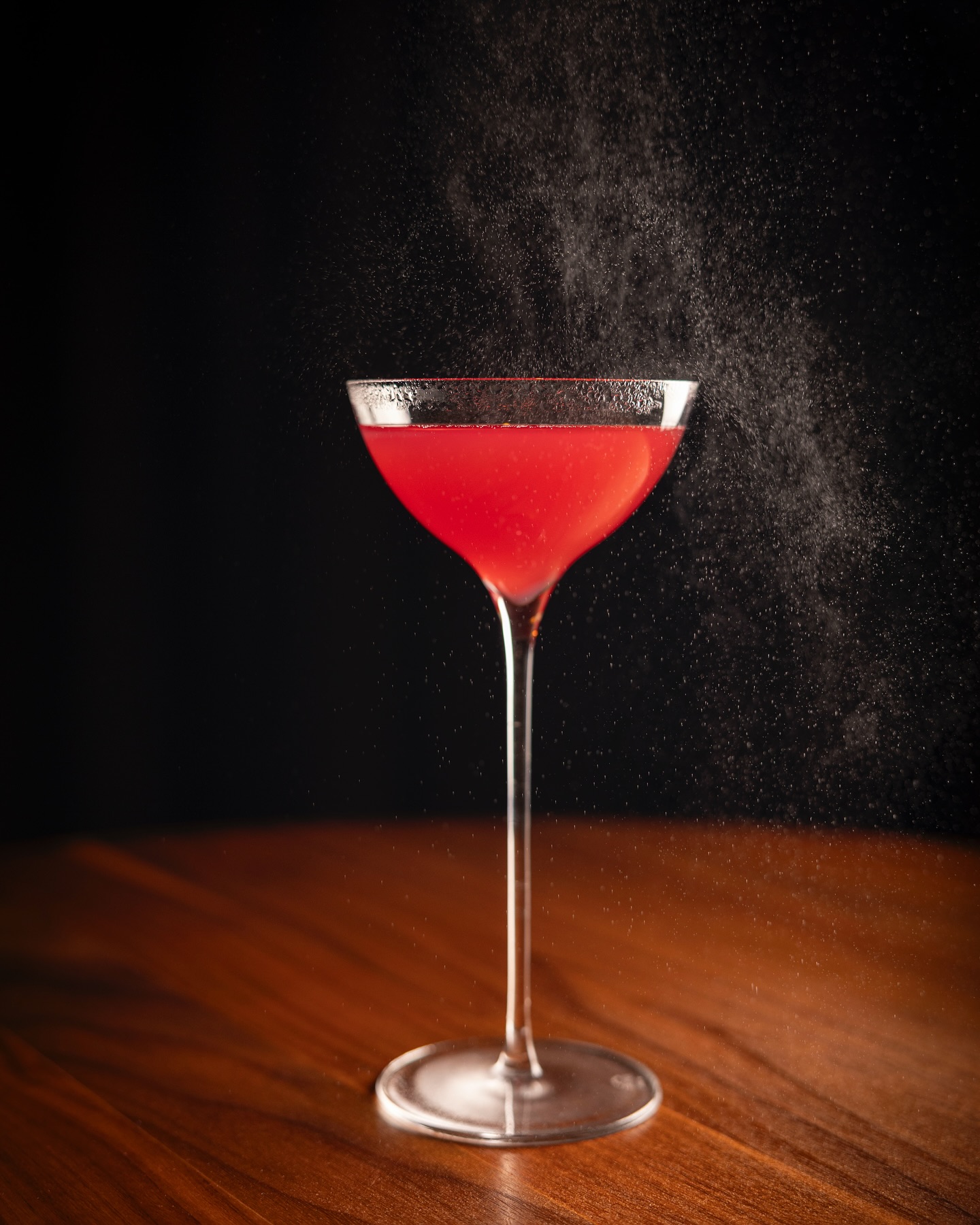
Unique & Honest takes the path less traveled, featuring lesser-known grapes, alpine whites, South African discoveries, and PX finish that keeps the palate engaged.
In recent years, RE-NAA’s magnificent front of house has devoted considerable energy to the non-alcoholic pairing. It’s no longer, as Torill says, “just juices or sweets,” but something built from vegetables, fruits, kombuchas, and light fermentations. The impact on the restaurant has been significant. It has opened doors to a more conscious enjoyment.
A Restaurant That Remains Playful
“Playful” describes something essential about RE-NAA, though not in the way you might expect. It’s not about theatricality or decoration. It’s a tool for keeping the experience human, for preventing the stiffness that can creep into places that take themselves too seriously, for remembering that even in the darkest winters, there must be music and laughter or we lose ourselves entirely.
The couple’s favorite example is funky, to say the least: in the toilets, they only play Prince. It’s a small gesture, but it clarifies their entire approach. The dining room can be choreographed with precision, the cooking must be precise, but the mood must stay approachable. Life is already hard enough.
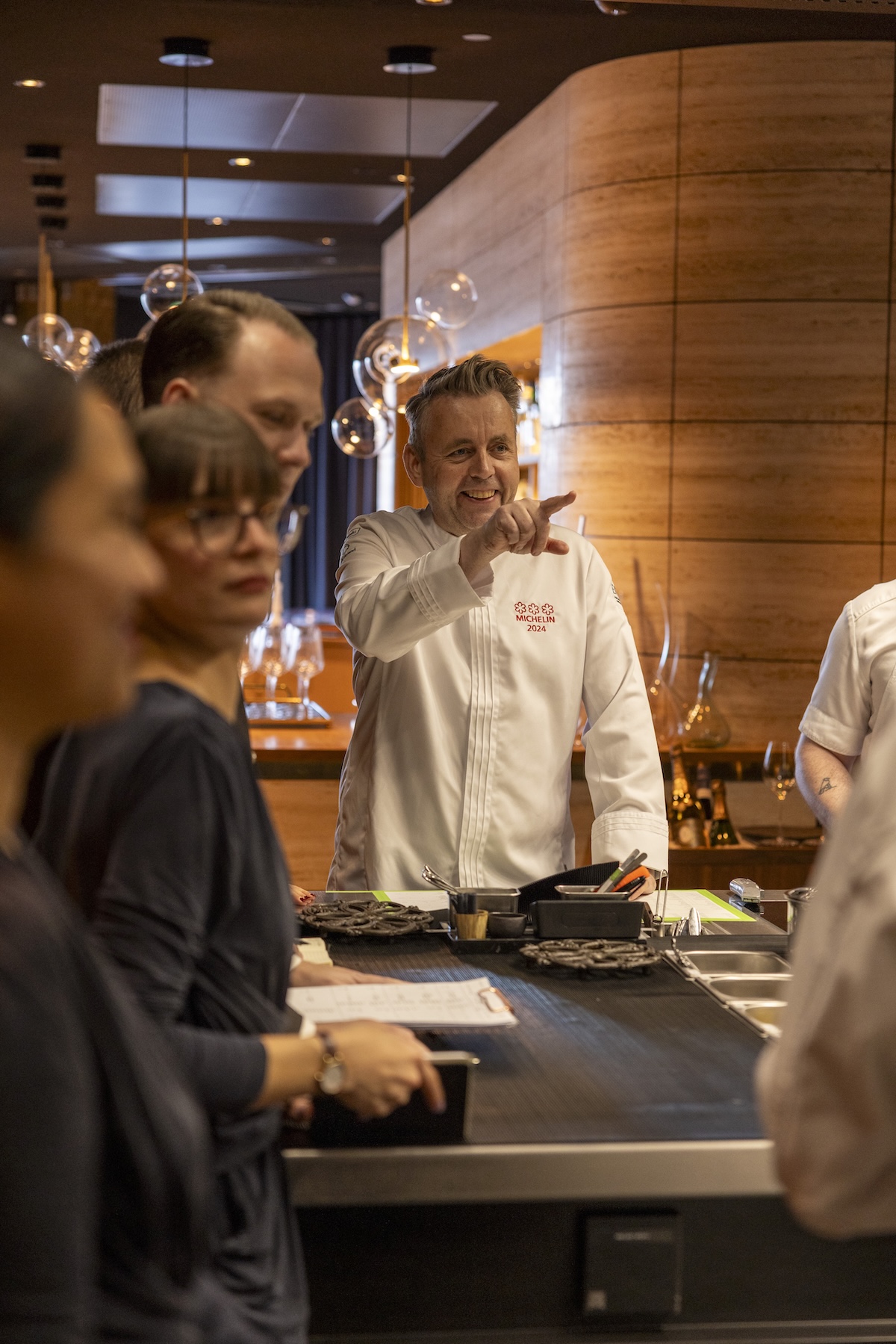
When asked what he hopes guests will say as they leave, Sven Erik doesn’t offer a prepared line. He mentions the only question that truly matters: “When can we come back?”
Then he expands on the thought. They want guests to feel they’ve had one of the best evenings of their lives because it was genuinely cared for, because they were held warm for a few hours in a place where everything outside might be harsh and cold and unforgiving.
RE-NAA doesn’t fight against Stavanger’s windy weather. It answers with craft and warmth built on discipline, with love made visible through food and service, with light that pushes back against the void.
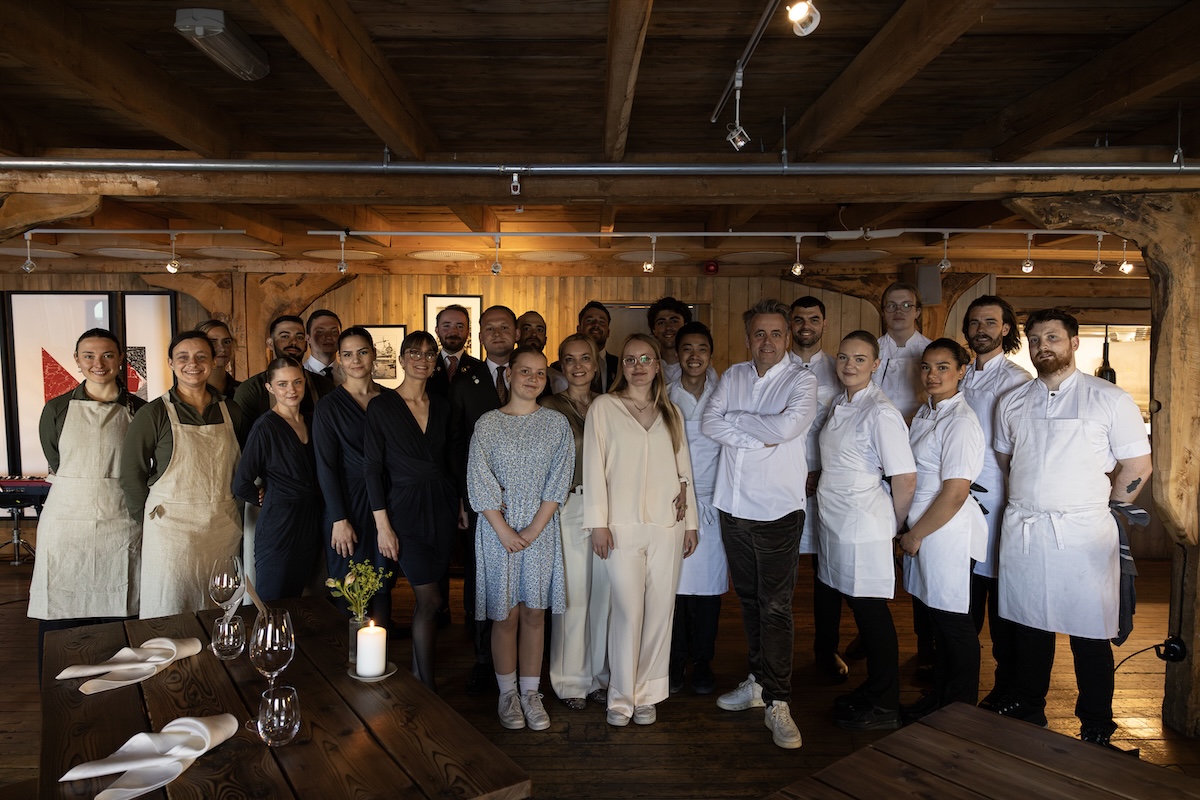
A small-city restaurant with reach beyond its geography, run by a partnership that understands the ancient sequence: learn the foundations first, then earn the freedom to explore. Sven Erik cooks with influences from everywhere he’s traveled. Torill brings the world to guests through hospitality that makes strangers feel like family unexpected bottles and fermented drinks.
What can you say about people who live where the North Sea meets the mountains, where winter darkness lasts for months, where survival has never been guaranteed? They have the strength and perseverance of the Vikings who came before them, who built boats and crossed impossible waters, who refused to be broken by cold or storm or the weight of endless night. And it’s this strength and perseverance, this refusal to surrender, that allows RE-NAA’s light to find its way through the cracks of ice and fjords, warming all who are brave enough to seek it out.
RE-NAA
Nordbøgata 8, 4006 Stavanger, Norway
www.restaurantrenaa.no
The post Where Vikings Sailed: RE-NAA, Stavanger’s Three-Michelin-Star Coastal Cuisine appeared first on Honest Cooking and Travel.