
Instructions (Seated Rear Delt Fly)
- While holding a dumbbell in each hand, sit on the edge of a bench and position your feet together on the floor.
- Bend forward at the hips so that your torso is as close to parallel to the floor as possible and your chest is almost touching your knees.
- Allow your arms to hang straight down with a slight bend in your elbows. Your palms should be facing each other and the dumbbells should be next to your ankles.
- Push your shoulders as far forward as they’ll go (think about rounding your shoulders toward the floor—this will feel a little awkward).
- Keeping your shoulders shifted forward, extend your arms out in an arc toward the ceiling with your palms facing the floor.
- Keep raising the dumbbells only until you feel your shoulder blades trying to move backward and your arms are roughly parallel to the floor.
- Reverse the movement to return the dumbbells to their starting position.
Instructions (Standing Rear Delt Fly)
- Holding a dumbbell in each hand, stand with your feet about shoulder-width apart.
- Keeping your back straight, lean forward by hinging at your hips and letting your knees bend slightly, just as you would for a deadlift. Your torso should be close to parallel with the floor.
- Allow your arms to hang down with a slight bend in your elbows. Your palms should be facing each other and the dumbbells should be at about the height of your mid-shin.
- Push your shoulders as far forward as they’ll go (think about rounding your shoulders toward the floor—this will feel a little awkward).
- Keep raising the dumbbells only until you feel your shoulder blades trying to move backward and your arms are roughly parallel to the floor.
- Reverse the movement to return the dumbbells to their starting position.
Expert Tips
- Keep your shoulder blades pushed down toward the floor throughout each rep. Don’t pinch your shoulder blades together when you raise the dumbbells. This forces your rear delts to do all of the work and prevents the exercise from turning into a trap exercise. This will slightly reduce how high you can raise the dumbbells, and the exercise may feel a little less effective, but this is better for isolating the rear delts.
- Keep your torso as still as possible throughout each rep. If you find yourself heaving your upper body up at the top of each rep, you’re using too much weight. Don’t expect to use heavy dumbbells for this exercise—quality beats quantity.
- Lower the dumbbells under control, and stop each rep before your arms are completely straight. This keeps tension on your rear delts throughout the entire rep.
Mike’s Take
The dumbbell rear lateral raise goes by many names, including the . . .
- Bent-over rear delt fly
- Rear lateral raise
- Dumbbell rear delt fly
- Rear delt dumbbell fly
- DB rear lateral raise
While many people think these refer to different rear lateral raise variations, they’re all names for the same exercise.
I prefer the name “dumbbell rear lateral raise,” as it’s arguably the most anatomically correct, but most people refer to it as the “dumbbell rear delt fly.”
The dumbbell rear delt fly is one of the few exercises that’s effective for targeting your rear (posterior) deltoids, which aren’t trained very well by most compound exercises. The rear deltoids are the smallest part of your shoulder muscles, but you don’t want to neglect them entirely, and this is my go-to exercise for training them.
Research shows that exercises that closely mimic the dumbbell rear delt fly such as the rear delt fly machine activate the rear delts to a high degree, and possibly more so than compound exercises like the lat pulldown and barbell row.
This doesn’t necessarily mean they’re better for building muscle (high muscle activation doesn’t always mean more muscle growth), but it’s a sign they’re an effective exercise for training the rear delts.
The two most common ways to perform the rear delt fly are:
- While sitting on a bench, which is known as the seated rear lateral raise
- While standing and bent over at the waist, which is known as the bent-over rear lateral raise
Both exercises are equally effective at training the rear delts, but most people find performing the dumbbell rear delt fly seated more comfortable, which is why I typically recommend it over the bent-over rear lateral raise and why it’s the variation I include in my programs Bigger Leaner Stronger for men and Thinner Leaner Stronger for women.
That said, which version you use comes down to personal preference, and I like to alternate between the two roughly every eight weeks or so. You can do the same or just stick with whichever is more comfortable.
Another good variation of this exercise is to perform it while lying chest-down on an incline bench set to about 30 degrees. This makes it impossible to use momentum to cheat and doesn’t require you to tense your low-back muscles like you do when standing or seated. You can also do a standing version of this, where you bend over at the waist and rest your chest against a bench.
I typically program the rear delt fly for 3 sets of 6–8 reps (for men) or 8–10 reps (for women) with 1–2 minutes rest, taking each set 1–2 reps shy of failure. Once your form is dialed in, you can also safely take this exercise to failure.
Note: Women don’t need to use a different rep range than men, but many women new to weightlifting prefer slightly higher reps, and both rep ranges are equally effective for building muscle.
Dumbbell Rear Delt Fly Alternatives
- Machine Rear Delt Fly, also called the reverse fly or reverse pec deck. This requires almost no balance or coordination and keeps constant tension on your rear delts throughout each rep. This is my all-time favorite rear delt exercise.
- One-Arm Bent-Over Cable Rear Delt Fly. This is another good alternative. You perform it like a cable lateral raise, except you bend over at the waist with your torso parallel to the floor to turn it into a rear delt fly.
- Prone Incline Dumbbell Rear Delt Fly. Lie face down on an incline bench set to about 30 degrees. This makes it much harder to cheat and prevents your low-back from becoming a limiting factor.
- Cable Face Pull. This trains your rear delts and rotator cuff muscles. Great for shoulder health, but hard to progress over time.
- Barbell Rear Delt Row. This is a great compound exercise for training your upper back and arms, including your rear delts. The downside is that it doesn’t isolate your rear delts as effectively as the dumbbell rear delt fly.
- Dumbbell Rear Delt Row. Same as the barbell rear delt row, but with dumbbells.
- Band Pull-Apart. Not ideal for training your rear delts, but better than nothing if you don’t have machines, barbells, or dumbbells.
- More rear delt exercises.
3 Dumbbell Rear Delt Fly Workouts
Here are three sample workouts that show how to program the dumbbell rear delt fly, whether you train it on a dedicated shoulder day, a pull day, or at home with nothing but dumbbells. In every case it goes last, after your other exercises.
Shoulder Workout with Dumbbell Rear Delt Fly
Seated Dumbbell Overhead Press: 3 sets | 4–6 reps | 2–3 min rest
Dumbbell Lateral Raise: 3 sets | 8–10 reps | 1–2 min rest
EZ-Bar Upright Row: 3 sets | 8–10 reps | 1–2 min rest
Dumbbell Rear Delt Fly: 3 sets | 8–10 reps | 1–2 min rest
The seated dumbbell overhead press goes first because it’s the most technically demanding and involves the heaviest weights. It primarily trains your front and side delts and triceps. The dumbbell lateral raise and EZ-bar upright row train your side delts, and then the dumbbell rear delt fly hits your rear delts.
Pull Workout with Dumbbell Rear Delt Fly
Barbell Deadlift: 3 sets | 4–6 reps | 2–3 min rest
Lat Pulldown: 3 sets | 6–8 reps | 2–3 min rest
Seated Cable Row: 3 sets | 6–8 reps | 2–3 min rest
Dumbbell Rear Delt Fly: 3 sets | 8–10 reps | 1–2 min rest
This is a good option if you follow a push pull legs routine. Your rear delts already get some work from the horizontal pulling exercises, so it’s often wise to train them on your pull days.
Here the barbell deadlift trains almost all of the muscles along the back side of your body, including your rear delts (isometrically). The lat pulldown and seated cable row hit your lats, biceps, and rear delts (and traps, if you perform them correctly). And the dumbbell rear delt fly rounds out the workout by specifically targeting your rear delts.
Dumbbell-Only Workout with Rear Delt Fly
Seated Dumbbell Overhead Press: 3 sets | 4–6 reps | 2–3 min rest
One-Arm Dumbbell Row: 3 sets | 6–8 reps | 2–3 min rest
Dumbbell Lateral Raise: 3 sets | 8–10 reps | 1–2 min rest
Dumbbell Rear Delt Fly: 3 sets | 8–10 reps | 1–2 min rest
If you don’t have a barbell or machines (such as when you’re training at home or traveling), this workout covers all three heads of your shoulders plus your upper back with nothing but a pair of dumbbells and a bench.
The seated dumbbell overhead press trains your front and side delts and triceps. The one-arm dumbbell row trains your traps, lats, biceps, and rear delts. The dumbbell lateral raise trains your side delts. And the dumbbell rear delt fly hits your rear delts.
The honest caveat: a fixed set of dumbbells is fine for getting started and reaching a moderate level of strength and muscularity, but it isn’t ideal for progressing long-term.
Once you can press the heaviest dumbbells you own for 8 reps, the limiting factor is the equipment, not your training.
To progress any of these workouts, use double progression: work within the given rep range, and once you hit the top of the range for all of your sets, add weight.
Muscles Worked by the Dumbbell Rear Delt Fly
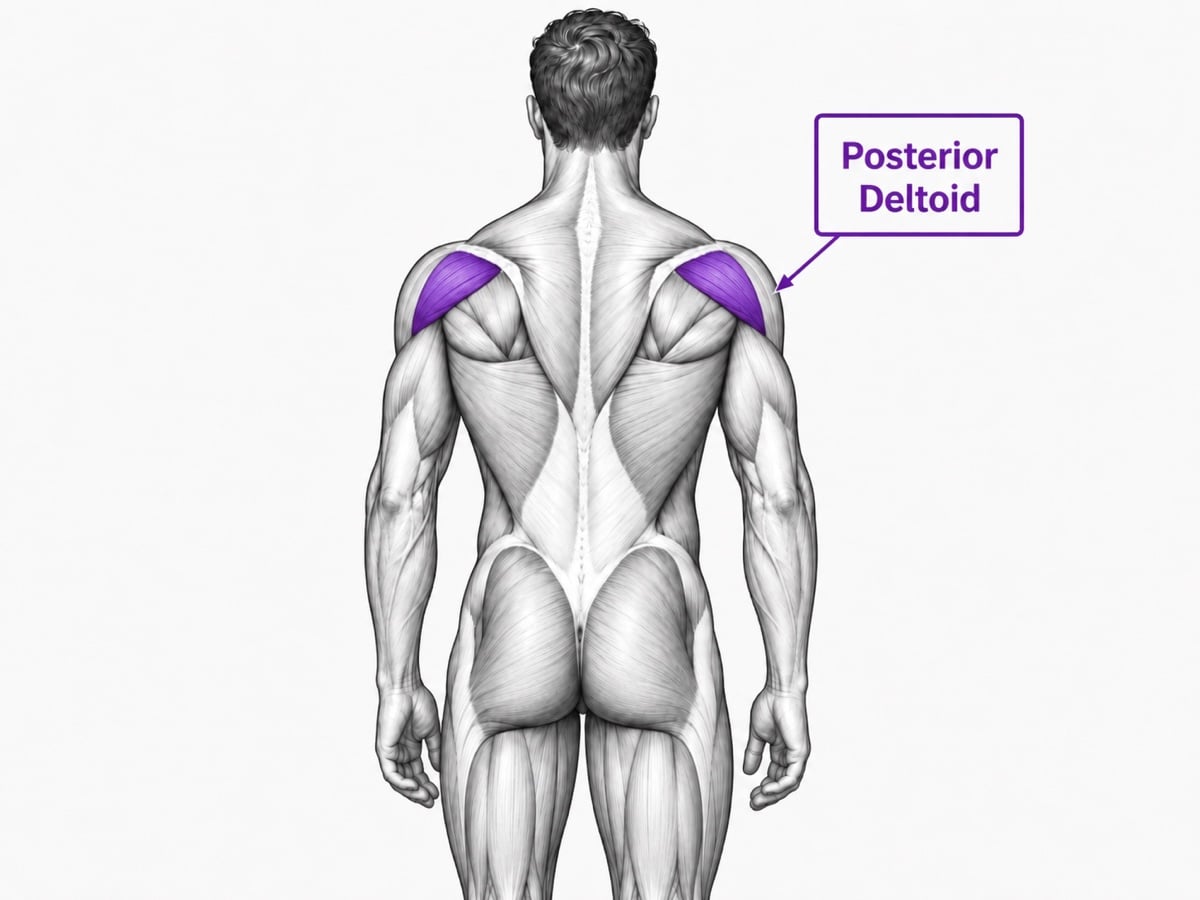
The main muscles worked by the dumbbell rear delt fly are the . . .
- Rear deltoids
- Trapezius (the diamond-shaped muscle across your upper back and neck)
- Rhomboids (the small muscles between your shoulder blades)
- Infraspinatus (a rotator cuff muscle on the back of your shoulder blade)
- Teres major and minor (two small muscles running from your shoulder blade to your upper arm)
Every muscle on that list besides the rear delts is bigger and stronger than the rear delts, sits right next to them, and will happily take over the moment the weight gets heavy. This is why the rear delt fly is one of the few exercises where going lighter genuinely makes it work better.
Many weightlifters spend more time training their front and side delts with pushing exercises than they do training their rear delts with pulling exercises.
Over time this can cause a strength and size imbalance between your rear delts and your front and side delts, which may increase your risk of injury.
More Shoulder and Rear Delt Exercises