

There was a saying in medieval alchemy, in sterquiliniis invenitur, that roughly translates to “in filth it will be found.”
Carl Jung later expounded on this, explaining that what we most want to find in our lives will be found in the places where we least want to look.
How true this is in fitness.
Only in the “filth” of energy balance, macronutrient balance, progressive overload, patience, and consistency—unsexy, unpalatable subjects that many want to avoid—will you discover the “fitness secrets of the super-fit.”
So it is with most everything in life. Only in the filth of all the things that are difficult, complicated, uncomfortable, unexciting, and exhausting are the true gems found. Often, this is nothing grander than detail—the small, exacting, easily skipped work that others overlook or can’t be bothered to do.
George Lucas understood this. In The Star Wars Archives, he described how an obsession with the smallest details let him create not just a movie to watch but an alternate reality to enter:
One thing I learned from Kurosawa is to try and instill an immaculate reality, an attention to detail that makes it real. Whether you’ve got dust or a rattling thing on the side of the ship, that adds another little element to it that keeps it looking real. What that does is say, “You believe where you are, no matter where you are.” I think I accomplished that. People think our places are real. There’s never a sense of, “Oh, I’m watching a science fiction movie.”
And that’s why Lucas carefully created every object in every frame of his iconic movies—every character, creature, costume, fork, napkin, tray, fixture, gun, chair, gadget . . . everything.
This is one of the simple secrets to greatness:
Pouring more of yourself into it than everyone else. Scrutinizing every feature. Attending to every detail. Polishing every inch. There are no weird tricks, no hacks, no shortcuts. There’s only the work.
This is why Steve Jobs made sure even the inside of his products were beautifully designed even though his customers would never see them.
This is why Napoleon pored over maps to meticulously plan his campaigns down to the smallest topographical elements.
This is why Michelangelo said that you must take “infinite pains” if you are “to make something that looks effortless.”
Sometimes there just isn’t an easier way to get what you want. Sometimes you just have to struggle. Sometimes it just takes what it takes.
You May Also Like
You don’t need supplements to build muscle, lose fat, and get healthy. But the right ones can help.
Take our 60-second quiz now to learn which supplements can help you achieve your fitness goals faster.
Sending…
Your free stuff is on the way!
Follow the Diet Plan that Helped Nikita Lose 15 Pounds in 3 Months
“I never thought getting in shape would be this simple! Everything just WORKS when you follow this plan.” And if he can do it, why not you?
Wait!
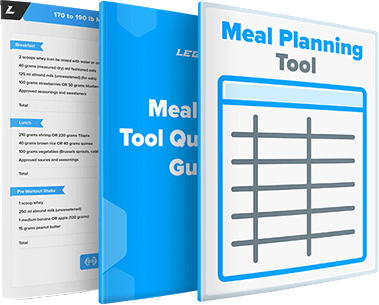
Want a Free Custom Meal Planning Tool?
Quickly calculate your calories, macros, and micros for losing fat, building muscle, and staying healthy.
Not happy with your purchase?
Simply let us know, and you’ll get a full refund, no questions asked. And you don’t even need to return anything.
So that means you can say “yes” now and decide later.
Many companies use shipping and handling fees to increase their profit margins, but here at Legion, we hate profits, so our shipping is free!
Okay, so we do dig on profits, but we also go in for happy customers, and free shipping works like gangbusters. So, if it’s your first order and you live in the United States, your order ships free. And if you’re a returning customer, your order ships free when it’s over $80.
And if you’re not happy with your purchase?
Simply let us know, and you’ll get a full refund, no questions asked. And you don’t even need to return anything.
So that means you can say “yes” now and decide later.
Why the $199 minimum purchase amount for free shipping?
To quench our piggish lust for grubby profits in the eternal service of the dread lord Mammon?
Kind of. But not really. Because here’s the truth:
Single-item orders are so blasted expensive to ship that we make very little profit on them. And no profits make the bean counters lose their marbles.
But when you order just one more item, it only costs us a few dollars more to ship both of them to you. Add a third item, and it’s just a few more shekels to ship.
And that allows us to make a profit. Which keeps the bean counters happier than a hammer in a nail factory.
So, if it pleases your Grace, we humbly request your mercy and patronage notwithstanding the vexing free shipping minimum.
Why the $299 minimum purchase amount for free shipping?
To quench our piggish lust for grubby profits in the eternal service of the dread lord Mammon?
Kind of. But not really. Because here’s the truth:
Single-item orders are so blasted expensive to ship that we make very little profit on them. And no profits make the bean counters lose their marbles.
But when you order just one more item, it only costs us a few dollars more to ship both of them to you. Add a third item, and it’s just a few more shekels to ship.
And that allows us to make a profit. Which keeps the bean counters happier than a hammer in a nail factory.
So, if it pleases your Grace, we humbly request your mercy and patronage notwithstanding the vexing free shipping minimum.
Split your entire online purchase into 4 interest-free payments, over 6 weeks with no impact to your credit.

25%
today
25%
2 weeks
25%
4 weeks
25%
6 weeks

Shop and add items to your cart as normal!

Choose Sezzle at Checkout! You’ll be redirected to Sezzle to Sign Up or Log In
to complete your order.

Your order will be shipped out right away* and your payments will be split up
over 6 weeks.
*shipping times subject to merchant shipping policy
Shop directory. Reschedule payments. Plus more!
Waiver and Release of Liability
In consideration of the services and/or products offered by Legion Athletics, Inc. (“Legion”) including, but not limited to, nutrition plans, exercise routines and coaching, and in addition to the payment of any fee or charge:
I knowingly and voluntarily enter into this waiver and release of liability and hereby waive any and all rights, claims or causes of action of any kind whatsoever arising out of my use of Legion’s services and/or products, and I hereby release and hold harmless Legion and its consultants, officers, contractors, agents, owners and employees from any and all responsibility, liability, cost and expenses, including for injuries, damages or disorders (physical, metabolic, or otherwise), resulting from my use of Legion’s services and/or products.
I understand that fitness activities including, but not limited to, strength, flexibility, and cardiovascular exercise, with or without the use of equipment, are potentially hazardous activities that involve a risk of injury and even death, and I am voluntarily participating in these activities and using equipment and machinery with knowledge of the risks involved. I hereby agree to assume and accept any and all risks of injury or death related to said fitness activities.
I understand Legion’s services and products are not meant to treat or manage any health conditions or circumstances, and I acknowledge that Legion has recommended I obtain a healthcare provider’s approval for my use of Legion’s services and/or products, through regular physical examination(s) and/or consultation. I acknowledge that I have obtained my healthcare provider’s approval or have decided to use Legion’s services and/or products without such approval and hereby assume all responsibility for my use of said services and/or products.
I understand that results from using Legion’s products and/or services are not guaranteed, and I agree to not hold Legion liable for any outcomes or lack thereof.
OUT OF STOCK
Security Check
Please click the checkbox below. We apologize for the inconvenience.
Fact Checked
Our scientific review board of nutritionists, dietitians, molecular biologists, doctors, and other accredited experts is responsible for reviewing every article, podcast, and video we produce to ensure they’re evidence based, accurate, trustworthy, and current.
Thanks to their connections, credentials, and academic experience, this team of MDs, PhDs, and other professionals has access to a wealth of research published in the largest and most prestigious journals in the world.
This allows them to not only review individual studies but also analyze the overall weight of the evidence on any and all topics related to diet, exercise, supplementation, and more.
If you feel that any of our content is inaccurate, misleading, out-of-date, or anything less than factual, please let us know in the comments section of the article in question.
Evidence Based
We follow a detailed, rigorous, multi-step process to create content that meets the highest standards of clarity, practicality, and scientific integrity.
First, our research associates provide our editorial team with accurate, up-to-date, proven scientific evidence.
Then, our editorial team uses this research to draft articles and outlines for podcasts and videos.
Finally, our scientific review board reviews the content to ensure all key information and claims are backed by high-quality scientific research and explained simply and precisely.
If you feel that any of our content is inaccurate, misleading, out-of-date, or anything less than factual, please let us know in the comments section of the article in question.
Opens in a new tab.