
Ah, the Michelin star: It’s the Midas touch craved by any restaurateur who’s in the business for quality. Ever since the Michelin Guide — founded in 1900 by the Michelin tire company as a motorists’ travel guide — began giving out stars, they’ve become one of the most coveted stamps of recognition in the food business. So what’s the difference between a Michelin star and a nod — or “recommended” — and how big is the gap, on paper and in real life?
Many people automatically assume a restaurant’s presence in the Michelin Guide is equivalent to a star, but that is not always — and statistically, more likely than not — the case. The guide has several types of recognitions, and a Michelin recommendation, or “Selected,” is a greater honor than it may appear at first sight.
A Michelin star awards excellence in cooking through its well-known three-tier system. It’s the sort of award that can turn any restaurant into a local institution overnight, and it’s not something the Guide gives away lightly. A recommendation, on the other hand, signals that inspectors have deemed a restaurant’s quality high enough to make it into the guide, although its cooking has not yet been singled out in quite the same way as a star.
A Michelin star is the ultimate culinary status symbol
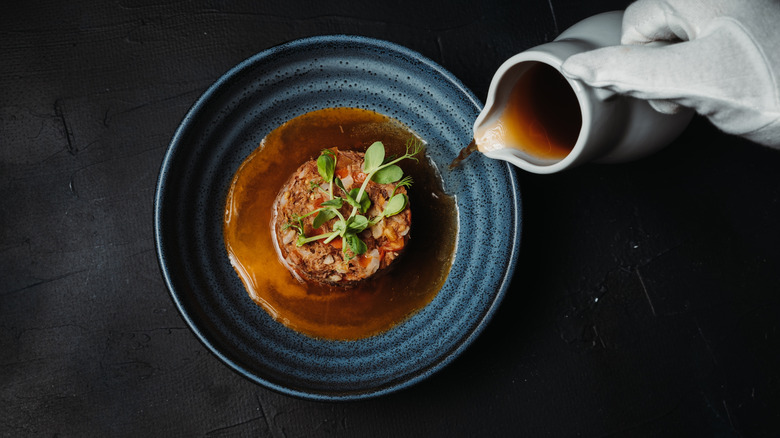
The restaurant industry’s equivalent of the Hollywood Walk of Fame, a Michelin star is just about the greatest accolade any dining establishment can receive — and if you hit the Holy Trinity, then you’re among only 161 restaurants in the world to have been conferred the honor. In the United States alone, for instance, only two hotels have three-starred restaurants.
The criteria for a Michelin star ultimately center on the quality and distinctiveness of the cooking. There are five criteria inspectors — who operate like secret Michelin spies — are on the lookout for: ingredient quality; flavor mastery and cooking technique; how the chef’s own personality comes through in the food; value for money; and consistency between visits. While Michelin stars are often associated with haute cuisine and fine dining, the specific decor, ambiance, or popularity of the restaurant is not what earns the accolade. Indeed, two street stands in Singapore formerly run by chef Chan Hon Meng had a star.
Many wonder what the different star levels signify, and each one has a meaning. One star denotes high-quality cooking; two, excellence that’s worth a dedicated visit; and three, an entire journey in itself. Owing to Michelin’s origins in the travel guide world, a star is not just a sign of gastronomic quality, but a signal that a place is worth visiting in its entirety.
A Michelin recommendation is a highly meaningful culinary honor

While a Michelin recommendation can confuse some diners — from being seen as interchangeable with a star to a distinctly lower-tier accolade — it is still highly meaningful. A Michelin recommendation means that inspectors have judged the establishment’s quality high enough to be recommended to restaurant-goers, although it might not yet have the brilliance required for a star or a Bib Gourmand, which the Michelin Guide has awarded since 1997 to restaurants offering exceptional quality at good value.
A recommendation is still no small feat. Michelin inspectors are known for their rigorous criteria, and they analyze restaurants with the same precision and attention as those conferred a star. There are some advantages to Michelin-recommended locales, too: They’re often more affordable — a Michelin star is often the fastest track to a price hike — and less internationally renowned, turning a reservation from an out-and-out war into a headache at worst.