
Watermelon is one of those amazing fruits that’s perfect for a large gathering or backyard barbecue because it’s so large. It can be transformed into a summer dish or sliced into triangles and passed around to feed dozens of guests, provided you pick a perfectly ripe one at the supermarket. But which kind should you purchase?
You’ve certainly seen a variety of watermelons at the grocery store. Some are seedless, some are smaller and rounder, and then there’s the standard big guy that’s usually dark green with lighter green stripes, often called a picnic watermelon. But there’s a less common variety, called the Black Diamond, that looks and tastes a bit different from the average fruit.
Although there are differing theories about how we came to the modern melon, the domesticated watermelon definitely traces its origins back to Africa. It appears that watermelons then moved into India and, ultimately, into Europe and the Americas, but there were a lot of changes along the way involving crossbreeding, and the Black Diamond is one of the most interesting specimens.
The heirloom Black Diamond is a flavorful giant
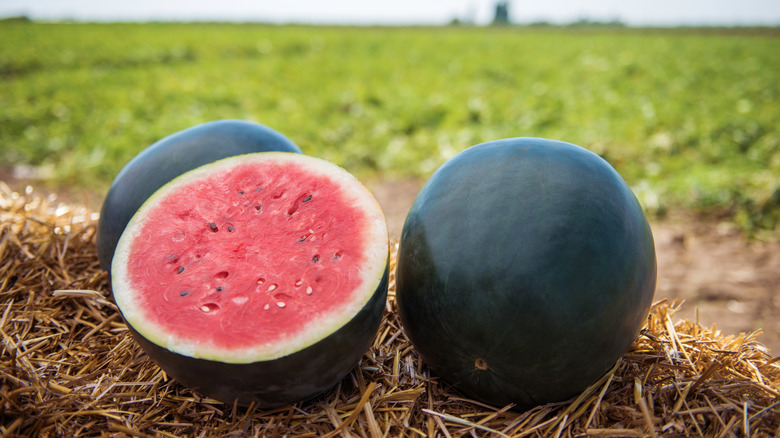
Black Diamond watermelons are known for their dark, thick rinds, which range from dark green to nearly black. They grow quite large, up to 50 pounds, so they can take a little longer to mature than the average watermelon. They have tough skin, can tolerate full sun, and are beloved for their bright red flesh. Black Diamond watermelons are an heirloom variety because their lineage can be traced, and because they are open-pollinated rather than hybridized. They were first developed by seed expert and botanist Melville Dillon in Arkansas in the 1940s. Because they’re an heirloom variety, their seeds can be saved to propagate a new crop the following year.
Beyond their massive size and color, Black Diamonds are loved for their incredibly sweet, juicy, and slightly denser flesh, which is crisp and crunchy with a bit of extra tanginess on the palate — they’d be unmatched muddled in a mezcal margarita or tossed in a refreshing mint and feta salad. However, if you want to get your hands on one, it can be a little tough. Seeds are widely available online, but buying the fruit fresh can be more difficult. They occasionally appear at Kroger and Meijer stores, but your best bet may be checking a local fruit stand or farmers market.
What’s the difference between Black Diamond and standard watermelons?
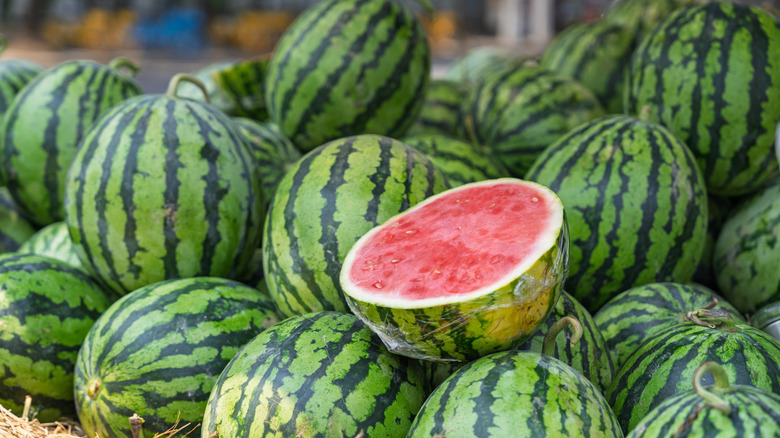
When it comes to what you may find at the supermarket, it turns out standard watermelons aren’t really that simple. They could be any number of varieties, and there are hundreds of genetically distinct watermelons grown in the Americas alone. Realistically, they are grouped into general types. Much of what you see at the grocery store consists of seedless varieties, which are loved, well, for their lack of seeds. They may still produce small white seeds, which are perfectly edible, but those are sterile — unlike the dark black ones that can be propagated — because the fruit is created by crossbreeding two genetically different plants.
Beyond the seedless varieties, perhaps the most common watermelons are the picnic varieties. These are the familiar large, oval-shaped fellas with stripes that generally weigh between 15 and 45 pounds. They are propagated naturally, so they still usually contain dark black or brown seeds. From there, there are minis, or personal watermelons, which are great for a smaller party, as well as varieties with yellow or red flesh that can bring a striking new element of color to the table. Overall, though, it can be difficult to distinguish exactly what the genetic makeup of any given watermelon may be at your local grocery store. But when you go with a Black Diamond, you’ll definitely know what you’re getting.