
Women should train their chest for four main reasons:
- It improves your body composition. If you’re dieting to lose weight, your body can lose either fat or muscle. By training your chest, you “force” your body to retain more muscle, which means a higher percentage of the weight you lose is fat rather than muscle mass.
- It helps build a balanced upper body. If you train your shoulders, arms, and back but neglect your chest, you can develop size imbalances that make your physique look lopsided.
- It can improve how your chest looks. Chest exercises don’t change breast tissue, but they can build the muscles underneath it, which may make your chest look a little firmer and more lifted.
- It makes everyday pushing movements easier. Stronger pecs help you perform countless day-to-day movements like getting up off the floor, rearranging furniture, catching yourself if you fall, and opening a heavy door.
Despite these benefits, many women skip chest training because they worry it will make their upper body bulky.
That isn’t true.
Your chest muscles are just like any other muscle group: training them makes them stronger and more developed, but it won’t change your physique overnight.
In fact, for most women, building oversized pecs would take highly deliberate effort: years of hard training, a sustained calorie surplus, and likely steroid use.
Another benefit of chest training many women overlook: most chest exercises also train your triceps.
That matters because many women want more defined, athletic-looking upper arms, and presses, push-ups, and dips are among the best exercises for building them.
Key Takeaways
- The best chest exercises for women are usually the simplest ones—compound movements like bench presses and push-ups that train your pecs through a full range of motion and are easy to progressively overload.
- Chest training won’t make you bulky. Building big pecs requires years of hard training, a calorie surplus, and deliberate effort—it doesn’t happen by accident.
- One dedicated chest workout per week is enough for most women, especially if your program already includes compound pressing movements on other days.
The 12 Best Chest Exercises for Women
The best chest exercises for women are usually compound movements that train your pecs through a full range of motion, allow you to progress in small increments over time, and are comfortable for you to perform.
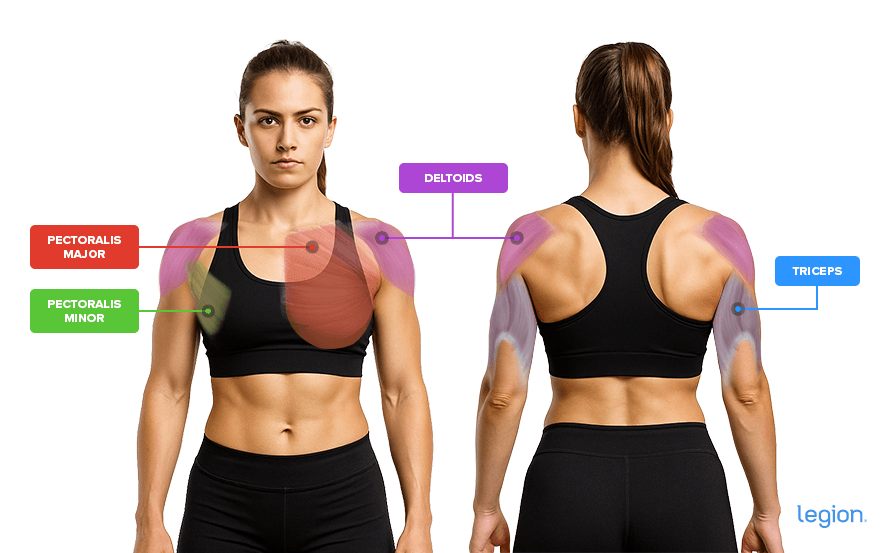
The chest has two main muscles: the pectoralis major and pectoralis minor.
The pectoralis major (“pec major”) spans your entire chest and moves your arm forward, upward, and across your body. The pectoralis minor (“pec minor”) sits underneath the pectoralis major, and it connects your ribs to your shoulder blade and helps move and stabilize the shoulder.
For all intents and purposes, you can ignore the pec minor. All chest exercises train both muscles more or less equally well, so there’s no point in trying to target it with particular exercises.
Here’s how the pec major looks, along with the other main muscles trained during a chest workout:
A quick word of warning: You’ll find countless influencers on social media pushing “special” chest exercise variations for women like the standing dumbbell squeeze press, Svend press, banded “breast lifter” flies, BOSU ball “instability” push-ups, around-the-worlds with 3-lb dumbbells, and more.
These may look cool, but they’re counterproductive.
These kinds of exercises don’t produce much in the way of mechanical tension and make it hard to add weight in consistent, small increments over time, both of which are essential for muscle growth. The technical term for this is progressive overload. Instead, you want to focus on exercises that are simple to perform, can be gradually loaded with more weight, and train as much muscle as possible in each rep.
The truth is you only need a few high-quality exercises to train your chest muscles effectively.
Below you’ll find a variety of bodyweight, barbell, dumbbell, and machine exercises that fit the bill. This way, you can pick and choose the right exercises for you based on what you have available and what suits your preferences.
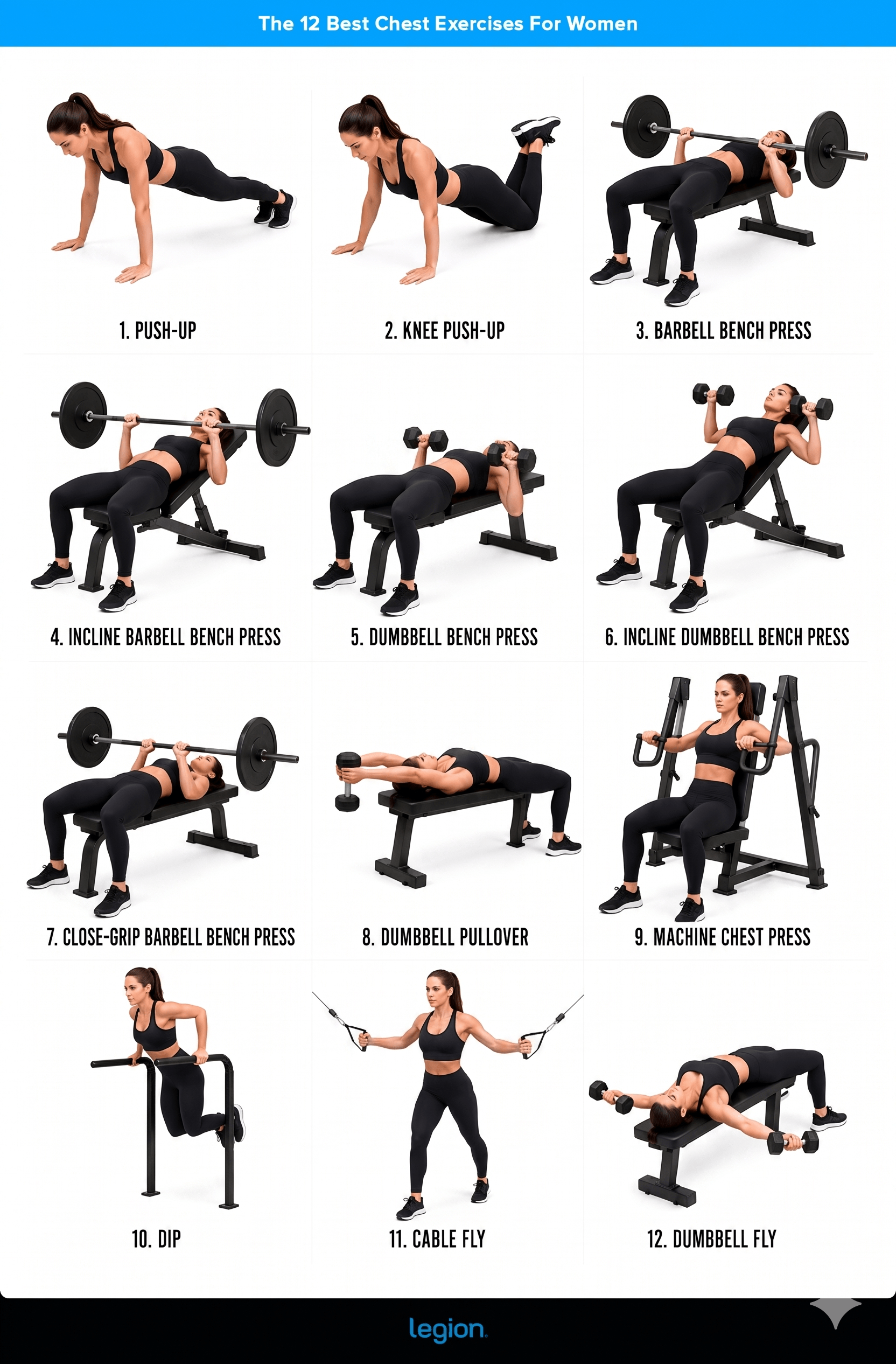
1. Push-up
The push-up is one of the best chest exercises for women because it trains your pecs through a full range of motion, requires no equipment, and is easy to make easier or harder. That makes it ideal for beginners and advanced lifters alike.
How to:
- Start in a high plank with your hands slightly wider than shoulder-width.
- Lower your chest toward the floor by bending your elbows.
- Push back up to return to the starting position.
Expert Tip: Brace your core to keep your body in a straight line from head to heels throughout the set. If your hips sag or rise, the exercise gets less efficient and harder to control.
READ MORE: How to Do the Push-up: Form, Variations, and Workouts
2. Knee Push-up
This variation is perfect for women who aren’t strong enough to perform more than 5-10 reps of the traditional push-up. Performing the push-up on your knees reduces the weight your upper body has to lift, making the exercise easier. Once you can do at least 10 reps of knee push-ups, you’re ready to do traditional push-ups.
How to:
- Get on all fours and place your hands slightly wider than shoulder-width apart.
- Walk your hands forward and allow your hips to drop until your body forms a straight line from your head to your knees.
- Lower your chest to the floor by bending your elbows.
- Push your body up and return to the starting position.
Expert Tip: Start with your toes on the floor for extra balance. Once you feel stronger, lift your feet so you’re balancing only on your knees to make the exercise more challenging.
3. Barbell Bench Press
The barbell bench press is one of the best chest exercises for women who want to gain strength quickly because it is more stable than dumbbell presses and usually lets you lift heavier weights. That makes progressive overload straightforward, which is exactly what you want for building bigger, stronger pecs.
How to:
- Lie on a bench and grab the bar with a slightly wider than shoulder-width grip.
- Pull your shoulder blades together and down and create a slight arch in your lower back.
- Unrack the bar and lower it to your mid-chest.
- Press the bar back to the starting position.
Expert Tip: Lower the bar under control and lightly touch your chest before pressing it back up. Letting the bar fall too quickly and bouncing it off your chest makes the exercise less effective and harder on your body.
READ MORE: The Definitive Guide on How to Bench Press (and the 8 Best Variations!)
4. Incline Barbell Bench Press
The incline barbell bench press combines the stability and loadability of a barbell with the upper-chest emphasis of an incline press. That makes it a great option for building strength and more fullness higher on your chest.
How to:
- Lie on an incline bench and grab the bar with a slightly wider than shoulder-width grip.
- Pull your shoulder blades together and down and create a slight arch in your lower back.
- Unrack the bar and lower it to your upper chest.
- Press the bar back to the starting position.
Expert Tip: To minimize strain on your shoulders, keep your elbows tucked about 6–8 inches from your ribcage, not flared straight out to the sides.
READ MORE: Incline Bench Press: A Definitive Guide to Incline Form & Set Up
5. Dumbbell Bench Press
The dumbbell bench press is one of the best overall chest exercises for women because it works each side of your body independently and allows you to position your shoulders and wrists in whatever way feels most comfortable to you. This makes it particularly helpful if you find the traditional bench press uncomfortable.
How to:
- Lie on a flat bench holding a dumbbell in each hand resting near your chest.
- Press the dumbbells up until your arms are straight.
- Reverse the movement and return to the starting position.
Expert Tip: Pinch your shoulder blades together and pull them down toward your butt for the entirety of each set. This gives you a more stable base and keeps your shoulders in a safer position.
READ MORE: How to Dumbbell Bench Press: Form, Benefits, and Variations
6. Incline Dumbbell Bench Press
The incline dumbbell bench press is one of the best ways to develop the upper portion of your chest. Like the flat dumbbell bench press, it trains your chest, shoulders, and triceps through a full range of motion and independently trains each side of your body.
How to:
- Set your bench to a low incline (about 30–45°).
- Hold a dumbbell in each hand and sit back on the bench with the weights resting near your chest.
- Press the dumbbells up until your arms are straight.
- Reverse the movement and return to the starting position.
Expert Tip: Use a low incline, usually around 30–45 degrees. Research shows this is high enough to emphasize the upper chest without turning the exercise into more of a shoulder press.
READ MORE: How to Do an Incline Dumbbell Press & Common Alternatives
7. Close-Grip Barbell Bench Press
The close-grip barbell bench press deserves a place in a women’s chest workout because it trains your chest while emphasizing your triceps more than a standard barbell bench press. That makes it especially useful for women who want to develop their pecs and triceps at the same time.
How to:
- Lie on a bench and grab the bar with a shoulder-width grip or slightly narrower.
- Pull your shoulder blades together and down and create a slight arch in your lower back.
- Unrack the bar and lower it to your mid-chest.
- Press the bar back to the starting position.
Expert Tip: Don’t grip the bar much narrower than shoulder-width. Going too narrow doesn’t train your triceps better, but it can make the exercise feel less stable and put more strain on your wrists.
8. Dumbbell Pullover
The dumbbell pullover trains your chest through a slightly different range of motion than most pressing exercises, which makes it a good alternative if other exercises have become boring or are bothering your joints.
How to:
- Lie on a bench and hold a dumbbell with both hands over your chest.
- Keeping a slight bend in your elbows, lower the dumbbell back over your head.
- Reverse the movement and return to the starting position.
Expert Tip: You can do the dumbbell pullover lying lengthwise on a bench or perpendicular to it. Try both to see which version that feels more comfortable.
READ MORE: How to Do the Dumbbell Pullover for Lats and Chest Size
9. Machine Chest Press
The machine chest press is an outstanding chest exercise because it’s easy to learn, doesn’t require much balance or skill to perform, and allows you to push very close to muscular failure without risk of dropping a weight on your chest or neck.
How to:
- Adjust the machine seat so the handles line up with your mid-chest.
- Grip the handles with your palms facing down or toward each other.
- Press the handles forward until your arms are straight.
- Reverse the movement and return to the starting position.
Expert Tip: Avoid letting the weights rest on the machine between reps—try to keep tension on your muscles during the entire set.
10. Dip
The dip is a great chest exercise for women because it trains your pecs and triceps through a full range of motion, and trains your chest muscles at slightly different angles (which may be better for overall muscular development).
If bodyweight dips are too difficult at first, the assisted dip machine is a perfectly good alternative. It trains the same muscles and movement pattern while helping you build the strength needed to do unassisted dips. And once you get really strong, you can even add weight using a dip belt.
How to:
- If you’re using an assisted dip machine, set the weight and place your knees on the pad. If you’re doing bodyweight dips, support yourself between the bars with your arms straight.
- Lower your body by bending your elbows until your upper arms are about parallel to the floor.
- Press yourself back up until your arms are straight.
Expert Tip: Lean slightly forward as you descend to keep more emphasis on your chest. Staying too upright usually shifts more of the work to your triceps and can be uncomfortable for your shoulders.
READ MORE: The Ultimate Guide to Chest Dips for Building Your Chest
11. Cable Fly
The cable fly is a great exercise for isolating your chest muscles. In other words, it allows you to do extra sets for your chest even after your triceps and shoulders are fatigued.
How to:
- Set the pulleys on a cable machine to your preferred height and grab one handle in each hand.
- Step forward so your arms extend slightly behind your torso.
- Bring your hands together in an arc while keeping a slight bend in your elbows.
- Reverse the movement and return to the starting position.
Expert Tip: Experiment with the cable height until you find what feels most comfortable. There’s no “right” position here—just whatever feels best.
12. Dumbbell Fly
The dumbbell fly is useful for the same reason as the cable fly: it lets you train your pecs after your triceps and shoulders are already fatigued. Generally, the cable fly is a superior option because it keeps tension on your muscles throughout the entire range of motion, but the dumbbell fly is still a good alternative if your gym doesn’t have cables or someone is using them.
How to:
- Lie on a flat bench holding a dumbbell in each hand over your chest with a slight bend in your elbows.
- Lower the dumbbells out to your sides until you feel a stretch in your pecs.
- Bring the dumbbells back together over your chest.
Expert Tip: Lower the dumbbells until you feel a deep stretch in your pecs, but don’t go so far that it irritates your shoulders.
The 3 Best Chest Workouts for Women
The best chest workout for women depends on your equipment and experience level, but the basic rules are the same: start with the most demanding exercise, move to easier exercises as you fatigue, train close to failure, and rest long enough to recover between sets.
The Best Chest Workout for Women Overall
This is the ideal chest workout for women who train in a fully equipped gym and have access to barbells, dumbbells, machines, and cables.
The Best Chest Workout for Women Overall
|
|
|
|

The Best Dumbbell Chest Workout for Women
This is the best chest workout for women who prefer to train with dumbbells and a bench, whether at home or in a basic gym.
The Best Dumbbell Chest Workout for Women
|
|
|
|
The Best Bodyweight Chest Workout for Women
This is the best chest workout for women who want to train at home or don’t have access to weights.
The Best Bodyweight Chest Workout for Women
|
|
|
How Often Should You Do These Workouts?
For most women, one dedicated chest workout per week—like one of the workouts above—is plenty.
If you follow a well-designed strength training program that includes plenty of compound exercises, you’ll also train your pecs indirectly during other workouts—such as when overhead pressing on a shoulder day, or when doing a triceps-focused press like the close-grip bench press or dip on an arm day.
If developing your chest is a major goal, though, training it twice per week is generally better. Read this article to learn why:
The Best Training Frequency for Building Muscle (According to 20 Studies)
Do Chest Exercises Make Breasts Tighter?
Breast tissue is mostly fat and glandular tissue, not muscle. While exercises like the bench press and push-up train the pecs underneath your breasts, they do not train or tighten the breasts themselves.
As your pecs grow, though, they can make your chest look slightly fuller and more supported, which may create a modest lifting effect.
To learn more about how to use strength training to improve the appearance of your breasts, check out this article:
13 Best Exercises to Lift Your Breasts Naturally
Supplements to Support Your Chest Workouts
You don’t need supplements to build your pecs, but the right ones can help you get results faster. Here are three worth considering:
Want even more specific supplement advice? Take the Legion Supplement Finder Quiz to learn exactly what supplements are right for you.
Want More Content Like This?
Check out these articles: